

How to Avoid Overstimulating Baby Toys
Table of Contents
- Why Overstimulation Matters for Your Baby's Development
- Signs of an Overstimulated Baby to Watch For
- The Impact of Battery-Operated and Noisy Toys
- Choosing Developmentally Appropriate Toys for Infants
- Building a Minimalist Toy Rotation System
- Creating a Calm Play Environment
- Soothing Techniques When Your Baby Is Overstimulated
Last Updated: August 21, 2026
Why Overstimulation Matters for Your Baby's Development
Overstimulating baby toys can disrupt your infant's ability to self-regulate and process sensory information effectively (peer-reviewed research). When babies are exposed to constant noise, flashing lights, and rapid stimulation, their developing brains struggle to filter what matters, leading to stress responses that interfere with healthy neurological development.
The issue goes deeper than just fussiness. Excessive sensory input during critical developmental windows can affect how your baby's brain learns to focus, calm down, and engage in meaningful play (the NIH). This is why understanding how to avoid overstimulating baby toys matters from the earliest months of life.
At Tender Tots & Wellness, we understand that parents often feel pressured to buy the loudest, most feature-packed toys, assuming more stimulation equals better development. The reality is quite different. Infants and toddlers actually thrive with toys that allow them to control the interaction, toys that respond to their actions rather than bombard them with constant input.
Minimalist, open-ended toys support cognitive development more effectively than battery-operated alternatives. Your baby's brain is learning to make connections, solve simple problems, and regulate their own attention. Toys that provide too much sensory input can actually hijack this learning process, leaving your child overstimulated and exhausted rather than engaged and curious.
Signs of an Overstimulated Baby to Watch For
An overstimulated baby displays clear behavioral signals that their nervous system has reached capacity. Recognizing these signs early helps you adjust the play environment before your baby becomes distressed.
Common indicators include excessive crying, arching their back away from toys, turning their head away from visual stimuli, or becoming unusually hyperactive and difficult to soothe. Some babies respond to overstimulation by going completely quiet and withdrawn, a shutdown response that's equally telling.
You might also notice your baby rubbing their eyes repeatedly, losing interest in toys within seconds, or having difficulty falling asleep despite being physically tired. Irritability that seems disconnected from hunger or discomfort often points to sensory overload. These signs are clear messages that the play environment needs adjustment.
Timing matters too. If your baby is overstimulated consistently at certain times of day, often late afternoon or early evening, it suggests cumulative sensory load throughout the day. This is when battery-operated toys and high-stimulation play become particularly problematic.
The Impact of Battery-Operated and Noisy Toys
Battery-operated toys deliver constant, unpredictable stimulation that infants cannot control. Unlike a wooden block your baby can hold and examine at their own pace, a toy that plays music, flashes lights, and makes sounds simultaneously overwhelms the developing sensory system.
The problem isn't that sound or lights are inherently bad, it's that battery-operated toys don't respond to your baby's actions in meaningful ways. Your infant cannot turn the stimulation on or off. They cannot control the volume, timing, or intensity. This creates a sense of helplessness that's developmentally counterproductive.
Noisy toys particularly interfere with auditory processing. Babies are learning to distinguish between different sounds, recognize voices, and understand language patterns. When background noise from toys masks these critical learning opportunities, it delays language development and auditory discrimination skills. Research from the American Academy of Pediatrics suggests that constant background noise in play environments correlates with reduced language exposure and slower vocabulary growth in infants (aap.org).
Battery-operated toys also tend to be visually complex, multiple colors, flashing patterns, and moving parts competing for attention simultaneously. This visual chaos prevents your baby from developing sustained focus, which is foundational for all later learning. Your infant's brain is supposed to be learning to concentrate on one object or person at a time.
The developmental cost is real. Babies who play primarily with overstimulating toys show patterns of shorter attention spans, difficulty with self-soothing, and reduced engagement with quieter, more meaningful play experiences. Once your baby becomes accustomed to high stimulation, returning to calmer toys often feels boring to them, a preference that's been conditioned rather than natural.
Choosing Developmentally Appropriate Toys for Infants
Developmentally appropriate toys match your baby's current abilities while inviting growth without overwhelming them. The key is selecting toys that let your baby be the director of play rather than a passive recipient of stimulation.
For newborns through 3 months, high-contrast black-and-white items support visual development without overstimulation. The Soft Baby Cloth Learning Book with black and white sensory patterns provides exactly this kind of focused, controllable visual input. Your baby can look as long as they want, look away whenever they choose, and there's no unpredictable noise or flashing to startle them.

From 3 to 6 months, babies develop hand control and object permanence. Simple wooden toys, soft fabric items, and objects with different textures support this stage. Toys should be quiet, safe to mouth, and simple enough that your baby can explore them without being distracted by competing stimuli. The Wooden Rainbow Stacking Toy offers color variety and tactile feedback without battery-operated complexity.
Between 6 and 12 months, babies begin problem-solving and cause-and-effect understanding. Open-ended toys like wooden stacking rings, soft blocks, and simple puzzles invite exploration without dictating how play should happen. The Montessori Wooden Tangram Puzzle Game introduces geometric thinking and spatial reasoning, skills that develop through your baby's own manipulation, not through programmed responses.
Age-appropriate selection also means respecting your baby's sensory threshold. Some infants are naturally more sensitive to stimulation than others. If your baby consistently shows signs of overstimulation, they may need even quieter, simpler toys than typical age recommendations suggest. This isn't a delay, it's individual neurological wiring that deserves respect.
Building a Minimalist Toy Rotation System
A toy rotation system prevents the visual clutter and decision fatigue that contribute to overstimulation. Instead of having every toy available simultaneously, you rotate a smaller selection, keeping the play environment calm and focused.
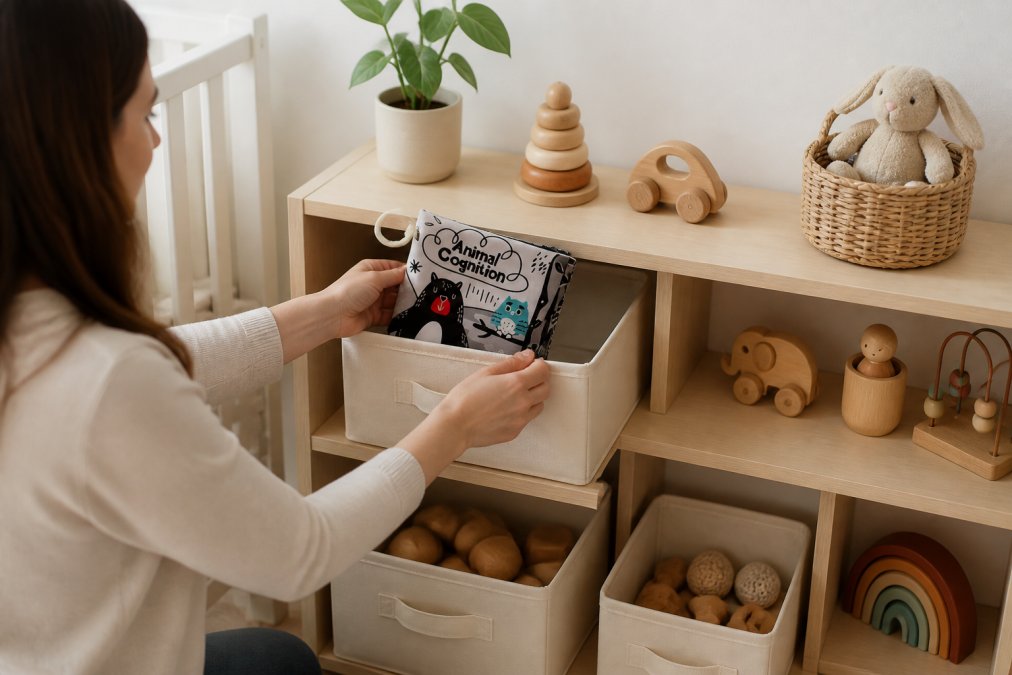
Start by selecting 5-8 toys that align with your baby's current developmental stage. These become your "active rotation." Store the remaining toys out of sight in a closet or storage area. Every 2-3 weeks, swap one or two toys from the active set with items from storage. This creates novelty without accumulation.
The rotation framework works because it addresses multiple overstimulation sources simultaneously. First, it reduces visual clutter. A room with fewer visible toys is inherently calmer, your baby's brain isn't processing dozens of competing visual stimuli. Second, it extends toy engagement. A toy that seems boring after two weeks becomes exciting again when it reappears after a month away. Third, it simplifies cleanup and organization, reducing parental stress that babies sense.
When building your rotation, prioritize toys made from natural materials, wood, fabric, rubber. These materials are inherently less stimulating than plastic with bright colors and patterns. They also tend to be quieter and safer for mouthing, which matters during early months.
Document your rotation schedule. Note which toys are active, when they rotate, and what you observe about your baby's engagement. You'll quickly notice patterns: certain toys hold attention longer, some combinations work better together, and your baby's preferences shift as they develop. This data helps you refine the system over time.
Creating a Calm Play Environment
The physical environment shapes your baby's ability to regulate arousal and engage in meaningful play. A calm play space doesn't mean boring, it means intentional, free from unnecessary stimulation.
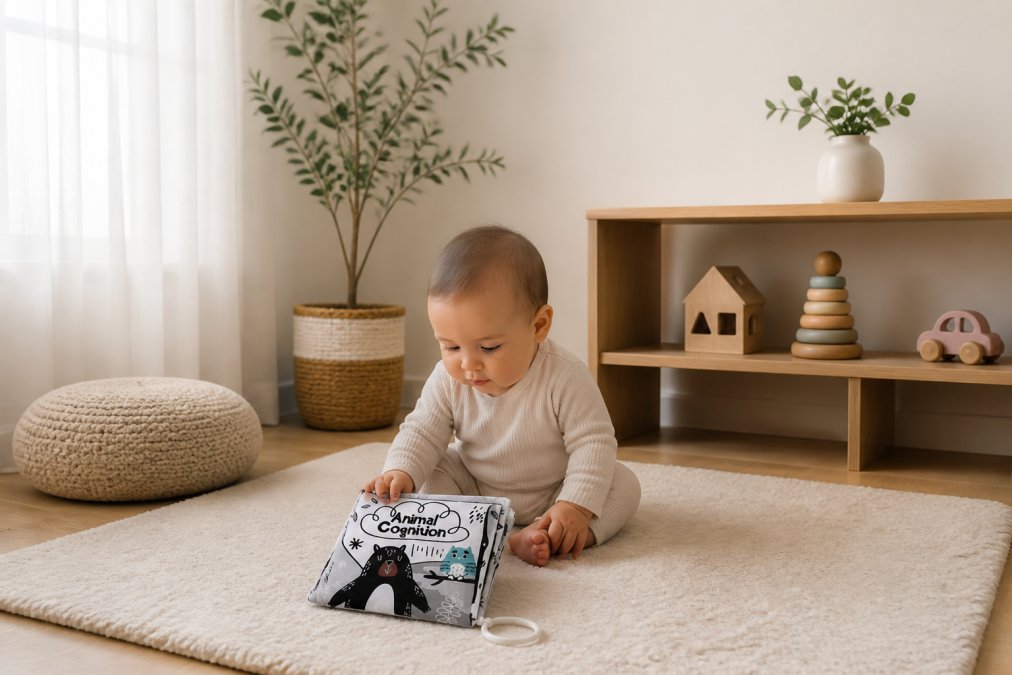
Start with color and lighting. Soft, neutral tones, creams, soft grays, natural wood tones, create a visually restful environment. Avoid bright primary colors, busy patterns, and high-contrast designs on walls or furniture. Natural light is ideal; if you need artificial lighting, choose warm bulbs rather than bright white or fluorescent options.
Sound management is equally important. Minimize background noise from televisions, music, or household activity during dedicated play time. Many parents discover their babies engage more deeply when there's intentional quiet. This doesn't mean silence, your voice, soft music, or natural sounds create a soothing backdrop. But constant background noise competes for your baby's attention.
Organization of toys matters significantly. Open shelving with only a few items visible is far better than toy bins overflowing with options. When your baby can see and access only 4-6 toys at once, decision-making is simpler and play becomes deeper. Closed storage keeps unused items out of sight, reducing visual load.
Temperature and comfort affect stimulation tolerance too. A warm, slightly dim room with comfortable bedding invites calm play. If your baby is too cold, too hot, or uncomfortable, they'll be fussy regardless of toy quality. These basic needs come before play environment optimization.
Consider also the rhythm of play. Alternating between active play and quiet time prevents cumulative overstimulation. After 15-20 minutes of engaged play, your baby often needs a break, a moment of minimal stimulation where they can decompress. This natural rhythm prevents the buildup that leads to meltdowns.
Soothing Techniques When Your Baby Is Overstimulated
Once your baby is overstimulated, the goal is to reduce sensory input as quickly as possible and help their nervous system return to baseline. Speed matters because overstimulation tends to escalate if unaddressed.
First, remove your baby from the stimulating environment. Move to a quieter, dimmer room with minimal visual activity. This immediate reduction in sensory input often begins calming within minutes. The change of environment signals to your baby's brain that the overwhelming situation has ended.
Use slow, rhythmic movement. Gentle rocking, swaying, or slow walking provides predictable, soothing input that contrasts sharply with overstimulation. Your baby's nervous system recognizes this pattern as safe and begins to downregulate. Avoid bouncing or quick movements, which can feel like continued stimulation.
Soft vocalization helps significantly. Quiet humming, gentle singing, or simply speaking in a calm, low voice provides auditory input your baby can focus on. This gives their brain something predictable to latch onto instead of processing chaotic stimulation.
Physical contact matters too. Holding your baby close, maintaining skin-to-skin contact if possible, or gentle stroking activates calming responses. Your steady heartbeat and breathing provide grounding sensory information. Avoid overstimulating touch, keep it gentle, predictable, and consistent.
Swaddling or wrapping in a soft blanket can help some babies feel contained and secure when overstimulated. The gentle pressure provides proprioceptive input that's organizing rather than stimulating. However, some babies find swaddling claustrophobic when already overwhelmed, so pay attention to your baby's response.
Once your baby is calm, keep the environment quiet and low-key for at least 30 minutes. Gradual re-engagement with toys and activity is better than immediately returning to normal play. Your baby's nervous system needs time to fully recover.
Overstimulation doesn't have to be a constant struggle. By understanding how to avoid overstimulating baby toys and creating an intentional play environment, you're supporting your baby's neurological development and building their capacity for self-regulation. Tender Tots & Wellness offers a carefully curated selection of Montessori-inspired toys designed for calm, focused play, including the Soft Baby Cloth Learning Book, Wooden Rainbow Stacking Toy, and Montessori Wooden Tangram Puzzle Game. These toys support developmental milestones without the overstimulation that comes from battery-operated alternatives. Start building a minimalist toy collection today and watch your baby engage more deeply, focus longer, and develop the self-regulation skills that matter for lifelong learning. Shop now and discover toys that truly support your baby's growth.

Frequently Asked Questions
What are the main signs of an overstimulated baby?
Signs include excessive crying, difficulty sleeping, arching their back, turning their head away, rubbing their eyes, or becoming unusually fussy. Overstimulation can also show as difficulty focusing, rapid mood changes, or clinginess. Recognizing these early signals helps you reduce sensory input before your baby becomes extremely distressed. Every baby shows overstimulation differently, so learning your child's specific cues is key.
What is the 20 toy rule?
The 20 toy rule suggests keeping only about 20 toys available at a time for your child. This approach reduces visual clutter and decision fatigue, helping your baby focus on deeper, more meaningful play with fewer options. The remaining toys rotate in and out every few weeks, keeping play fresh without overwhelming your child's sensory system. This minimalist toy rotation system aligns with Montessori principles and supports better cognitive development.
How do I know if a toy is developmentally appropriate for my baby's age?
Developmentally appropriate toys match your baby's current motor skills and cognitive abilities. For infants under 6 months, choose high-contrast, textured items like the Soft Baby Cloth Learning Book. For 6-12 months, introduce toys that encourage grasping and exploration, like the Wooden Rainbow Stacking Toy. Always check age recommendations, avoid small choking hazards, and select toys that encourage open-ended play rather than single-function activities.
Can battery-operated toys actually harm my baby's development?
Constant exposure to noisy, battery-operated toys can overstimulate your baby's auditory and sensory systems, making it harder for them to self-regulate and focus. These toys often limit open-ended play, which is crucial for cognitive and motor skill development. Natural, quiet toys with tactile feedback encourage self-directed exploration and deeper engagement. Balancing interactive play with calm, sensory-rich toys supports healthier neurological development.
This article was written using GrandRanker