

Natural Remedies for Toddler Cough and Congestion
Table of Contents
- Understanding Toddler Cough and Congestion
- Safe Natural Remedies for Toddler Cough and Congestion
- How to Use a Humidifier for Toddler Congestion
- Saline Drops and Nasal Aspiration
- When to See a Doctor for Toddler Cough
- Age-Specific Safety Guidelines and Non-Honey Alternatives
- Creating a Restful Sleep Environment
- Conclusion
- Frequently Asked Questions
Last Updated: September 15, 2026
Understanding Toddler Cough and Congestion
Natural remedies for toddler cough and congestion start with understanding what you're treating. A toddler cough is a reflex that clears the airway and usually signals a viral infection, not something a prescription can fix. Most cases improve within one to two weeks.
Coughing is protective, not the enemy: mucus traps irritants and the cough moves them out. Your job isn't to silence the cough but to thin secretions so they clear more easily. Parents often ask which remedies are genuinely safe for a small child, that's what this guide answers.
Common Causes and Symptoms
The usual culprits are viral infections, post-nasal drip, dry indoor air, and triggers like dust or smoke. Symptoms include a runny nose, congestion, low-grade fever, and a cough that worsens at night when mucus pools in the throat.
Watch for these signs that point to something more than a routine cold:
- Persistent wheezing or whistling on exhale
- Rapid or labored breathing
- A cough lasting beyond two to three weeks
Safe Natural Remedies for Toddler Cough and Congestion
The safest remedies for a toddler cough are the simplest: fluids, honey for children over one year, moisture in the air, and saline. None require a prescription, and all work with your child's body rather than against it.
Hydration and Warm Liquids
Fluids thin mucus, making it easier to cough up. Offer water throughout the day; warm caffeine-free tea or broth also soothes a sore throat. Don't wait until your child is thirsty, small, frequent sips beat one large drink.
Honey Dosage for Toddler Cough
Honey is one of the few remedies with real evidence behind it for children over one year old. Give half a teaspoon to one teaspoon straight or in warm water, up to a few times daily, and always before bed for nighttime cough.
Never give honey to a child under twelve months. It can carry spores that cause infant botulism, a rare but serious condition, the single most important safety line.
Steam and Humidifier Use
Steam and humidifiers add moisture to the airway, loosening chest congestion and easing a dry, hacking cough. A warm shower with the door closed creates a steam room; ten to fifteen minutes in it, holding your toddler, often quiets a nighttime cough.
Cool-mist humidifiers do the same over a longer stretch. Keep mist directed away from the crib and clean the unit regularly so it doesn't breed mold or bacteria.
How to Use a Humidifier for Toddler Congestion
A cool-mist humidifier in your toddler's room is one of the simplest ways to ease congestion overnight. Keep the air moist enough to thin mucus without encouraging mold.
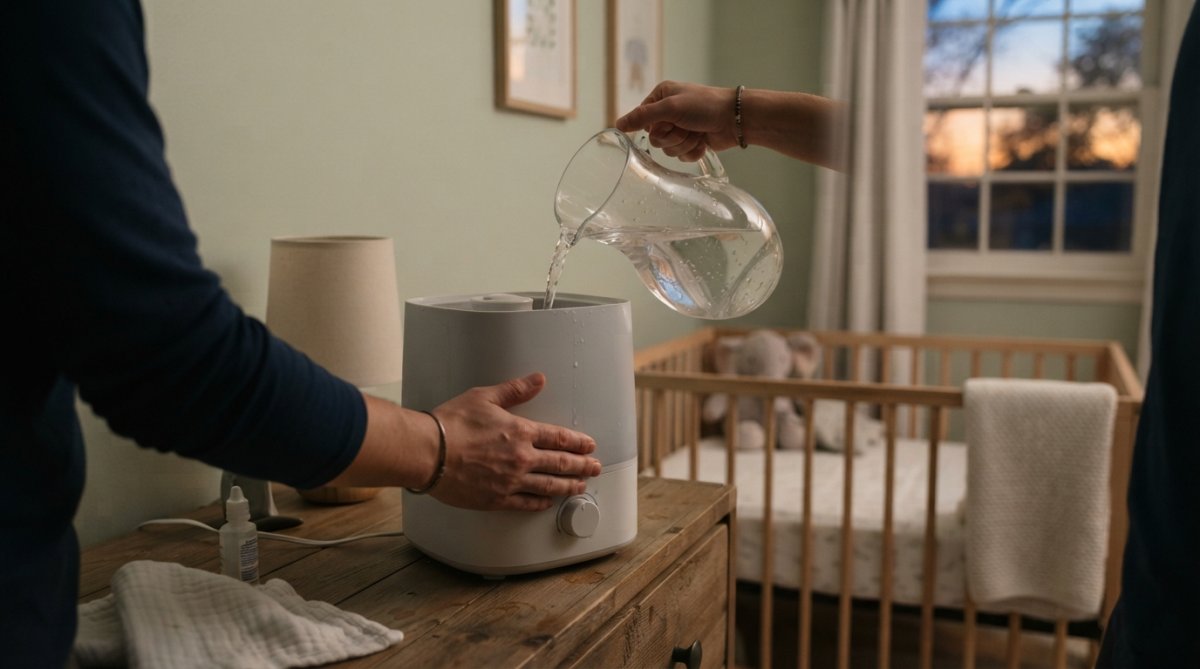
Follow these steps:
- Choose a cool-mist model, which is safer around small children than a warm-mist unit.
- Fill with fresh water each day; never let water sit for long periods.
- Place the humidifier several feet from the crib, aiming mist into the room, not at your child.
- Aim for a comfortable moisture level; too much humidity encourages mold and dust mites.
- Empty, rinse, and dry the tank daily, and deep-clean it weekly.
- Run it during naps and overnight, then air out the room during the day.
If your child has asthma or allergies, check with your pediatrician before regular use.
Saline Drops and Nasal Aspiration
Saline drops and nasal aspiration are the workhorses of toddler congestion relief: saline loosens dried mucus, and gentle suction removes it so your child can breathe and feed more comfortably.
Use saline a few minutes before feeding and sleep. For infants and young toddlers, a bulb syringe or aspirator clears loosened secretions. Don't suction too aggressively or often, it irritates the nasal lining and worsens swelling. Two to three times a day is enough.
When to See a Doctor for Toddler Cough
Call your pediatrician if your toddler has trouble breathing, is wheezing, has a fever that won't settle, is dehydrated, or is unusually lethargic. Trust your instincts: if something feels wrong, make the call.
Red flags that need prompt medical attention:
- Breathing difficulty, including chest retractions or flaring nostrils
- Wheezing or a whistling sound with each breath
- A fever in a very young infant, or a persistent high fever in an older toddler
- Fewer wet diapers, dry mouth, or no tears when crying (signs of dehydration)
- A cough that lasts more than two to three weeks or keeps worsening
For general guidance on childhood respiratory symptoms, the American Academy of Pediatrics health information for parents is a reliable starting point. When in doubt, call rather than wait.
Age-Specific Safety Guidelines and Non-Honey Alternatives
Age changes everything with toddler cough remedies. What's safe at three years can be dangerous at three months, it comes down to airway size, swallowing coordination, and how a child's body handles specific substances.
The Age-Gated Safety Chart
| Age | Safe options | Avoid, and why |
|---|---|---|
| Under 6 months | Saline drops and gentle suction, breast milk or formula as usual, cool-mist humidifier, upright holding during feeds | Honey (botulism spores can colonize an immature gut), OTC cough and cold medicine (no proven benefit and real risk of dosing errors), steam rooms unsupervised (scalding and overheating risk), anything placed in the crib |
| 6-12 months | Everything above, plus warm (not hot) liquids in a sippy cup, extra fluids | Honey (botulism risk persists until 12 months), OTC cough suppressants, menthol rubs on the face or under the nose |
| 12-24 months | Everything above, plus honey in small doses, warm broth, a thin pillow if the child is mobile | OTC cough and cold medicine without a doctor's approval, cough suppressants that stop the cough reflex entirely |
| 2 years and up | The full range of natural remedies, including honey, warm liquids, saline, humidifier, and a slight mattress incline | Cough suppressants unless a doctor prescribes them; combination cold medicines that treat symptoms the child does not have |
The hardest line is honey: never give it to a child under twelve months, in any amount, cooked or raw. Honey can carry Clostridium botulinum spores an infant's digestive tract cannot handle, and infant botulism, though rare, is serious. No exceptions.
Non-Honey Alternatives for Cough Relief
What About Over-the-Counter Options?
Creating a Restful Sleep Environment
Why Position Matters, and Where It Gets Dangerous
What Is Actually Safe by Age
| Age | Safe sleep setup for congestion | Never do this |
|---|---|---|
| Under 12 months | Firm, flat crib mattress; back sleeping; cool-mist humidifier in the room; saline before bed | Pillows, wedges, positioners, rolled towels, car seats, swings, adult beds, or any incline |
| 12-24 months | Same flat, firm surface; a very slight incline is sometimes tolerated if the child is mobile and the surface stays firm | Stacking pillows, loose bedding, or propping on a sofa |
| 2 years and up | A thin pillow is generally acceptable; a small incline under the head of the mattress can help | Adult beds, recliners, or anything that lets the child slump |
Building the Rest of the Room
The Bedtime Sequence That Works
Order matters. About 20-30 minutes before bed:
Conclusion
Get started with Tender Tots & Wellness.
Frequently Asked Questions
What helps with congestion and cough in toddlers?
For toddlers over 12 months, start with hydration and warm caffeine-free liquids to thin mucus. A cool-mist humidifier adds moisture to the air, easing a stuffy nose. Saline drops followed by gentle nasal aspiration clear nasal passages. For children over one year, honey is a proven cough soother. Elevating the head of the mattress slightly can help drainage during sleep. Always supervise steam inhalation and never leave a toddler alone in a bathroom with running hot water.
When should I call a pediatrician for a toddler's cough?
Call a pediatrician if your toddler has difficulty breathing, wheezing, or chest congestion that worsens. Also seek care for a fever above 100.4°F in a child under three months, a cough lasting more than two weeks, or if your child is lethargic or refusing fluids. A barking cough with a high-pitched sound may signal croup, which needs medical evaluation. Trust your instincts: if something feels wrong, call your doctor.
Are honey and steam safe for toddlers with congestion?
Honey is safe for children over 12 months but never for infants under one year due to botulism risk. For toddlers, give half a teaspoon to one teaspoon as needed, up to a few times daily. Steam therapy can loosen secretions, but safety is key: run a hot shower to fill the bathroom with steam, sit with your toddler for 10-15 minutes, and never leave them unattended near hot water. A cool-mist humidifier is a safer alternative for overnight use.
How can I help my toddler sleep better with a cough?
Elevate the head of the mattress slightly by placing a folded towel under the crib sheet (never use pillows for children under two). Run a cool-mist humidifier in the room to keep airways moist. Give a dose of honey before bed if your child is over one year. Use saline drops and nasal aspiration before sleep to clear congestion. Keep the room cool and dark, and offer comfort. If sleep is severely disrupted for multiple nights, consult your pediatrician.