

Compact Baby Swing for Small Spaces: 2026 Guide
Table of Contents
- Why a Compact Baby Swing Works in Small Spaces
- Baby Swing Safety Guidelines: CPSC Rules Every Parent Should Know
- How to Choose a Baby Swing for Small Apartments
- Compact Baby Swing Features That Matter Most
- Durability, Resale Value, and Transitioning to Floor Play
- Frequently Asked Questions
Last Updated: September 21, 2026
Why a Compact Baby Swing Works in Small Spaces
A compact baby swing is a motorized infant seat with a reduced footprint and often a foldable frame, so it soothes a baby without taking over a room. For apartment families, that footprint is the difference between a swing used daily and one that becomes an obstacle.
Baby Swing Safety Guidelines: CPSC Rules Every Parent Should Know
Baby swing safety guidelines in the U.S. are set by the Consumer Product Safety Commission (CPSC), whose mandatory federal standard for infant swings covers stability, restraints, and seat angle (Infant & Cradle Swings Business Guidance). Any new swing should carry certification that it meets that standard.
Weight Limits, Harness Rules, and Recline Angles
Stop using the swing the moment your baby reaches the manufacturer's maximum weight capacity, even if they still seem comfortable. Most swings are for infants only, so check the label rather than guessing.
Overnight Sleep Warning and Supervision Requirements
Infant swings are not beds. The CPSC and the American Academy of Pediatrics advise against letting a baby sleep in a swing, especially overnight or unsupervised. If your baby falls asleep there, move them to a firm, flat sleep surface as soon as practical.
How to Choose a Baby Swing for Small Apartments
Choosing a baby swing for a small apartment comes down to three measurements: footprint, clearance to move, and whether it fits through your doorways. Get those right and the rest is preference.
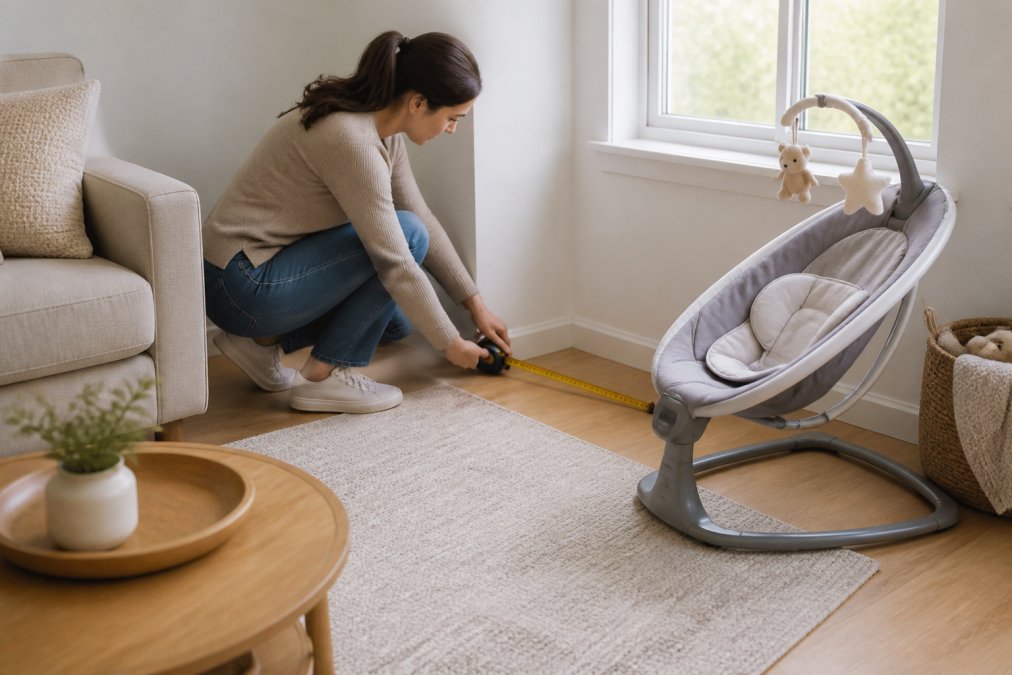
Measure Your Space: Footprint, Clearance, and Doorways
Start with a tape measure, not a product page. Listed dimensions describe the frame at rest, but a space-saving footprint still needs room to sway or glide without bumping furniture.
Here's a measurement checklist to consider:
- Mark the swing's base dimensions on the floor with painter's tape
- Add clearance on all sides for the motion arc (check the manual for the exact figure)
- Measure your narrowest doorway if you plan to move it between rooms
- Confirm the swing fits beside your seating without blocking a walkway
- Check ceiling height if the model has a tall frame or mobile arm
Foldable Design and Vertical Storage Solutions
A foldable design makes a compact swing genuinely apartment-friendly: when the frame collapses, you can tuck it behind a sofa, slide it into a closet, or stand it upright in a corner.
Measure your storage spot before you buy, not after. A swing that folds to a slim profile is only useful if it actually fits in the closet, behind the door, or in the gap beside your washer where you plan to keep it.
Compact Baby Swing Features That Matter Most
The features that matter most in a compact swing are the ones you'll use daily: power, noise, and ease of cleaning. Everything else is a nice-to-have. In a small space, the trade-offs compound, so we go deeper than the spec sheet.
Power Options: Battery-Operated vs. AC Adapter
Battery-operated swings are the most portable, moving room to room without hunting for an outlet, useful in older apartments with limited sockets or where the only outlet sits behind a sofa.
- Cord length, a short adapter cord limits where the swing can sit relative to an outlet.
- Auto-off timer, many compact swings shut off after 10, 20, or 30 minutes, which saves battery and prevents overuse.
- Battery type, D-cells last longer per set than AA, but cost more upfront.
- USB-C or barrel plug, some newer models charge via USB-C, which is easier to replace if the cable is lost.
Noise Levels and Acoustic Impact in Small Apartments
Motorized motion always produces some sound, and in a small apartment it carries further than you'd expect. A swing that hums quietly in a large house can feel loud in a studio with thin walls, and if you share a wall or have a light-sleeping partner, noise is the single feature most likely to determine whether the swing gets used at 2 a.m.
- Motor type. Brushless motors tend to run smoother and quieter than brushed motors. If a listing specifies brushless, that's a meaningful signal for apartment use.
- Motion type. A gentle side-to-side sway typically produces less mechanical noise than a front-to-back glide with a heavier pendulum, because there's less mass changing direction.
- Surface and placement. A swing on a hardwood floor with bare walls will sound louder than the same swing on a rug against a wall with a bookshelf or curtain to absorb sound. Placing the swing away from the shared wall, not against it, is one of the cheapest acoustic fixes available.
- Speed setting. Higher speeds almost always mean more motor noise. If your baby only needs a slow rock, you may never hear the loudest setting.
Ease of Cleaning and Machine-Washable Fabrics
In a small apartment, a swing that can't be cleaned easily becomes a problem fast, there's nowhere to hide a stained seat, and spit-up and diaper leaks find the fabric regardless of care. The features that matter are simple:
- Removable, machine-washable seat pad. This is the single biggest convenience factor. Check the care tag: some pads are spot-clean only, which is a dealbreaker for daily use.
- Harness straps that wipe clean. Straps usually can't go in the wash, so look for ones that are easy to sponge down.
- A frame with few crevices. Smooth plastic and metal tubes wipe down faster than fabric-wrapped joints and decorative seams.
- A removable toy bar or mobile. These collect dust and drool; being able to detach and rinse them is a small but real win.
Durability, Resale Value, and Transitioning to Floor Play
A well-built compact swing often outlasts one baby, which matters if you plan to resell or pass it down. But 'durability' is vague on a product page. Here's what can determine whether a swing holds up, and holds its value, over two or three years.
What Actually Drives Long-Term Durability
Frame durability and a washable seat pad hold value longest, since fabric stains and wobbly frames kill resale prices. The specifics:
- Frame material. Molded plastic frames resist dents but can crack at stress points over time; powder-coated steel or aluminum frames resist flexing but can chip and rust if stored damp. Neither is universally better, the failure mode is just different.
- Joint and hinge quality. The folding mechanism is the most-used moving part on a compact swing, and it's the first thing to loosen. Metal hinges with locking detents outlast plastic friction joints.
- Motor lifespan. Motors are the component most likely to fail first on a heavily used swing. A swing that ran daily for six months has more motor wear than one used twice a week for a year.
- Fabric quality. Tightly woven, removable pads survive repeated washing far better than loose knits or spot-clean-only fabrics, which pill and stain.
Cleaning and Storage That Protect Resale Value
How you store the swing between babies matters as much as how you use it. Habits that preserve condition:
- Clean the fabric before storing, not after. Set-in stains are much harder to remove months later, and a stained pad is the single biggest hit to resale price.
- Dry the frame completely. Storing a damp frame in a closet invites rust at the joints and mildew in the fabric.
- Store upright, not stacked under heavy items. A folded swing crushed under boxes can bend the frame or crack the folding hinge.
- Keep the power adapter with the swing. A missing adapter is a common reason buyers pass on a used listing.
Transitioning From Swing to Floor Play
When your baby starts sitting up with support and showing real interest in the world, often around four to six months, though every baby is different, it's time to transition away from the swing. The swing soothed a baby who couldn't yet self-regulate; once they can reach for toys and push up on their hands, floor time does more for development than motion does.
A practical roadmap for the transition:
- Shorten swing sessions first. Instead of replacing the swing cold turkey, cut sessions down and add floor time after each one.
- Set up a floor play station in the swing's spot. A padded play mat with a few toys in the same corner makes the swap feel natural and keeps the routine intact.
- Keep the swing available for fussy moments. Many parents find the swing still earns its keep during the witching hour even after floor play becomes the default.
- Watch for the climb-out. Once your baby can sit up unassisted or push to standing, the swing is no longer safe, the harness can't contain a determined climber. That's the hard stop, regardless of weight.
The features that decide whether a compact swing earns its space are simple: a footprint that fits your room, a fold that fits your storage, and a motor quiet enough for your walls. But what decides whether it earns its money back is how you clean, store, and eventually transition away from it. Buy for the space, maintain for the resale.
Frequently Asked Questions
Are compact baby swings as effective as full-sized models?
Compact baby swings provide the same soothing motion and safety features as full-sized models, just in a smaller footprint. They typically offer multi-motion settings, vibration, and soothing melodies. The main trade-off is a lower weight capacity, often 20 to 25 pounds compared to 30 pounds on larger swings. For most families, a compact baby swing works well until the baby starts sitting up or reaches the weight limit, usually around 6 to 9 months.
What safety standards should I look for in a 2026 baby swing?
Look for a swing that meets CPSC safety guidelines, including a five-point harness, a stable base that won't tip, and a weight limit clearly stated by the manufacturer. The CPSC recommends using a swing only for supervised soothing, never for overnight sleep. Check for a safety certification label and avoid swings with drop-down sides or loose parts. A reclining seat position that keeps the baby's head above the stomach helps reduce breathing risks.
How much space do I need for a compact baby swing?
Most compact baby swings need a footprint of about 24 to 30 inches wide and 24 to 30 inches deep, plus at least 12 inches of clearance around the base for stability. Measure your intended spot and check doorways if you plan to move the swing between rooms. Foldable designs can collapse to under 10 inches wide for vertical storage in a closet or behind a door, which helps in small apartments.
Can a baby swing be used for overnight sleep?
No. The CPSC and the American Academy of Pediatrics advise against using any baby swing for overnight sleep. Swings keep a baby in a semi-upright position that can cause the head to slump forward and block the airway. Use the swing only for short, supervised soothing sessions while you are awake and nearby. For sleep, place your baby on a firm, flat surface in a crib or bassinet that meets current safety standards.
Small-space parenting means every purchase has to earn its place, and a compact baby swing is no exception. Tender Tots & Wellness curates baby gear chosen to fit modern, minimalist homes, with free worldwide shipping and a mix of timeless design and current trends. Browse our collection to find a swing that soothes your baby without crowding your home, and shop now to get started.