

How to Assemble a Travel System Stroller 2026
Table of Contents
- What You'll Need Before You Start Assembly
- Step-by-Step Travel System Stroller Assembly Guide
- How to Attach a Car Seat to a Stroller Frame
- Travel System Stroller Safety Check After Assembly
- Stroller Assembly Troubleshooting Tips
- Tool-Free vs Tool-Required Assembly: What to Expect
- Frequently Asked Questions
Last Updated: October 3, 2026
What You'll Need Before You Start Assembly
Assembling a travel system stroller is easier when you clear space and gather a few basics first. Most parents finish in under an hour, and the overwhelmed feeling goes away fast once you know what to expect.
A travel system stroller is a stroller frame plus an infant car seat that clicks into it, so you move a sleeping baby from car to sidewalk without waking them.
Have these ready before you start:
- A clear floor space, about 2 by 2 meters
- The stroller box and all packing materials
- The user manual for your exact model
- A small screwdriver, only if your manual calls for one
- Scissors or a box cutter for tape and zip ties
Keep the manual for weight capacity, recline positions, and cleaning.
Step-by-Step Travel System Stroller Assembly Guide
Most travel system stroller frames arrive 80% built. You are attaching wheels, opening the chassis, and locking parts into place, not building from scratch. Work on a soft surface like a rug or towel; hard floors scratch the frame finish.
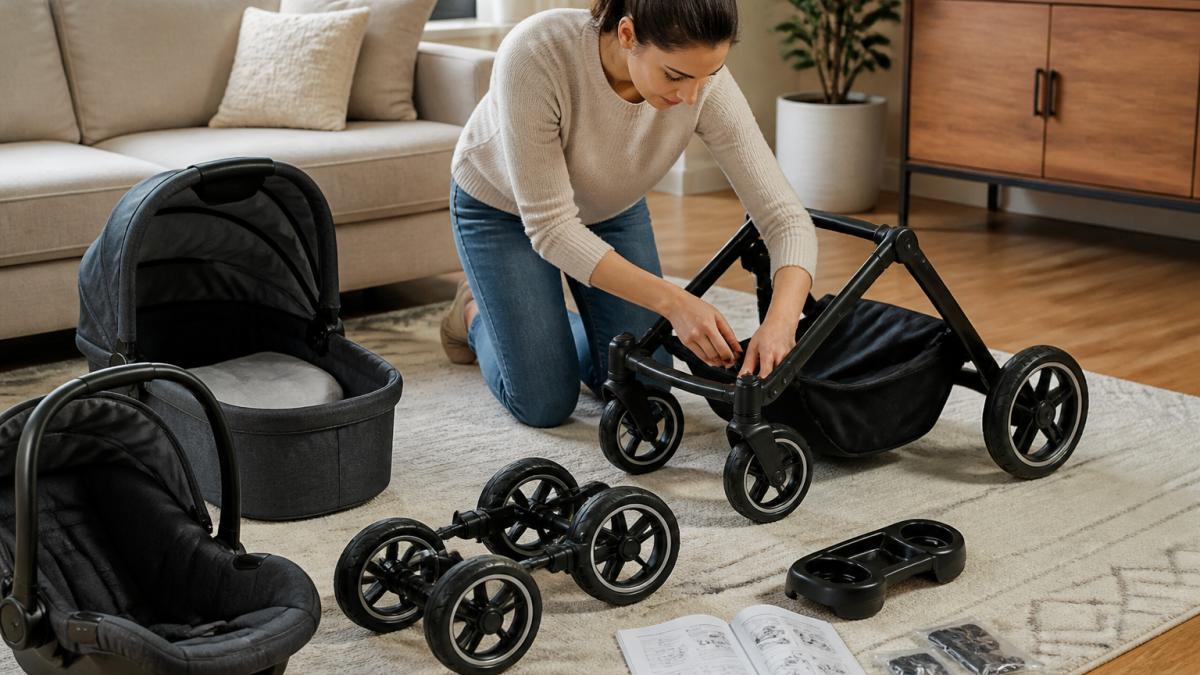
Unboxing and Parts Identification
Lay every part out and match it to the manual diagram. A typical box contains:
- The stroller frame with the folding hinge
- Two rear wheels and two front swivel wheels
- The seat unit or bassinet
- The canopy
- A storage basket
- A bumper bar
- A car seat adapter, if it is not already on the frame
Check for a locking pin, axle caps, and any small hardware bag. Missing pieces are the top reason assembly stalls.
Wheel Attachment and Frame Unfolding
Push each wheel onto its post until you hear a click, then tug to confirm it is locked. Front swivel wheels go on the front posts, rear wheels on the rear axle. To unfold the frame, hold the handle and press the folding hinge release; the chassis should open with light pressure. Listen for the click that tells you the frame lock has engaged.
Seat Unit, Canopy, and Accessory Installation
Slide the seat unit onto the frame mounts until it locks; most models let you choose parent-facing or forward-facing mode by flipping the seat before it clicks in. Snap the canopy onto the frame posts, clip the bumper bar into its side sockets, and hang the storage basket under the frame using the hooks or straps provided.
How to Attach a Car Seat to a Stroller Frame
Attaching a car seat to a stroller frame takes seconds once you know the click-in mechanism. Line up the car seat with the frame mounts, lower it straight down, and press until both sides click. Then do the tug test: lift the car seat by its handle. If it moves, it is not locked.
A few things to check:
- The adapter matches your car seat brand and model
- The car seat sits level, not tilted
- Both side latches are engaged, not just one
Adapter compatibility varies, so check your manual before assuming the seat will fit.
Travel System Stroller Safety Check After Assembly
A travel system stroller safety check takes about five minutes and catches the mistakes that cause wobbles, tipping, and loose seats.
C, Connections locked. Grab the seat unit at the top of the backrest and pull up, push down, then rock it side to side.
I, Inflate-free tires and wheel security. Pull each wheel straight off its post; it should not budge. Spin it; it should rotate freely without wobble.
C, Car seat adapter seated. Attach the car seat and do the tug test: lift it by the handle; it should not separate from the frame.
K, Kill the roll. Engage the brake and push the stroller forward firmly. It should not move. Then release the brake and confirm the wheels roll.
After the CLICK test, do a load check. Stay under the weight capacity in your manual, which includes the child, the diaper bag, and anything hanging from the handle. Hanging a heavy bag from the handlebars is a tipping hazard even within the weight limit, because the limit is calculated for weight in the seat, not on the handle.
Large Capacity Mummy Baby Backpack – Insulated, Waterproof & Multi-Function →

Finally, check the harness. Buckle the five-point harness and pull each strap to confirm it is threaded correctly and not twisted.
Stroller Assembly Troubleshooting Tips
Most assembly problems trace back to an unengaged lock, a mismatched adapter, a wheel on the wrong post, or a part still wrapped in packing foam. Rather than a brand-specific guide, you need the universal assembly logic every travel system stroller follows, the same three-mechanism architecture:
- A frame lock that holds the chassis open
- A seat mount that holds the seat or car seat adapter to the frame
- A wheel retention system that holds each wheel to its post
When something goes wrong, the problem is almost always in one of those three systems. Work through them in order.
Frame will not unfold or will not stay open
The frame lock is the first thing to check. Most frames have a primary release (a trigger or button on the handle) and a secondary safety latch near the folding hinge. If the secondary latch is engaged, the frame will not open no matter how hard you pull the primary release, look for a small lever, tab, or sliding button near the hinge and disengage it. If the frame opens but collapses when you let go, the frame lock is not fully seated; open it again and push down on the center of the seat mount area until you hear a distinct click. A frame that opens halfway and stops usually has a packing strap or zip tie still attached to the chassis, run your hand along the inside of the frame tubes and remove anything that is not part of the stroller.
Wheel will not click in or wobbles after installation
Check the post first. Many wheels ship with a plastic shipping cap or foam spacer that must be removed before the wheel will seat. If the post is clear, check the wheel itself, some have a retaining pin or button that must be depressed while sliding the wheel on. If the wheel clicks in but wobbles, the axle is not fully seated; pull it off and look for the groove or notch the retention mechanism locks into. If the wheel does not reach that groove, something is blocking it, often a burr or packing material. Front swivel wheels that will not swivel usually have a swivel lock engaged, look for a small button or lever on the wheel housing and release it.
Car seat will not lock to the frame
This is almost always an adapter issue. Travel system car seats lock to the frame through an adapter specific to the car seat brand, a Graco car seat will not lock to a Chicco adapter, and vice versa. Check the adapter for a brand name or model number molded into the plastic. If the adapter is correct, check alignment: most car seats have two attachment points that must engage simultaneously, so lift the seat off and lower it straight down, keeping it level, until both sides click. Some adapters must be flipped depending on whether you are using the car seat or the toddler seat, so check your manual for the correct orientation.
Stroller pulls to one side or feels unstable
Recheck that both front wheels are fully seated and in the same swivel mode. If one is locked straight and the other is swiveling, the stroller will pull. If it still pulls, check the rear axle, on some models it is a single bar that must be fully seated in both frame mounts, or the stroller will track crooked.
When to stop and call the manufacturer
If a part is genuinely missing or broken, stop and contact the retailer or manufacturer. Do not force anything, forced parts crack, and a cracked frame is a safety problem. Most manufacturers have a parts replacement program and will send a missing wheel, adapter, or hardware bag at no cost. Check the manual for the customer service number or the warranty card in the box.
One more universal rule: if you have to use force, you are doing it wrong. Every connection on a travel system stroller is designed to engage with light pressure. If a part will not go on, it is misaligned, blocked, or the wrong part. Stop, look at the connection point, and figure out which of those three it is.
Tool-Free vs Tool-Required Assembly: What to Expect
Most travel system strollers assemble without tools: wheels push on, the frame unfolds by hand, and the seat and canopy snap into place. A few models still need a screwdriver for the bumper bar, storage basket, or rear axle caps; your manual will say so on the first page.
If you are shopping for a stroller and want the simplest setup, look for these:
- Quick-release wheels with no pins
- A one-hand folding hinge
- A car seat adapter that ships with the frame
One detail most guides skip: set the handle height before your first walk. A handle that is too low makes you lean forward, which shows up as back pain after a few weeks of daily use.
Once assembly is done, a well-organized diaper bag makes outings smoother. Our Large Capacity Mummy Baby Backpack has an insulated bottle compartment and dry/wet separation, so bottles and messy clothes stay apart. It is $69.99 and built for longer days out.
Assembly is the easy part. Tender Tots & Wellness carries baby gear chosen to fit a modern family's needs, with free worldwide shipping and a mix of timeless and modern design. Start with our diaper backpack, our 360° Rotate Spill-Proof Baby Bowl at $30.99, and our Pure Cotton Changing Pad Cover at $21.99.


Frequently Asked Questions
Do all travel system strollers assemble the same way?
No. Assembly steps vary by brand and model, especially around wheel attachment, frame locking, and car seat adapter compatibility. Most travel system strollers follow a similar order: unbox and identify parts, attach wheels, unfold and lock the frame, install the seat or bassinet, then click in the infant car seat. Always follow the user manual that came with your specific stroller, since locking pins, click-in mechanisms, and folding hinges differ between models.
How do I ensure my car seat is securely attached to the stroller frame?
Listen for the click. When you lower the infant car seat onto the adapter or frame mounts, you should hear an audible click and feel the seat lock into place. Give the seat a gentle tug upward to confirm it will not lift off. Check that the adapter compatibility matches your car seat model, and verify the click-in mechanism is fully engaged on both sides before placing your baby inside.
What should I do if parts are missing from my stroller box?
First, recheck the packing materials and the bottom of the box, since small parts like locking pins or axle caps often settle in the corners. Compare what you have against the parts list in the user manual. If something is genuinely missing, contact the retailer or manufacturer with your order number and a photo of the parts list. Do not substitute hardware from a hardware store, as it may not meet the stroller's safety certification.
Are there safety standards I should check after assembling my stroller?
Yes. After assembly, confirm the frame locks fully open, all wheels spin freely and the brake engages on both rear wheels, the five-point buckle and safety harness adjust smoothly, and the car seat clicks in without wobble. Check the weight capacity listed in your manual and never exceed it. Register your stroller with the manufacturer so you receive any recall notices, and keep the user manual for future reference.