

How to Build a Montessori Playroom: 2026 Guide
Table of Contents
- What Makes a Montessori Playroom Different
- Montessori Furniture for Toddlers: What You Actually Need
- How to Organize Montessori Toys for Maximum Engagement
- Montessori Toy Rotation Guide: Less Is More
- Designing Your Montessori Playroom by Developmental Stage
- Integrating a Montessori Space Into a Shared Living Area
- Maintenance, Cleaning, and Keeping the Space Intentional
- Conclusion
Last Updated: August 15, 2026
What Makes a Montessori Playroom Different
A Montessori playroom is a carefully prepared environment designed to support a child's natural drive to explore, concentrate, and develop independence. Unlike a conventional playroom stacked with bright plastic toys, a Montessori space puts the child in control of their own learning. Every object has a purpose. Every shelf is within reach. The room itself becomes the teacher.
The difference between a standard playroom and a Montessori one isn't about spending more money. It's about spending more thought.
Core Principles: Order, Autonomy, and the Prepared Environment
The prepared environment is the cornerstone of Montessori philosophy, a space organized with the child's developmental needs in mind, where everything is accessible, purposeful, and visually calm. According to the American Montessori Society's overview of Montessori principles, the environment should support freedom of movement, freedom of choice, and the natural work cycle of a child.
Three principles guide every design decision:
- Order: A consistent, predictable layout helps children develop spatial awareness and routine. When toys return to the same spot after play, children learn to respect their space and build concentration.
- Autonomy: Child-led play means the child initiates, directs, and concludes the activity. Your job is to set up the conditions, not manage the play.
- Minimalism: Visual clutter is the enemy of focus. A calming environment with neutral tones and limited options actually increases engagement.
Montessori Furniture for Toddlers: What You Actually Need
Most parents overbuy. The truth is that you need very little, and what you do need should be functional, child-sized, and low to the ground. A toddler who can access their own toys, sit at their own table, and see themselves in a low mirror is practicing independence every single time they walk into the room.
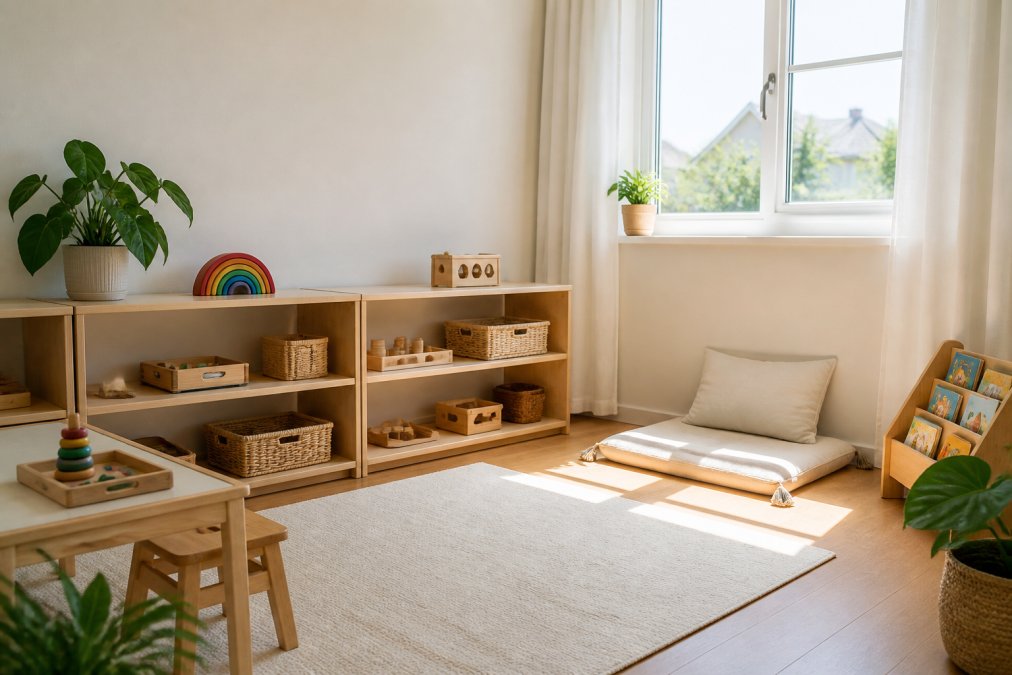
Low Shelving, Floor Beds, and Child-Sized Spaces
Low open shelving is the single most important piece of furniture in a Montessori playroom. Shelves should sit at the child's eye level, typically between 12 and 24 inches high, with items displayed facing forward so the child can see what's available without digging.
A floor bed supports freedom of movement from the earliest months, allowing babies to roll, crawl, and eventually pull themselves up on their own terms.
Other functional furniture worth having:
- A low table and chair set sized for the child (knees at 90 degrees when seated)
- A low mirror at floor level to support body awareness
- Open baskets and trays for activity stations rather than lidded boxes
- A small reading nook with a cushion or floor pillow
Skip the toy chest. It creates chaos and defeats the purpose of accessible storage.
Budget-Friendly DIY Furniture Hacks
Montessori furniture doesn't need to carry a premium price tag. Practical DIY approaches include repurposing low bookshelves as display shelves, stacking wooden crates for open storage, using floor cushions instead of chairs, and exploring IKEA hacks like the Kallax unit positioned horizontally.
How to Organize Montessori Toys for Maximum Engagement
The biggest mistake parents make is treating organization as a one-time task. Montessori organization is an ongoing system.
Baskets, Trays, and Activity Stations
Each item on a Montessori shelf should have a designated home. Trays and baskets group related materials into self-contained activity stations. A tray signals to the child: this is a complete activity.
Effective organization principles:
- One activity per tray or basket
- Trays contain all materials needed to complete the activity independently
- Left-to-right arrangement on shelves mirrors reading direction
- Rotate activities rather than displaying everything at once
For younger toddlers, open baskets work better than trays because they're easier to grip. As children approach age three, flat wooden trays encourage more deliberate, focused work.
Reducing Visual Clutter Without Going Bare
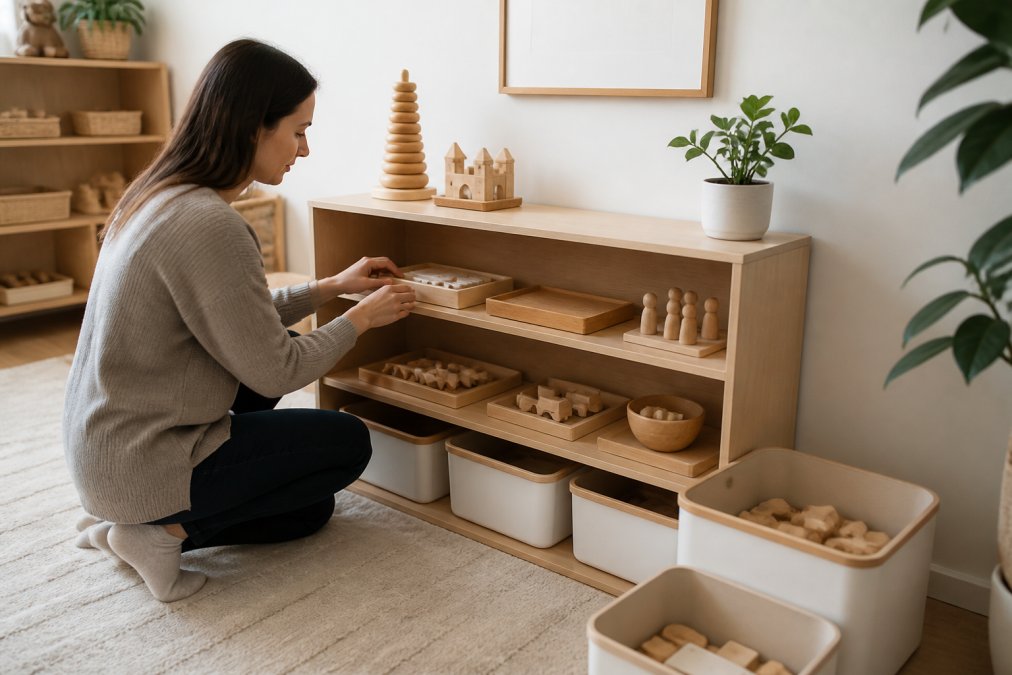
Visual clutter disrupts concentration. Display six to eight items at a time, each clearly separated on the shelf with visible space between them. Neutral tones on walls and storage help the toys themselves become the visual focus.
Montessori Toy Rotation Guide: Less Is More
A Montessori toy rotation guide cycles a limited number of toys in and out of the play space on a regular schedule. Fewer, more intentional options produce deeper engagement than a room full of choices.
How Many Toys to Display by Age
| Age Range | Displayed Items | Rotation Frequency | Complexity Level |
|---|---|---|---|
| 0-6 months | 2-3 items | Every 1-2 weeks | Simple sensory objects |
| 6-12 months | 3-5 items | Every 2 weeks | Cause-and-effect toys |
| 1-2 years | 5-7 items | Every 2-3 weeks | Fine motor challenges |
| 2-3 years | 6-8 items | Every 3-4 weeks | Open-ended materials |
| 3-6 years | 8-10 items | Every 4-6 weeks | Scaffolded activities |
These are starting points. If your child is ignoring most items, you have too much out. If they're working through everything quickly, add one or two items rather than rotating everything at once.
Building a Rotation Schedule That Actually Works
A workable approach: divide your toy collection into three groups (A, B, C), display Group A for three to four weeks, swap in Group B when engagement drops, and cycle through all three before repeating. The key signal for rotation is behavior, when a child stops returning to an activity independently, that's when to swap it out.
Designing Your Montessori Playroom by Developmental Stage
The most practical insight is this: the space should grow with the child. What works at six months is wrong at eighteen months, and what works at two years needs to evolve by four.
Ages 0-12 Months: Sensory Development and Freedom of Movement
The infant environment prioritizes sensory development and unrestricted physical movement. Key elements include a firm floor mattress, a low mirror positioned beside it, two to three high-contrast visual objects, simple cause-and-effect toys, and clear floor space for rolling and crawling.
According to the CDC's developmental milestones guidance for infants, tummy time and floor exploration are critical for building gross motor skills. The prepared environment for this age is essentially a safe, stimulating floor.
Ages 1-3 Years: Fine Motor Skills, Reading Nooks, and Purposeful Work
Toddlers between one and three are in a sensitive period for fine motor skills, language, and purposeful work. They want to do real things, not just play with toys.
Priorities for this stage include activities involving transferring, pouring, sorting, and stacking; a small reading nook with five to eight board books displayed face-out; simple puzzles and shape sorters; and open-ended toys that can be used in multiple ways.
The Montessori Wooden Tangram Puzzle Game at $14.30 challenges spatial reasoning and fine motor control without overwhelming a toddler. The Phonics Learning Posters set at $12.33 turns a wall into a functional learning space without adding shelf clutter.
Ages 3-6 Years: Open-Ended Toys and Scaffolded Independence
Children in this age range are ready for more complex materials, longer work cycles, and genuine scaffolding toward independence. The room should include activities that take multiple sessions to master, a small table and chair for seated work, accessible art materials, and an expanded reading nook.
The MontiPlay Magic Montessori Play Toolbox at $45.00 and the Wooden Tool Disassembly Playset at $55.99 support cognitive development and purposeful, hands-on work. The DIY Wooden Rainbow Toy at $25.00 is a classic open-ended toy supporting imaginative play, color recognition, and spatial reasoning.


Integrating a Montessori Space Into a Shared Living Area
Not every family has a spare room. The good news is that a Montessori playroom doesn't require a dedicated room to be effective. The most important thing is defining a clear zone. A rug, a specific corner, or a low shelf arrangement can establish that boundary.
Practical strategies include using a low shelf as a room divider, keeping the child's materials within the defined zone, matching the aesthetic to the rest of the room, and using a small floor cushion or mat to define the reading nook.
According to research from the National Association for the Education of Young Children, well-defined, predictable play spaces support children's ability to self-regulate and engage in sustained independent play, regardless of space size.
Maintenance, Cleaning, and Keeping the Space Intentional
A Montessori space that isn't maintained stops being Montessori. A practical maintenance routine includes daily returns of items to designated spots, weekly wiping of trays and shelves with removal of broken materials, monthly assessment of engagement and rotation, and seasonal audits of the full toy collection.
Most wooden Montessori materials should not be submerged in water. A cloth dampened with mild soap solution, followed by a dry wipe and air drying, is sufficient for regular cleaning.
The seasonal audit is the step most parents skip and the one that matters most. A shelf holding toys your child has outgrown isn't a prepared environment anymore. Keep the space current, and the space keeps working.
Building a Montessori playroom takes more intention than budget, but finding the right materials still matters. Tender Tots & Wellness offers a curated selection of Montessori-inspired wooden toys, puzzles, and educational tools designed to fit a real family's space and budget, with free worldwide shipping on every order. Browse the full collection to find open-ended toys and activity materials that match your child's current developmental stage. Shop now and build a space that grows with your child.
Frequently Asked Questions
How do you set up a Montessori play area on a budget?
Start with what you have. A low bookshelf turned on its side becomes accessible storage. Wicker baskets and wooden trays from discount stores work perfectly as activity containers. Limit toys to 8-10 items on display at a time. Open-ended toys like the DIY Montessori Wooden Rainbow Toy ($25) offer more developmental value per dollar than battery-powered alternatives. Neutral paint and a small floor cushion complete the prepared environment without major spending.
How many toys should be in a Montessori playroom?
Most Montessori practitioners recommend displaying 8-12 items at a time for toddlers, rotating the rest in storage. Too many choices overwhelm young children and reduce concentration. Each item on the shelf should be complete, purposeful, and developmentally appropriate for the child's current stage. The goal is an environment where every object invites engagement rather than one where toys compete for attention.
What kind of furniture is needed for a Montessori playroom?
Low, open shelving is the single most important piece of Montessori furniture for toddlers. It gives children independent access to materials without adult help, which builds autonomy and spatial awareness. A child-sized table and chair, a low mirror at floor level, and a soft floor mat for movement work round out the basics. Furniture should be sturdy, free of sharp edges, and sized so the child can reach everything without climbing.
What is the Montessori approach to organizing a playroom?
The Montessori approach treats order as a developmental tool, not just tidiness. Each toy or activity has a fixed, visible home on the shelf. Children learn to retrieve items, complete a work cycle, and return them independently. Trays and baskets group related materials so nothing is loose or confusing. Rotating toys in and out of storage keeps the environment fresh and sustains engagement without adding more objects to the room.
What are the biggest criticisms of setting up a Montessori playroom at home?
The most common concern is cost: genuine Montessori materials can be expensive. The practical answer is selective buying. Prioritize open-ended wooden toys, low shelving, and neutral storage over specialty items. A second criticism is that the minimalist setup looks sterile. In practice, natural materials, a few plants, soft textiles, and a reading nook with books add warmth without creating visual clutter. The space should feel calm, not empty.
How do I integrate a Montessori play space into a shared living room?
Designate one corner or wall as the child's dedicated play zone using a low shelf as a visual boundary. Keep the toy rotation tight so the area stays contained. Choose furniture in neutral tones that complement your existing decor. A small rug defines the space without permanent changes. When toys are organized on trays and baskets rather than scattered, the area reads as tidy to adults while remaining fully accessible to children.
This article was written using GrandRanker