

How to Pick Safe Non-Toxic Toys: A Parent's Guide
Table of Contents
- Why Safe Non-Toxic Toys Matter for Your Child
- Materials to Avoid When Buying Toys
- Safe Materials for Baby Toys That Parents Trust
- Understanding CPSC Toy Safety Standards and Certifications
- Your Step-by-Step Checklist for Picking Safe Toys
- How to Build a Montessori Playroom with Non-Toxic Toys
- Second-Hand and Hand-Me-Down Toy Safety
- Conclusion
Last Updated: August 18, 2026
Why Safe Non-Toxic Toys Matter for Your Child
When babies and toddlers explore the world through taste and touch, toy safety becomes urgent. Toys containing lead-based paint, phthalates, or PVC can leach chemicals during normal play, especially when chewed or aged. Young children's smaller bodies mean even trace toxin exposure has outsized effects. At Tender Tots & Wellness, every product is chosen as something you'd feel safe handing to your own child without hesitation.

Non-toxic toys often align with developmental benefits. Natural materials like solid wood and organic cotton encourage imaginative play rather than overstimulation. The challenge isn't finding options, it's knowing which are genuinely safe versus merely marketed that way. A toy labeled "natural" or "eco-friendly" doesn't automatically mean it's chemical-free. This guide walks you through what to look for, which materials to avoid, and how to verify safety certifications.
Materials to Avoid When Buying Toys
Polyvinyl chloride (PVC) is inexpensive and flexible but often contains phthalates, chemicals that leach into saliva when chewed. Phthalates are endocrine disruptors that interfere with hormone development. Avoid toys listing PVC or emitting strong chemical smells.
Lead-based paint was banned in 1978 but persists in older toys and hand-me-downs. Lead exposure causes developmental delays and learning problems even at low levels. Lead is invisible and odorless, so testing is essential for vintage purchases.
BPA (Bisphenol A) mimics estrogen in the body and has been linked to developmental issues. Many manufacturers now market "BPA-free" products, but always verify.
Formaldehyde appears in pressed wood toys and adhesives and is a known carcinogen. Solid wood toys are safer than particleboard alternatives, especially when sealed with water-based finishes.
Heavy metals like cadmium, arsenic, and chromium accumulate in the body over time. Third-party testing is the only reliable verification method.
Synthetic materials warrant scrutiny. Polyurethane foam can off-gas volatile organic compounds when new. Plastic toys without proper certification are red flags. When in doubt, choose materials you can verify.
Safe Materials for Baby Toys That Parents Trust
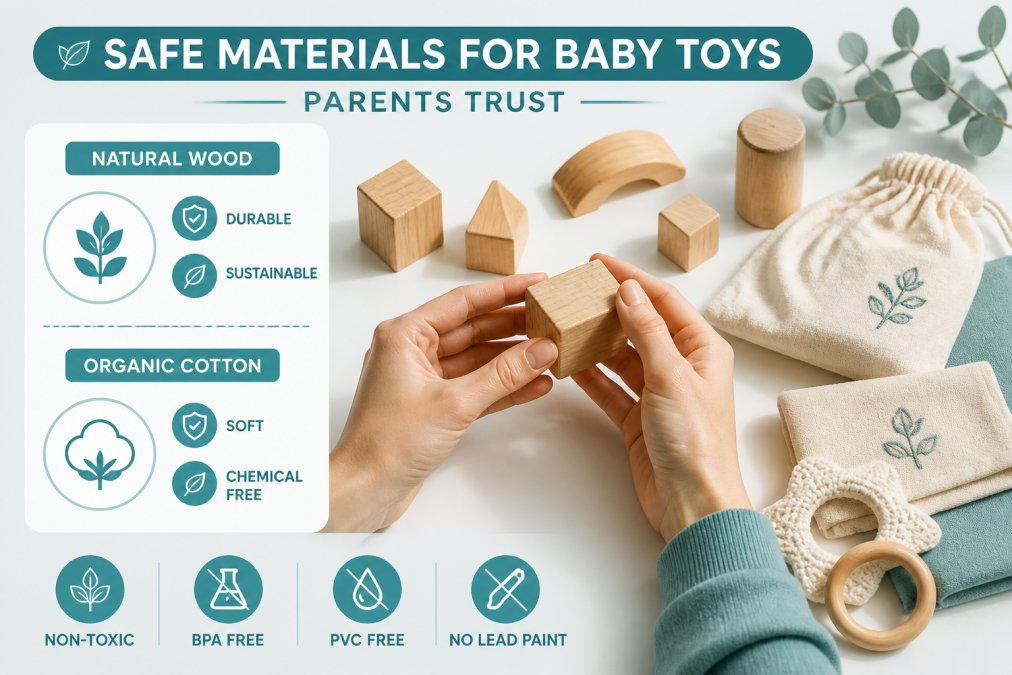
Solid wood is the gold standard. Unlike particleboard, it doesn't require formaldehyde-containing adhesives. FSC-certified wood indicates responsible forest management. Water-based finishes are safer than polyurethane. Solid wood toys are durable, naturally antimicrobial, and often become family heirlooms.
Organic cotton and natural fabrics are excellent for soft toys. Grown without synthetic pesticides, organic cotton eliminates chemical residue. Natural dyes provide an extra safety layer over synthetic alternatives containing heavy metals.
Natural rubber from sustainably harvested rubber trees is safe for teething toys. Unlike PVC, it contains no phthalates and is naturally antimicrobial and biodegradable.
Stainless steel and untreated aluminum are non-porous and don't leach chemicals. Ensure smooth edges and no sharp points.
Wool and animal fibers are naturally fire-resistant without chemical flame retardants. Merino wool toys are soft, temperature-regulating, and hypoallergenic.
These materials share transparency, you can understand their origin, processing, and safety profile.
Understanding CPSC Toy Safety Standards and Certifications
ASTM F963 is the federal standard manufacturers must follow. It covers choking hazards, flammability, toxicity, and sharp edges. If a toy doesn't claim ASTM F963 compliance, that's a red flag.
Phthalate-free certification verifies toys designed for mouthing contain no phthalates. Look for explicit claims on packaging.
Lead-free certification confirms testing for lead content meeting federal limits. Verification matters, especially for vintage or imported toys.
FSC certification on wooden toys indicates responsibly managed forests and reflects manufacturer commitment to quality.
Third-party testing from organizations like TUV SUD, SGS, or Intertek is more reliable than manufacturer claims alone.
Checking certifications is straightforward: look for logos and numbers on packaging or product descriptions. Verify CPSC compliance by checking their database for recalls. A quick search of the toy name plus "CPSC recall" reveals documented safety issues.
Smaller manufacturers and artisanal makers might lack visible certifications. Research the manufacturer's practices, ask about materials and finishes, and rely on parent reviews focusing on safety.
Your Step-by-Step Checklist for Picking Safe Toys
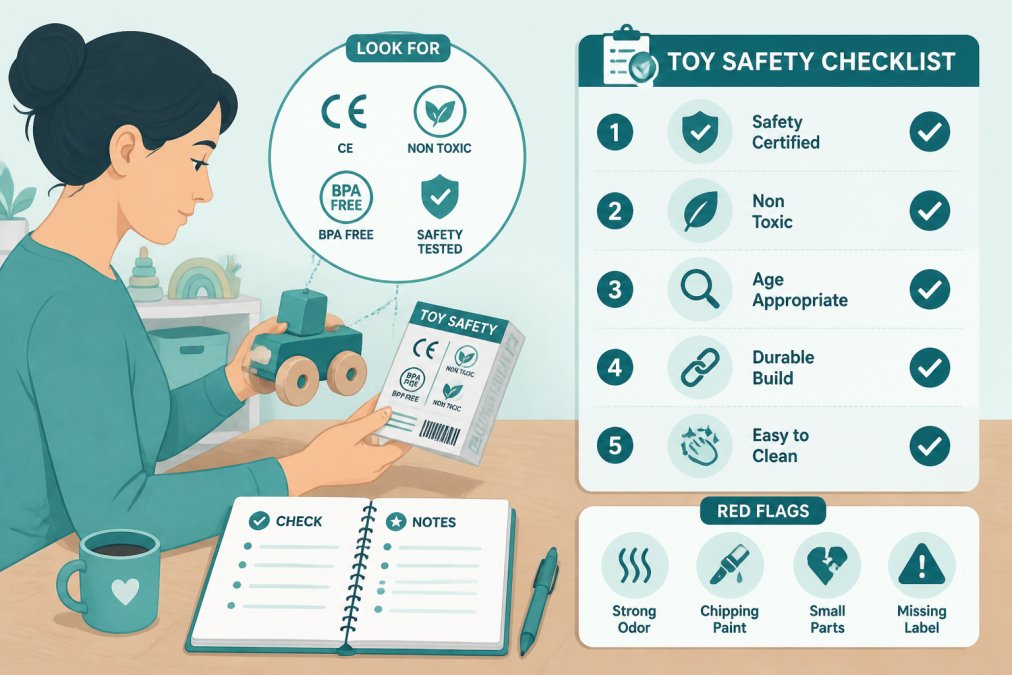
Step 1: Identify the primary material. Determine if it's plastic, wood, fabric, rubber, or a combination. If material isn't clearly stated, that's a concern. Solid wood, organic cotton, and natural rubber are green lights.
Step 2: Check for ASTM F963 compliance. Look for this standard on packaging or contact the manufacturer directly.
Step 3: Verify certifications for your toy type. Teething toys need phthalate-free certification. Wooden toys should have FSC certification or water-based finishes. Soft toys need organic cotton certification.
Step 4: Research the manufacturer. Are they transparent about materials and processes? Check for CPSC recalls or safety violations.
Step 5: Examine the toy physically. Inspect for loose parts, sharp edges, or rough seams. Sniff for strong chemical smells indicating off-gassing.
Step 6: Check the age recommendation. This ensures appropriate safety for your child's developmental stage.
Step 7: Look up any recalls. Search the CPSC website before purchasing.
Step 8: Ask about cleaning and maintenance. Understanding how to safely maintain the toy keeps it safe over time.
This checklist takes 5-10 minutes per toy and prevents later stress about toy safety.
How to Build a Montessori Playroom with Non-Toxic Toys
Start with open shelving at child height. Low open shelves let children see and choose toys independently, encouraging decision-making. Keep shelves organized with one toy type per shelf.
Rotate toys regularly. Every 2-4 weeks, rotate a smaller selection to keep play fresh and reduce overwhelm.
Choose toys with a purpose. Wooden puzzles develop spatial reasoning. Nesting bowls teach size gradation. Avoid electronic toys that do the playing for the child.
Invest in quality over quantity. Well-made wooden toys outlast cheap plastic alternatives and can be passed down. Tender Tots & Wellness offers options like the Montessori Wooden Tangram Puzzle Game, which encourages geometric thinking while using sustainable materials.

Create a sensory exploration area. Include toys with different textures, weights, and temperatures to support sensory development.
Minimize visual clutter. Use natural wood tones and soft colors. Avoid bright primary colors and excessive stimulation so attention focuses on play.
Include practical life activities. Child-sized tools and tasks give children meaningful work. The Tender Tots Wooden Tool Disassembly Playset teaches problem-solving and fine motor skills.
Maintain the space regularly. Keep toys clean, in good repair, and organized. Remove broken or disengaging toys.
Children in well-designed Montessori environments show greater focus and independence, and knowing every toy is non-toxic lets you relax while your child plays.
Second-Hand and Hand-Me-Down Toy Safety
Test for lead if the toy is older. Toys manufactured before 1978 can contain lead-based paint. Lead test kits are inexpensive and simple to use.
Inspect for wear and deterioration. Peeling paint, cracked plastic, or loose parts create new hazards. Discard significantly worn toys.
Check for recalls. Search the CPSC database even for toys that were safe when manufactured.
Clean thoroughly before use. Wash fabric toys in hot water. Wipe wooden or plastic toys with mild soap and water.
Be selective about soft toys. Stuffed animals harbor dust mites and bacteria. Machine-wash if possible; decline if cleaning isn't feasible.
Ask about the toy's history. Understanding where it came from and its age helps you make informed decisions.
Document what you accept. Keep a list of hand-me-down toys with names, manufacturers, and dates received for future recall checks.
Second-hand toys aren't inherently unsafe but require more verification than new toys with certifications.
Choosing safe non-toxic toys is one of the most concrete ways you protect your child's health and support development. Once you know what to look for, materials, certifications, manufacturer transparency, and age-appropriate design, the process becomes easier. At Tender Tots & Wellness, we've curated toys meeting these standards, including the Magnetic Alphabet & Number Learning Letters and Montessori Wooden Tangram Puzzle Game, each chosen for safety and developmental value. Shop now and build a playroom where your child can explore, learn, and grow with complete peace of mind.

Frequently Asked Questions
How do I know if a toy is non-toxic and safe?
Check for third-party certifications like ASTM F963, CPSC compliance labels, and phthalate-free or BPA-free markings on packaging. Look for solid wood or organic cotton materials rather than PVC or polyvinyl chloride. Contact the manufacturer if certifications aren't visible, and verify the product hasn't been recalled on the CPSC website. Reputable brands like Tender Tots & Wellness prioritize transparent labeling and safety testing.
What materials should I avoid when buying toys for babies?
Avoid PVC (polyvinyl chloride), which often contains phthalates that disrupt endocrine function. Skip toys with lead-based paint, synthetic materials without certifications, and polyurethane foam without off-gassing verification. Steer clear of toys with heavy metals or formaldehyde. Check labels for phthalate-free and BPA-free claims. When in doubt, choose natural alternatives like FSC-certified solid wood, organic cotton, or water-based finishes that have undergone third-party testing.
Are wooden toys always safer than plastic toys?
Not automatically. Safety depends on how the toy is made, not just the material. Wooden toys are safer when made from FSC-certified solid wood with water-based finishes and no synthetic coatings. However, some plastic toys are safe if they're phthalate-free, BPA-free, and meet CPSC standards. The key is verifying certifications and materials for both wood and plastic options. Always check labels and avoid secondhand items with peeling paint or unknown origins.
What certifications should I look for on toy packaging?
Look for ASTM F963 certification, which ensures toys meet safety standards for age-appropriate use. Check for CPSC compliance labels and third-party testing marks. FSC certification on wooden toys confirms sustainable, responsibly sourced materials. Labels stating phthalate-free, BPA-free, and formaldehyde-free are important. Some toys display non-toxic material badges or hypoallergenic certifications. When building your Montessori playroom, prioritize toys with multiple certifications as a sign of rigorous safety testing and regulatory compliance.
This article was written using GrandRanker