

How to Rotate Baby Toys for Focused Play: A Simple Guide
Last Updated: October 22, 2026
Quick Summary
To learn how to rotate baby toys for focused play, sort toys into categories, store most in labeled boxes, and keep only eight to ten items on a low open shelf. Swap the shelf contents from a stored box every one to two weeks, leaving one familiar toy in place as an anchor.
- Sort toys into categories such as teethers, board books, stacking toys, and sensory items before rotating.
- Keep eight to ten items out at once, including books, rattles, and one or two larger toys.
- Swap shelf contents weekly or every two weeks, and leave one familiar toy in place as an anchor.
- Match rotation to developmental stage, from one focal point for newborns to two-to-three-week cycles for toddlers.
- Check every toy for small parts, loose batteries, and strings longer than about seven inches before it goes out.
Table of Contents
- Why Toy Rotation Works for Babies
- Step 1: Sort Toys Into Categories
- Step 2: Set Up Rotation Boxes and Storage
- Step 3: Decide How Many Toys to Have Out for Baby
- Step 4: Build a Baby Toy Rotation Schedule
- Step 5: Create a Focused-Play Setup for Babies
- Toy Rotation Ideas for Babies by Developmental Stage
- Toy Safety, Cleaning, and Choking Hazards
- Frequently Asked Questions
Why Toy Rotation Works for Babies
Toy rotation means keeping only a small selection of toys available while the rest stay stored, then swapping them on a regular schedule.
At Tender Tots & Wellness, we hear the same story from parents: the playroom is full, and the baby is bored. The steps below show you exactly how to rotate baby toys for focused play, from sorting to scheduling. Zero to Three on how play builds early brain development
Step 1: Sort Toys Into Categories
Pull every baby toy into one room and sort it into groups. This decluttering step is the one most parents skip.
Sort into these toy categories:
- Teethers and rattles for mouthing and grasping
- Soft toys and loveys for comfort and tummy time
- Stacking and nesting toys for problem-solving
Set aside anything broken, missing parts, or outgrown, and be honest about duplicates, five rattles do the same job as one.
Choosing Which Toys to Keep Available
Keep toys that match your baby's current skills, not the ones you hope they will grow into. A baby working on sitting does not need a walker yet.
A simple rule: if your baby has not touched a toy in two rotations, it can leave the rotation for a while. Interest comes back when the toy does.
Step 2: Set Up Rotation Boxes and Storage
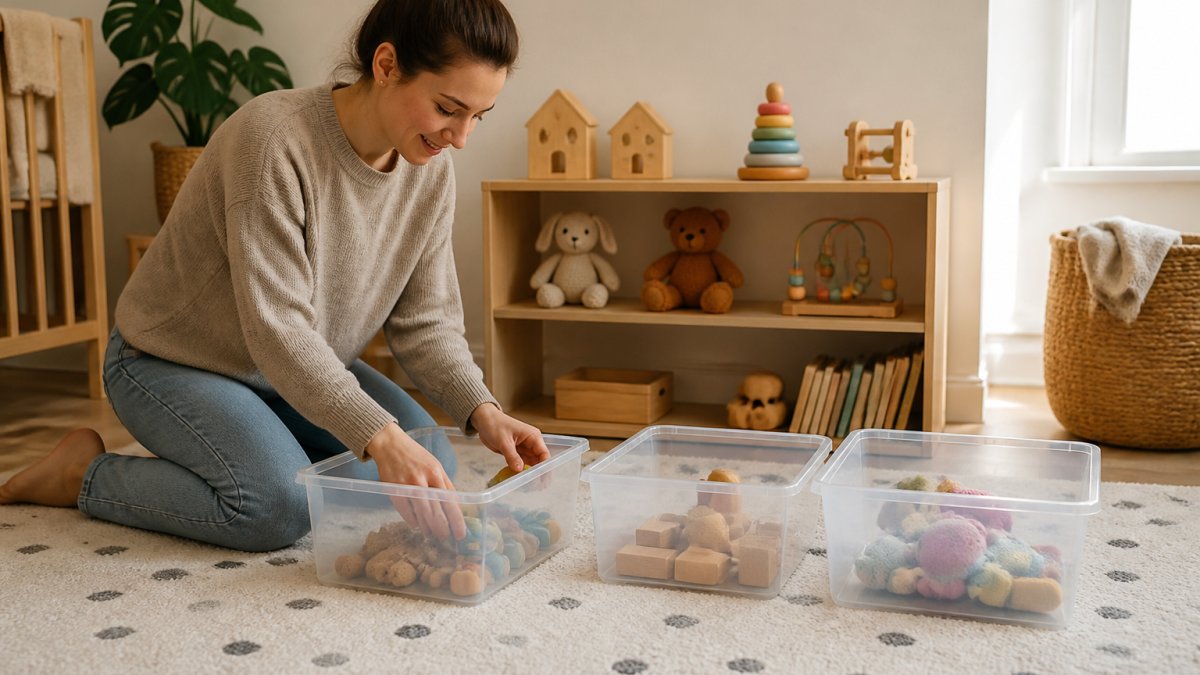
You need two kinds of storage: rotation boxes for toys that are put away, and a low, open shelf for toys that are out. Clear bins with lids work well for the boxes, label each by category or week and keep them out of sight, because a baby who can see the stored toys will want them all back. For the play space, choose a low shelf or basket your baby can reach without help; an open shelf shows a small selection clearly, while a deep toy chest hides everything in a jumble.
- Use 3 to 4 rotation boxes, one for each swap cycle
- Label boxes with a date or category
- Store boxes on a high closet shelf or in a garage bin
Step 3: Decide How Many Toys to Have Out for Baby
How many toys to have out for baby comes down to one number: eight to ten items, including books, rattles, and one or two larger toys. The number matters more than the toys themselves, a baby with eight well-chosen toys will explore each one longer than a baby with thirty.
Try this starting point:
- 3 to 4 small manipulative toys
- 2 board books
- 1 soft comfort toy
Adjust as you observe. If your baby ignores most of the shelf, cut back to six items. If they seem restless, swap in one new item rather than adding five.
Step 4: Build a Baby Toy Rotation Schedule
A baby toy rotation schedule does not need to be complicated. Pick one day each week or every two weeks, and swap the shelf contents from a stored box. That is the whole system.
Here is a sample rotation plan you can copy:
| Rotation | What Goes Out | What Goes Away | Timing |
|---|---|---|---|
| Week 1 | Box A: rattles, 2 books, soft ball | Box C items | Monday morning |
| Week 2 | Box B: stacking cups, crinkle toy, 2 books | Box A items | Monday morning |
| Week 3 | Box C: sensory scarves, board book, activity gym | Box B items | Monday morning |
| Week 4 | Refresh Box A with one new item | Box C items | Monday morning |
How Often to Rotate Baby Toys
How often to rotate baby toys depends on your baby, but every one to two weeks suits most families. Younger babies lose interest faster, so a weekly swap works well in the first year; older babies may stay engaged for two to three weeks. Watch for disengagement, a baby who walks past the shelf without reaching, or tosses toys aside within seconds, is telling you it is time to refresh.
Step 5: Create a Focused-Play Setup for Babies
A focused-play setup is a small, low-distraction zone where a baby can see, reach, and explore a couple of toys without competing sights, sounds, or piles of options. Most rotation guides stop at "put out fewer toys." The physical arrangement matters just as much, because a baby's attention is shaped by what is inside their field of view and within arm's reach.
Arrange the space around the baby's body, not the room
A baby on their back sees mostly what is overhead and to the sides; a baby learning to sit sees a wider arc but still reaches mainly forward and to each side. Build the setup around those limits:
- Floor time (back or tummy): place one toy just beyond the fingertips so a swipe or scoot is required, and one within easy grasp for immediate success. Keep the rest out of the sightline, behind the baby or off to the side.
- Sitting play: a low, open shelf or a shallow basket at chest height when seated keeps toys visible and reachable without a caregiver handing them over. Two or three items on the shelf is plenty.
- Crawling and pulling up: anchor one larger toy (an activity gym, a sturdy push-along) at the edge of the mat so movement has a destination, and keep small manipulative toys in a single basket rather than scattered.
Cut the competing input
Overstimulation usually comes from background noise and motion, not the toys themselves. Before you set up focused play:
- Turn off the TV and any background music with lyrics; a fan or white-noise machine is fine.
- Move the setup away from doorways, pet traffic, and windows with passing activity.
- Use a plain mat or rug rather than a busy patterned one, high-contrast patterns compete with the toys for attention.
- Put away the toys from the previous rotation before bringing out new ones, so the shelf never holds both sets.
Set up for observation, not direction
Place a cushion or floor chair for yourself just outside the play zone. The goal is to be nearby and available without narrating or demonstrating, babies tend to sustain attention longer when an adult watches quietly and responds to bids for help rather than leading the play. If your baby hands you a toy, accept it, name it once ("You found the red cup"), and hand it back.
Keep the setup safe for independent movement
A focused-play zone only works if a baby can move freely in it. Anchor rugs and mats so they do not slide, keep the shelf low and stable enough that it will not tip if a baby pulls up on it, and clear the floor of cords, pet toys, and anything small enough to mouth.
Toy Rotation Ideas for Babies by Developmental Stage
Toy rotation ideas for babies should match what their bodies and brains can do right now, and the rotation itself should change as skills change. A newborn needs a single, clear focal point; a crawler needs a reason to move. Here is how to tailor the shelf and the swap rhythm by stage.
0 to 3 months: one focal point at a time
Vision is still developing and hands are mostly closed. Keep the available set tiny, a high-contrast card or book, one lightweight rattle, and a soft book for tummy time. Rotate every one to two weeks, and change the position of the item more often than the item itself; moving a card from overhead to the side gives a newborn a new thing to track.
3 to 6 months: reaching and grasping
Once a baby swipes with intent and brings objects to the mouth, add grasping toys, a textured ball, a baby-safe mirror, and crinkle cloth. Keep three to four items out and rotate weekly, interest fades fast at this age. Watch for: a toy transferred from one hand to the other, and mouthing that has become deliberate rather than accidental.
6 to 9 months: cause and effect
Sitting usually arrives here, which changes the whole setup. Bring in stacking cups, a drum or shaker, board books with sturdy pages, and a soft block set. Rotate every one to two weeks, keeping one familiar comfort item on the shelf as an anchor. Watch for: banging two objects together, dropping a toy on purpose to see what happens, and searching for a toy that has rolled out of sight, signs the baby is ready for toys with a visible mechanism like a pop-up button, a spinner, or a toy that rattles when shaken.
9 to 12 months: problem-solving and movement
Nesting toys, a simple shape sorter, push-along toys, and lift-the-flap books fit this stage. Rotate every two weeks, swapping in one new item at a time rather than replacing the whole shelf. Watch for: a baby who solves the shape sorter easily and then loses interest, that is the cue to move up a level, not to add more toys at the same level.
12 to 18 months: pretend play and building
Simple puzzles, larger building blocks, and early pretend-play items like a soft doll or a play phone belong here. Rotation can stretch to two to three weeks, because attention spans lengthen and toddlers return to the same toy with new purposes. Watch for: using an object for something other than its intended function (a block as a phone), which signals pretend play is starting and that open-ended toys will earn their place on the shelf.
A simple tracking method
You do not need an app. A sheet of paper inside the storage closet door works: list each box, the date it went out, and one note about what your baby did with it. When a box comes back out, the note tells you whether to keep the contents, swap one item, or retire the set.
Toy Safety, Cleaning, and Choking Hazards
Safety comes before any rotation plan. Check every toy before it goes on the shelf, and again when it comes back out.
Watch for these hazards:
- Small parts: anything that fits inside a toilet paper tube is a choking risk for babies under three
- Loose batteries: battery compartments should be screwed shut
- Broken pieces: cracked plastic or split seams can create sharp edges
Clean toys between rotations: wipe hard plastic with a mild soap solution, wash fabric toys per their care labels, and air-dry everything fully before storing so nothing grows mildew in a closed bin.
The Consumer Product Safety Commission toy safety guidance is worth a quick check whenever you bring in a new or secondhand toy.
Frequently Asked Questions
How many toys should I leave out for my baby at once?
Most babies do well with a small selection of eight to ten items available at a time, including a couple of larger toys and a few small ones. A small selection keeps the play space calm and makes it easier for your baby to choose and focus. If your baby seems bored within minutes or flits from toy to toy without settling, try reducing the number further. If they ignore everything, bring out one or two items from storage instead of adding more.
How often should I rotate baby toys?
A flexible schedule works best. Many families rotate every one to two weeks, while others wait about four weeks or until they notice signs of disengagement, like a baby ignoring toys they used to love. Watch your child rather than the calendar. If a toy still holds attention, leave it out longer. If interest drops, swap it for something from storage. The baby toy rotation schedule should serve your child's interest, not the other way around.
What should I do if my baby wants a toy that is put away?
Bring it back out. Toy rotation is a tool for reducing clutter and overwhelm, not a strict rule. If your baby asks for or clearly misses a stored toy, retrieve it and let them play. You can swap out something they have lost interest in to keep the number of available toys steady. Following your child's lead supports child-led play and keeps the experience positive for both of you.
Is toy rotation safe for infants and younger babies?
Yes, with safety checks. For infants, choose toys without small parts, loose strings, or batteries that can be accessed, and check for choking hazards before each rotation. Follow age recommendations on packaging and inspect toys for cracks or loose pieces every time you bring them out. Clean toys between rotations, especially items that went into mouths. If you are unsure whether a toy is appropriate for your baby's stage, keep it in storage until they are older.
Rotating baby toys takes one sorting session and a weekly swap, but the payoff is a calmer play space and a baby who engages longer. If you want a shelf full of toys that are actually built for this kind of focused play, Tender Tots & Wellness curates Montessori-inspired toys and baby essentials with free worldwide shipping and high-quality pieces at fair prices. Shop now and build a rotation your baby will love.