

Montessori Principles for a Minimalist Nursery: Complete 2026 Guide
Table of Contents
- Understanding Montessori Principles for a Minimalist Nursery
- Creating a Prepared Environment: Montessori Nursery Ideas
- Montessori Baby Room Setup: Step-by-Step Layout
- Selecting Open-Ended Materials and Montessori Toy Rotation
- Building a Montessori Nursery on a Budget
- Common Mistakes and Safety Considerations
- Frequently Asked Questions
Last Updated: October 16, 2026
Understanding Montessori Principles for a Minimalist Nursery
A minimalist nursery built on Montessori principles creates a calm, intentional space where your child can explore, learn, and develop independence from birth.
At Tender Tots & Wellness, we believe that less is genuinely more when it comes to early childhood environments. The Montessori method emphasizes that children learn best when surrounded by order, accessible materials, and freedom to explore at their own pace.

The key insight most parents miss: a minimalist nursery isn't about deprivation. It's about intentionality. Every item in the room serves a developmental purpose or supports daily routines.
The Core Pillars: Order, Independence, and Freedom
Three foundational principles shape how you design and maintain a Montessori-inspired minimalist nursery.
Order means everything has a designated place. Your child learns that the world is organized and predictable.
Independence is the ability for your child to meet their own needs with minimal adult intervention. Low shelving means they can reach toys. A floor bed allows them to get in and out of sleep space safely.
Freedom refers to freedom of movement and freedom to choose. Your child should be able to move freely through the nursery without obstacles.
Creating a Prepared Environment: Montessori Nursery Ideas
The prepared environment is the foundation of Montessori practice. Unlike traditional nurseries filled with character-themed decor and bright primary colors, a Montessori nursery is deliberately calm, orderly, and designed around your child's actual developmental needs rather than adult aesthetics.
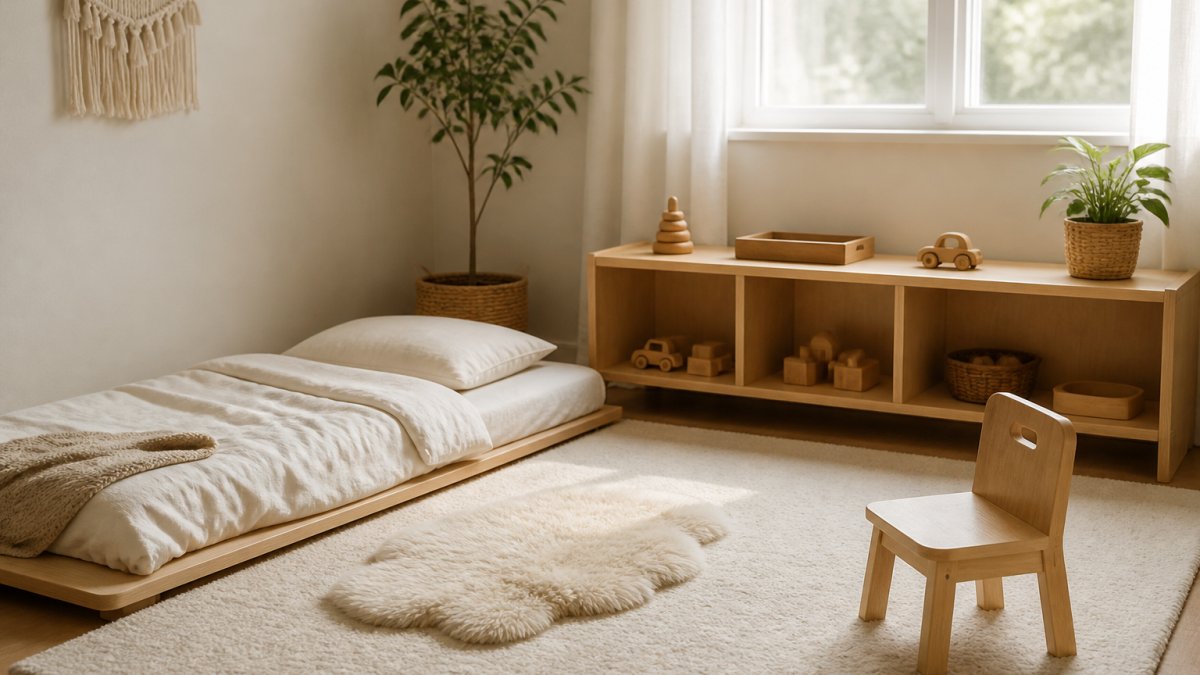
Visual Simplicity and Intentional Design
Visual simplicity doesn't mean empty or cold. It means every visual element serves a purpose. Walls should be neutral, soft whites, warm grays, or gentle earth tones.
Keep decorative items minimal and meaningful. A single piece of artwork at your child's eye level, a plant or two, and perhaps a mirror for self-discovery work better than collections of posters or wall decals. Natural light is your best design tool.
Intentional design also means thinking about traffic flow. Your child should be able to move from the sleeping area to the play zone to the changing station without obstacles or confusion. Open floor space matters.
Low Furniture and Accessible Storage
Child-sized furniture is essential, but it doesn't mean filling the room with pieces. One low shelf, one small chair, and a low changing table are often enough. Your child should be able to see what's available at their eye level and reach items independently.
Open shelving works better than closed storage. When toys are visible in baskets or on shelves, your child can make choices and learn to return items to their homes.
The changing table can be a low dresser with a padded top, or a purpose-built low changing station.
Montessori Baby Room Setup: Step-by-Step Layout
Creating a functional minimalist nursery requires thoughtful zoning. Your nursery needs distinct areas for sleeping, movement and play, and care routines, but these zones can overlap in small spaces.
Sleeping Area: Floor Beds and Safe Sleep Spaces
A floor bed, a low mattress placed directly on the floor or a very low frame, is central to Montessori infant care.
For newborns, a floor bed can be a firm mattress (meeting safety standards) with fitted sheets and a lightweight blanket or sleep sack. Avoid pillows, bumpers, and excess bedding. Keep the sleep space simple and safe.
As your child grows and becomes more mobile, the floor bed becomes their own safe space to retreat to. They learn that the bed is for rest, and they can access it independently. This builds healthy sleep associations and independence around rest time.
Movement and Play Zones
A movement area should have clear floor space for rolling, crawling, and eventually walking and running. This might be a section of the room with a washable play mat, or simply an open floor area. Your child needs room to practice gross motor skills without obstacles.
The play zone contains your open-ended materials on low shelving. A small basket of sensory items (textured balls, wooden rings, soft cloths) and perhaps one manipulative toy (like the Tender Tots Wooden Tool Disassembly Playset, which develops fine motor skills and problem-solving through hands-on exploration) supports your child's natural curiosity and concentration.

Practical Layouts for Small and Shared Spaces
In a small nursery or shared bedroom, zones blend together. A corner for sleeping, a small open area, and a single low shelf can serve all functions.
If the nursery is shared with a sibling, define your infant's zone clearly. A low gate or visual boundary can separate the baby's area from older siblings' toys and activities, preventing safety issues and reducing visual clutter for the baby.
For shared rooms, minimize the number of items in the baby's zone and keep older siblings' toys in a separate storage area. This protects both children and keeps the baby's environment calm and focused.
Selecting Open-Ended Materials and Montessori Toy Rotation
Open-ended toys, materials that can be used in many ways without a single "correct" use, are the heart of Montessori play. They encourage creativity, problem-solving, and sustained concentration.
What to Include: Age-Appropriate Open-Ended Play
For infants (birth to 6 months), focus on sensory exploration: natural wood rings, soft cloth balls, mirrors for self-discovery, and high-contrast cards. These materials support visual development and hand-eye coordination without overstimulation.
From 6 to 12 months, add manipulatives: objects to grasp, shake, and bang; baskets with safe household items like wooden spoons; simple shape sorters.
From 12 months onward, introduce more complex materials: stacking toys, sorting activities, simple puzzles, and pretend play items.
Tender Tots Wooden Tool Disassembly Playset for Kids →
Avoid toys with batteries, sounds, or lights. These overstimulate and reduce your child's ability to concentrate. Avoid toys with small parts that pose choking hazards.
How to Rotate Toys and Maintain the Environment
Toy rotation is key to maintaining a minimalist environment while keeping your child engaged. Keep about 25-30% of toys available at any time, rotating every two to four weeks. Store rotated toys in bins in a closet or another room.
Rotation serves multiple purposes: it prevents overwhelm, maintains your child's interest, allows deeper engagement with fewer materials, and teaches you what your child actually enjoys playing with.
After play, restore materials to their homes before bringing out new items. This teaches order and respect for the environment. If your child isn't interested in a toy after several rotation cycles, remove it from the collection.
| Rotation Schedule | Frequency | Best For |
|---|---|---|
| Every 2 weeks | Highly engaged infants | Maintaining novelty and focus |
| Every 3-4 weeks | Most toddlers | Balancing interest and order |
| Every 4-6 weeks | Older toddlers | Deeper exploration of materials |
Building a Montessori Nursery on a Budget
A minimalist approach is naturally budget-friendly. You're buying fewer items, so you can invest in quality pieces that last and support genuine development.
Essential vs. Nice-to-Have: Where to Invest
Essential items are those that directly support your child's development and safety: a safe sleep surface (whether a crib or floor bed), a changing area, basic clothing, and a few open-ended toys. These deserve your investment because your child uses them daily.
Nice-to-have items are decorative or convenience-focused: themed decor, character toys, fancy furniture, or items that don't serve a clear developmental purpose. These can wait or be skipped entirely.
Start with the essentials. A simple wooden shelf costs less than a themed toy organizer and works better for a Montessori space. A few quality wooden toys support more learning than a dozen plastic ones.
Budget Tiers and Shopping Strategy
Minimal budget ($200-400): A floor mattress, one low shelf, a few wooden toys, and natural household items (wooden spoons, fabric scraps, safe kitchen items).
Moderate budget ($400-800): Add a low changing table, a small wooden chair, more carefully selected toys, and perhaps one or two specialty pieces like a mirror or climbing structure.
Comfortable budget ($800+): Invest in higher-quality furniture, more varied materials, and specialty Montessori items. Quality pieces last through multiple children and grow with your family.
Shop secondhand for furniture. Quality wooden pieces are durable and timeless. Avoid items with safety concerns or excessive wear.
Common Mistakes and Safety Considerations
The most common mistake is underestimating how much your child benefits from simplicity.
Another mistake is rotating toys too frequently or keeping too many items available. Your child needs time to explore and master materials.
Safety requires specific attention. A floor bed must meet current safe sleep guidelines, firm surface, fitted sheet, no pillows or blankets for infants under 12 months (the CDC). Ensure all furniture is stable and cannot tip (CPSC Anchor It! Campaign Marks 10 Years).
Check that low shelving is securely anchored to the wall. Your mobile toddler will pull themselves up using furniture, and unstable pieces are a fall risk.
Ensure your child cannot access anything unsafe, cleaning supplies, medications, cords, or small objects.
Building a Montessori minimalist nursery means creating an environment that respects your child's developing mind and body. Order, independence, and freedom work together to support natural learning and healthy development.
Frequently Asked Questions
What are the core Montessori principles for a minimalist nursery?
Montessori principles center on a prepared environment that fosters independence, concentration, and self-directed learning. Key principles include order (everything has a place), freedom of movement (low furniture and open spaces), and intentionality (only materials that serve development). A minimalist approach amplifies these by removing visual clutter, limiting toy selection, and focusing on quality open-ended materials that spark discovery rather than overstimulation.
How do you set up a Montessori baby room setup for different ages?
For infants (0-6 months), create a calm sleep space with a low bed, soft textures, and one or two high-contrast visual materials. For mobile infants (6-12 months), add low open shelving with 4-6 simple toys and a movement area with safe floor space. For toddlers (12-24 months), expand to 8-10 rotated toys, child-sized furniture they can access independently, and practical life materials like low baskets for self-care routines.
How many toys should be in a Montessori minimalist nursery?
A prepared environment typically includes 6-10 toys available at once, rotated every 2-4 weeks. This prevents overwhelm, builds focus, and deepens engagement with each material. Rotation maintains novelty and allows children to rediscover materials with fresh eyes. Store unused toys in closed bins outside the nursery to keep the visual environment calm and intentional.
Is a floor bed appropriate for a Montessori baby nursery?
Yes, floor beds align with Montessori principles of independence and freedom of movement. They allow infants and toddlers to get in and out of bed safely without assistance, supporting autonomy. Use a low platform bed or mattress directly on the floor with guardrails if needed. Ensure the room is fully baby-proofed so your child can move freely and safely explore their sleep space.
How can I create a Montessori nursery on a budget without compromising quality?
Prioritize essentials: a safe sleep space, low open shelving, and 6-8 quality open-ended toys. Invest in one or two key pieces like a low bed or shelf ($50-150 each), then fill with affordable wooden toys, baskets, and natural materials. Tender Tots & Wellness offers budget-friendly options like the Wooden Tool Disassembly Playset ($55.99) and WordWise Blocks ($25.00) that deliver educational value without premium pricing.
What makes a space a truly prepared Montessori environment?
A prepared environment is orderly, calm, and accessible to the child. It includes low furniture and storage the child can reach independently, carefully selected materials that invite concentration, soft lighting, natural colors, and plenty of open floor space. Every item serves a purpose in supporting development. The caregiver's role is to observe, maintain order, and introduce materials thoughtfully as the child's skills evolve.
How do I maintain a minimalist Montessori nursery when I have limited space?
Use vertical storage with low open shelving to maximize wall space, rotate toys frequently to reduce what's visible at once, and choose multifunctional furniture (low bed with storage underneath). Keep the color palette neutral and limit decorations to 2-3 intentional pieces. Store seasonal items and off-rotation toys in a closet or separate room. Small spaces actually support the minimalist Montessori aesthetic, less room means less clutter by design.
What's the difference between true Montessori toys and toys just labeled Montessori?
Authentic Montessori materials are open-ended, purposeful, and designed to isolate a single skill or concept. They invite discovery through hands-on exploration rather than batteries, lights, or predetermined outcomes. Look for natural materials (wood, metal, fabric), simple design, and clear educational intent. Tender Tots & Wellness curates genuinely Montessori-aligned items like wooden building toys and phonics materials that support real learning, not just the aesthetic.