

Best Montessori Toys for 1 Year Olds (2026 Guide)
Table of Contents
- Why Montessori Toys Work Differently for 1-Year-Olds
- Top Montessori Toys for 1 Year Olds: Compared by Skill
- Montessori Activities for 12-18 Month Olds Beyond Toy Play
- How to Build a Montessori Toy Rotation Schedule
- Safety Considerations and Toy Maintenance
- Quick Comparison: Montessori Toys by Price and Skill Focus
- Conclusion
Last Updated: August 13, 2026
Most parents discover Montessori toys through a friend's recommendation or social media, then wonder whether they're buying something developmental or just a prettier plastic toy. At Tender Tots & Wellness, we've curated genuinely Montessori-aligned toys for 1-year-olds. This guide explains what makes each one worth your attention, how they map to your child's developmental stage, and how to build a rotation system that keeps learning fresh without cluttering your home.
The best Montessori toys for 1-year-olds are open-ended, made from natural materials, and designed to build one or two specific skills at a time. Below, we cover four top picks from our catalog with honest assessments, DIY ideas, a toy rotation framework, and maintenance tips most guides skip.
Quick Picks:
- Best for Open-Ended Play: DIY Wooden Rainbow Toy, $25
- Best for Cognitive Development: MontiPlay Magic Montessori Play Toolbox, $45
- Best for Spatial Awareness: Wooden Tangram Puzzle Game, $14.30
- Best for Fine Motor Skills: Wooden Tool Disassembly Playset, $55.99
Why Montessori Toys Work Differently for 1-Year-Olds
Montessori toys are purpose-built learning tools, not entertainment devices. They isolate one concept at a time, color, shape, weight, texture, so a child can master it through repetition and self-correction without adult direction. That single-concept focus separates them from conventional toys that layer in lights, sounds, and characters to hold attention artificially.

For 1-year-olds, this approach matches how their brains actually develop.
Developmental Milestones at 12-18 Months
Between 12 and 18 months, children refine the pincer grasp, develop hand-eye coordination, begin understanding object permanence, and start engaging in cause-and-effect reasoning. Gross motor skills advance rapidly, most children this age pull to stand, cruise furniture, and begin walking independently.
Cognitive development centers on exploration through tactile engagement: touching, mouthing, dropping, and stacking. Children build spatial awareness by fitting objects together and pulling them apart, and develop early independent play, the ability to stay engaged with a single object for a few minutes without prompting. The right Montessori toys meet children exactly here, sized for small hands and simple enough to explore without instruction.
Natural Materials vs. Plastic: What the Research Supports
Wooden and fabric toys offer sensory qualities that plastic cannot replicate. The weight, grain, and temperature of wood give genuine tactile feedback during exploration, supporting sensory development in ways uniform plastic surfaces don't. According to American Academy of Pediatrics guidance on play and child development, open-ended, hands-on play with simple materials is among the most effective ways to support early cognitive and motor development.
Natural materials are also more durable and safer. For safety, look for toys finished with non-toxic, water-based paints or food-grade oils.
Top Montessori Toys for 1 Year Olds: Compared by Skill
The four toys below are drawn from the Tender Tots & Wellness catalog, assessed against the developmental priorities of the 12-18 month window: fine motor skills, gross motor coordination, cognitive development, sensory exploration, and open-ended play.
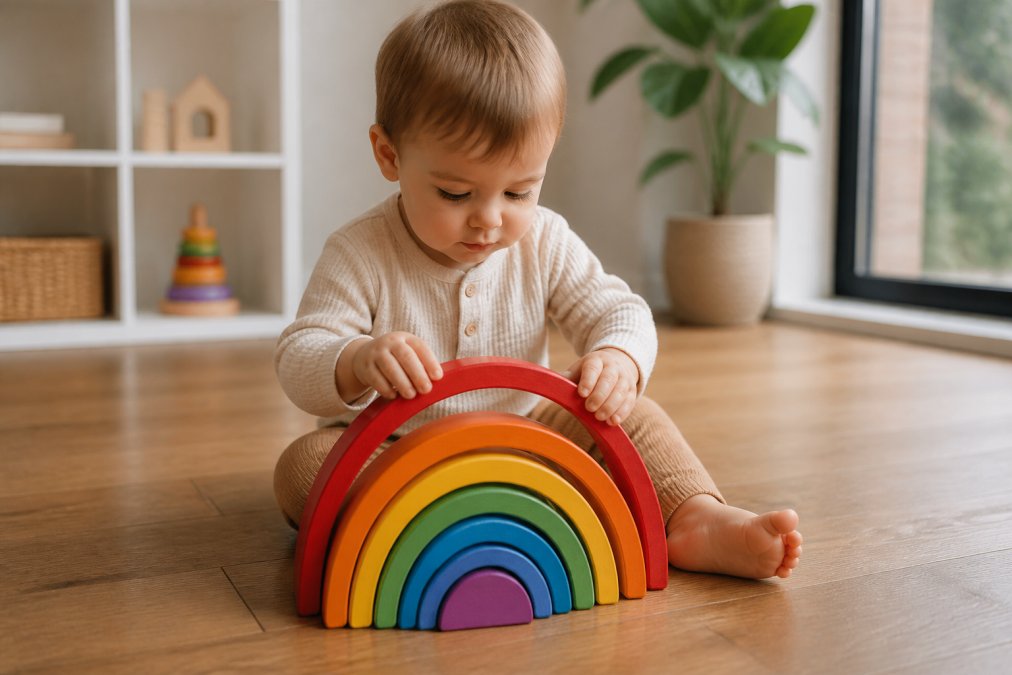
1. DIY Wooden Rainbow Toy - Best for Open-Ended Play ($25)
The wooden rainbow toy is the definition of open-ended play. There are no rules, no correct outcome, and no battery compartment. A toddler can stack the arches, nest them, line them up by size, or use them as a tunnel for smaller toys.
For 1-year-olds, the arches support stacking and sorting, two core skills at this stage. Handling each piece builds grasping strength and refines the pincer grasp. Because the arches vary in size, children naturally develop spatial awareness as they figure out which piece fits inside which. The rainbow toy is also one of the best parent-child bonding tools in this list, inviting adults to play alongside without taking over.
Best for: Toddlers who need open-ended, screen-free play that grows with them through age 3 and beyond. One honest limitation: At 12 months, some children will spend more time mouthing the arches than stacking them. That's developmentally normal; just confirm the finish is non-toxic.
Shop the DIY Wooden Rainbow Toy, $25.00, free worldwide shipping.
2. MontiPlay Magic Montessori Play Toolbox - Best for Cognitive Development ($45)
This is the most holistic option in the lineup. The MontiPlay Toolbox stimulates cognitive development, sensory exploration, and fine motor skills simultaneously, a multi-sensory approach that aligns with how 1-year-olds actually learn.
The toolbox format encourages children to discover the world through structured but open-ended interaction. Pulling items out, examining them, fitting them back in, each action builds cause-and-effect reasoning and reinforces object permanence. At $45, it sits in the mid-range of the catalog, with versatility that lets a 14-month-old and a 2.5-year-old engage with it differently but equally meaningfully.
Best for: Parents who want one toy that covers multiple developmental areas. One honest limitation: The toolbox works best when introduced gradually. Start with two or three elements, then add more over time.
Shop the MontiPlay Magic Montessori Play Toolbox, $45.00, free worldwide shipping.

3. Wooden Tangram Puzzle Game - Best for Spatial Awareness ($14.30)
At $14.30, this is the most accessible entry point in the collection and punches well above its price.
The tangram puzzle challenges children to fit geometric wooden pieces together to form shapes. For toddlers at the older end of the 12-18 month window, it introduces early problem-solving through trial and error. The smooth, colorful wooden pieces feel satisfying in small hands, and the tactile feedback of a piece clicking into place is genuinely rewarding. Though listed as "ages 3 and up" for full puzzle-building, 1-year-olds benefit from handling, sorting, and exploring the pieces, which builds fine motor skills and color recognition well before puzzle-solving becomes relevant.
Best for: Budget-conscious parents who want a durable, Montessori-aligned toy that grows with the child. One honest limitation: Supervision is important at 12 months due to smaller pieces.
Shop the Wooden Tangram Puzzle Game, $14.30, free worldwide shipping.

4. Wooden Tool Disassembly Playset - Best for Fine Motor Skills ($55.99)
Fine motor skill development at 12-18 months centers on grasping, twisting, and manipulating small objects with increasing precision. The Wooden Tool Disassembly Playset is built exactly for that.
Children take apart and reassemble pieces using realistic tool simulations, building hand-eye coordination, problem-solving, and focused concentration that supports longer independent play sessions. The build-and-disassemble loop is inherently satisfying: there's always a clear goal, and achieving it builds confidence. The smooth wooden construction means no sharp edges or splinters, and child-safe materials make it worry-free for parents.
Best for: Toddlers already showing strong grasping ability and interest in how things work. One honest limitation: The disassembly mechanics suit 18+ months better. At exactly 12 months, let the child explore the pieces freely before introducing assembly.
Shop the Wooden Tool Disassembly Playset, $55.99, free worldwide shipping.
Montessori Activities for 12-18 Month Olds Beyond Toy Play
Toys are only part of the picture. Genuine Montessori learning happens throughout the day, woven into ordinary routines.
Practical Life Activities That Build Independence
Practical life activities are everyday tasks adapted for toddler participation. They build independence, concentration, and fine motor skills, often more effectively than dedicated toy time.
Simple examples for 12-18 months: transferring objects from one container to another using hands or a spoon, wiping a small surface with a damp cloth, placing objects into a basket and removing them, or pouring water between two small cups during bath time. The key principle: the process matters more than the result. A toddler who spills half the water while pouring is still building coordination and concentration.
According to Zero to Three's developmental guidelines for toddlers, child-led exploration and repetition of simple tasks are foundational to building executive function skills that persist into school age.
DIY and Upcycled Montessori Toy Ideas
Some of the most effective Montessori toys for 1-year-olds cost nothing and are made from materials already in your home.
Five DIY ideas that work:
- Object permanence box: Cut a hole in a shoebox lid and give the child a small ball to drop through.
- Fabric texture board: Glue swatches of different textures (burlap, velvet, felt, sandpaper) to cardboard for tactile exploration.
- Treasure basket: Fill a low basket with safe household objects of different textures and weights, a wooden spoon, metal bowl, smooth stone, ribbon.
- Nesting containers: Repurpose graduated food storage containers for stacking and nesting play.
- Posting box: Cut a slot in a plastic container and provide popsicle sticks for posting, a fine motor workout that costs almost nothing.
How to Build a Montessori Toy Rotation Schedule
A Montessori toy rotation schedule cycles a limited number of toys in and out of your child's accessible space, keeping the environment fresh without overwhelming it. Fewer toys available at once leads to deeper, more focused engagement with each one.
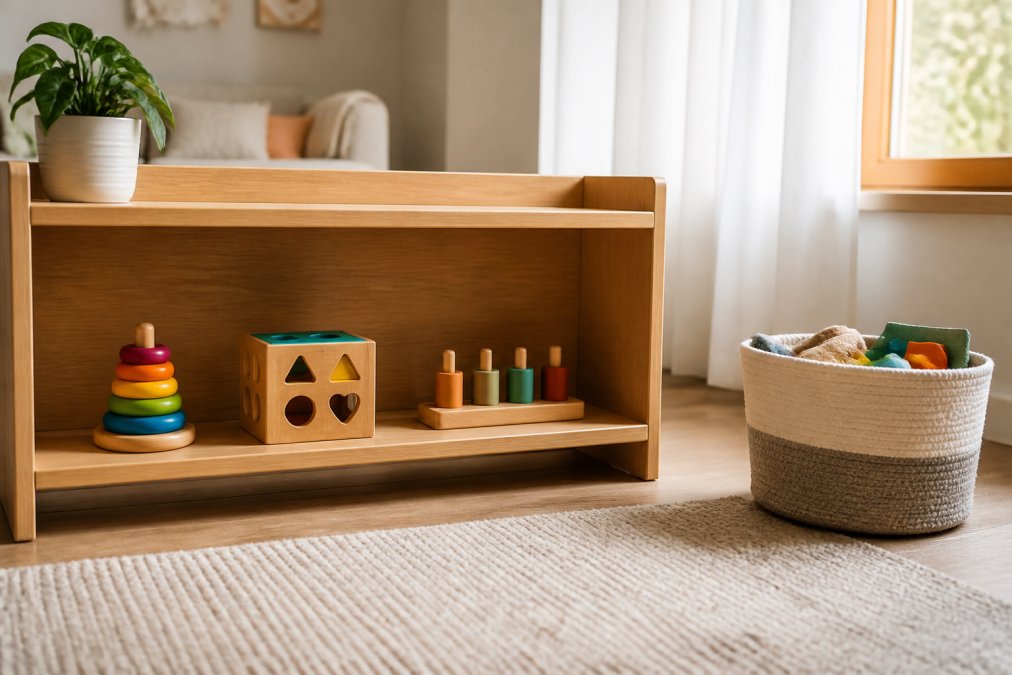
A practical rotation framework for 1-year-olds:
| Rotation Phase | Toys Available | Duration | What to Watch For |
|---|---|---|---|
| Active set | 3-4 toys | 1-2 weeks | Deep engagement, repeated play |
| Transition | Swap 1-2 toys | End of each cycle | Renewed interest in "new" items |
| Storage | Remaining toys | Out of sight | Prevents overstimulation |
| Review | All toys | Monthly | Remove outgrown items |
How to start: Choose three or four toys addressing different skill areas. Put everything else in a closed bin or closet. After one to two weeks, swap one or two items. The toys that return from storage will feel genuinely new to your child. Use vertical space with a low shelf at toddler eye level for active toys and a closed cabinet or high shelf for stored toys.
Safety Considerations and Toy Maintenance
CPSC Standards and Non-Toxic Materials to Look For
Toy safety for 1-year-olds is governed by the U.S. Consumer Product Safety Commission. For wooden Montessori toys, verify:
- Non-toxic finishes: Look for water-based paints, food-grade mineral oil, or beeswax finishes. Avoid unspecified lacquers or varnishes.
- Small parts: Any piece small enough to fit inside a 35mm film canister is a choking hazard for children under 3.
- Smooth surfaces: Well-made wooden toys should be sanded smooth with no splinters, rough edges, or loose components.
- ASTM F963 compliance: This is the standard safety specification for U.S. toy manufacturers.
Cleaning and Caring for Wooden Toys
Wooden toys require different care than plastic ones. Wipe with a slightly damp cloth and mild soap; do not submerge in water. Dry immediately after wiping. For deeper sanitizing, use a diluted white vinegar solution (one part vinegar to one part water), wipe, and dry promptly.
Every few months, apply a light coat of food-grade mineral oil or beeswax conditioner to wooden surfaces. This prevents drying and cracking, keeps the wood smooth, and extends the toy's life considerably. Watch for cracking or splitting wood, chipping paint or finish, and loose components, retire or refinish as needed. A well-maintained wooden toy can genuinely last through multiple children.
Quick Comparison: Montessori Toys by Price and Skill Focus
| Toy | Price | Primary Skill | Best Age Fit | Open-Ended? |
|---|---|---|---|---|
| DIY Wooden Rainbow Toy | $25.00 | Open-ended play, stacking | 12 months+ | Yes |
| MontiPlay Magic Play Toolbox | $45.00 | Cognitive development, sensory | 12-36 months | Yes |
| Wooden Tangram Puzzle Game | $14.30 | Spatial awareness, sorting | 15 months+ | Partially |
| Wooden Tool Disassembly Playset | $55.99 | Fine motor skills, problem-solving | 18 months+ | Yes |
All four toys are available with free worldwide shipping through Tender Tots & Wellness.
Choosing the right Montessori toys for 1-year-olds is harder than it should be, the market is flooded with products that use Montessori as a marketing term without developmental substance. Tender Tots & Wellness takes a different approach: every toy in our catalog is chosen for its alignment with real developmental milestones, material quality, and ability to support independent, child-led learning. Browse our full collection and get started with free worldwide shipping on your first order.
Frequently Asked Questions
What age should you start Montessori toys?
Montessori toys are appropriate from birth, but they become especially impactful around 6 months when babies begin grasping and exploring. For 1-year-olds, the focus shifts to stacking, sorting, cause-and-effect, and sensory exploration. The key is matching the toy to the child's current developmental stage rather than pushing ahead. A 12-month-old benefits most from open-ended wooden toys that encourage independent play and fine motor skill development.
Are wooden toys actually better than plastic for Montessori play?
Wooden toys offer tactile qualities that plastic typically cannot replicate. The weight, texture, and temperature of natural materials provide richer sensory feedback, which supports sensory development and tactile exploration. Wooden toys also tend to be more durable and are often finished with non-toxic coatings. That said, the Montessori principle is about open-ended, child-led play, so the material matters less than whether the toy respects the child's independence and developmental stage.
What are good Montessori games for a 1-year-old?
At 12-18 months, the best Montessori activities involve simple cause and effect, grasping, and object permanence. Stacking wooden arches, fitting shapes into sorters, pulling objects in and out of containers, and simple puzzle pieces all fit this stage well. Practical life activities like transferring objects between bowls or turning pages of a board book also count. The wooden rainbow toy and the MontiPlay Toolbox are both solid starting points for this age range.
How do I choose Montessori-friendly toys that aren't just regular toys with a fancy label?
Genuine Montessori-inspired toys share a few clear traits: they are open-ended with no single correct outcome, made from natural materials where possible, sized for the child's hands, and free from batteries or flashing lights. Look for toys that invite the child to do the work, such as stacking, sorting, or fitting pieces together. If a toy does all the action for the child, it is not truly Montessori-aligned regardless of how it is marketed.
What is a Montessori toy rotation schedule and how often should I rotate?
A Montessori toy rotation schedule means keeping only a small selection of toys accessible at one time, then swapping them out regularly to maintain the child's interest and encourage deeper focus. For 1-year-olds, rotating every one to two weeks works well. Store unused toys out of sight in a bin or closet. When a toy reappears after a break, toddlers often engage with it more creatively, which supports cognitive development and independent play without requiring constant new purchases.
This article was written using GrandRanker