

Montessori vs Reggio Emilia: Key Differences for Parents
Table of Contents
- Montessori vs Reggio Emilia: Core Philosophy Differences
- Classroom Environment and the Role of the Teacher
- Montessori Toys for 1 Year Olds: What Actually Fits Each Approach
- Reggio Emilia Project-Based Learning Examples in Practice
- How to Choose a Preschool Program: A Decision Framework
- Neurodiversity, Transitions, and Long-Term Outcomes
- Frequently Asked Questions
Last Updated: September 22, 2026
Montessori vs Reggio Emilia: Core Philosophy Differences
Montessori vs Reggio Emilia approach differences come down to one question: who sets the agenda? In Montessori, a trained teacher prepares a sequenced curriculum of hands-on materials and children choose within it. In Reggio Emilia, topics emerge from children's interests, and teachers document and extend those ideas through long-term projects. Both are Italian in origin, reject rote instruction, and treat the early years as serious intellectual work.
Montessori: Self-Paced Mastery with Didactic Materials
Montessori education is a pedagogical philosophy built on self-paced mastery of a defined sequence of didactic materials. Children work independently, choosing activities the teacher has already shown them. Materials are self-correcting: a knobbed cylinder that doesn't fit tells the child something is wrong without an adult saying so. Mixed-age classrooms let older children teach younger ones.
Reggio Emilia: Emergent Curriculum and Collaborative Inquiry
The Reggio Emilia approach is an emergent curriculum model in which learning topics arise from children's interests and are explored collaboratively through long-term projects. A child asks why the puddles disappeared after recess; three weeks later the class has built a rain gauge, painted water cycles, and interviewed a gardener.
Classroom Environment and the Role of the Teacher
Walk into a Montessori room and you'll see order; walk into a Reggio room and you'll see a project mid-flight. Both are intentional but signal different things about how learning happens.
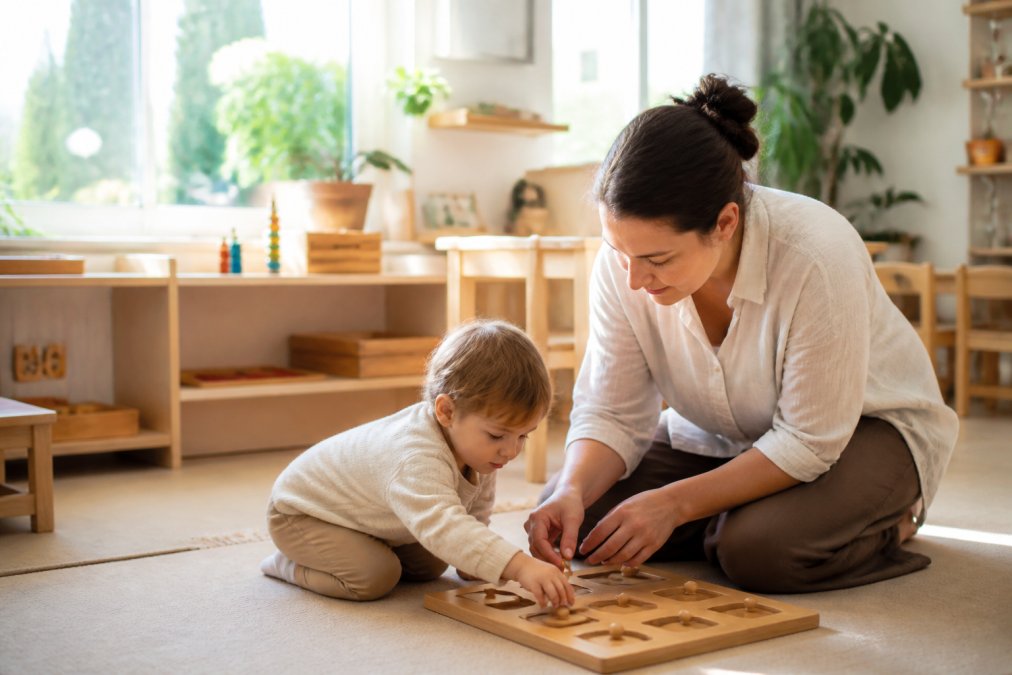
Prepared Environment vs. Atelier and Studio Spaces
The Montessori prepared environment is engineered for independence: child-height shelves, one of each material, everything within reach. The room itself is a teaching tool, and its calm order is deliberate.
Teacher as Observer vs. Teacher as Co-Learner
A Montessori teacher is a facilitator and observer first: they give lessons, then step back, knowing when to intervene and when to stay quiet.
Montessori Toys for 1 Year Olds: What Actually Fits Each Approach
Montessori toys for 1 year olds share a few traits: simple, made of natural materials, and doing one thing well, a wooden object permanence box, nesting cups, a chunky peg board. No flashing lights, batteries, or plastic voices.
Reggio Emilia Project-Based Learning Examples in Practice
Reggio Emilia project-based learning examples tend to start small and run long. A shadow on the wall becomes a weeks-long study of light. A dead bird found on the playground becomes a conversation about life cycles, drawn, sculpted, and revisited.
Here's how a typical project unfolds:
- A child notices something and asks a question
- The teacher brings it to the group and records their theories
- Children test ideas through drawing, building, and talking
- The teacher documents each stage with photos and transcripts
- The class revisits earlier theories and revises them
- Work is displayed publicly for families to see
How to Choose a Preschool Program: A Decision Framework
Learning how to choose a preschool program gets easier when you stop asking which philosophy is better and start asking which fits your child, schedule, and budget. Both produce capable, curious kids on different roads, and the practical differences show up fast in a real classroom.
| If your child... | Lean toward | Because |
|---|---|---|
| Thrives on routine and order | Montessori | Predictable sequence, clear materials, known next step |
| Asks endless "why" questions | Reggio Emilia | Interests drive the curriculum, so questions become the syllabus |
| Works well alone for long stretches | Montessori | Uninterrupted independent work cycles are protected |
| Lights up in group play | Reggio Emilia | Collaborative inquiry is the core, not an add-on |
| Needs clear feedback | Montessori | Self-correcting materials signal errors without an adult |
| Resists being directed | Reggio Emilia | Fewer adult-set expectations, more child-led direction |
| Melts down in loud, busy rooms | Montessori | Calmer, ordered rooms with one of each material |
| Needs to move and touch constantly | Either, watch the room | Both use hands-on work; the question is whether the room tolerates big movement |
What to Ask on a Tour
A tour is a research visit, not a sales pitch. Bring specific questions and listen for specifics in return.
- For a Montessori program: Ask whether the classroom is fully implemented or "Montessori-inspired," how long the uninterrupted work cycle is (authentic programs protect a two- to three-hour block), what happens when a child avoids a curriculum area for weeks, and whether lead teachers hold a recognized Montessori credential.
- For a Reggio-inspired program: Ask how projects start and how long they run, whether the program employs an atelierista or has a dedicated studio, how documentation is shared with families and whether children revisit earlier work, and how teachers decide a project is finished.
- For both: Ask about teacher turnover, class size, and adult-to-child ratios. Ask how they handle a child who doesn't fit the mold. Ask what a typical day looks like from drop-off to pickup, hour by hour.
Red Flags to Watch For
- A Montessori room where all children do the same activity at the same time, that's a worksheet classroom wearing wooden materials.
- A Reggio room where every child's project looks identical, that's a craft week, not inquiry.
- Teachers who can't explain why a material or project is on the shelf today.
- A director who answers every question with a philosophy slogan instead of a classroom example.
- No visible documentation of children's work, or documentation that hasn't changed since your last visit.
The Logistics Nobody Puts in the Brochure
Philosophy is free; preschool is not. Tuition varies enormously by region and program type, and authentic Montessori and Reggio-inspired programs often cost more than conventional preschools due to specialized teacher training and lower ratios. Ask about the annual calendar, holiday closures, sick-day policies, billing schedule, waitlists, sibling priority, and whether the program runs a full or half day, a half-day schedule can quietly become a full-time logistics problem for working parents.
Matching Approach to Your Child's Temperament
Temperament matters more than philosophy on paper. A child who craves order can feel unmoored in a fully emergent room, and a child who bristles at sequence can feel boxed in by a strict Montessori shelf. Neither reaction means the philosophy is wrong, it means the fit is wrong for that child right now.
A Simple Decision Sequence
- List your non-negotiables: schedule, commute, budget, and any learning or sensory needs.
- Shortlist two to four programs that clear those filters, across both philosophies if possible.
- Tour each one and take notes on the same five questions so you can compare apples to apples.
- Ask for a trial day or a parent observation session if the program offers one.
- Trust your read of the adults. A skilled teacher in the "wrong" philosophy beats an unskilled teacher in the "right" one almost every time.
Neurodiversity, Transitions, and Long-Term Outcomes
Most comparisons stop at the classroom door. The questions parents lose sleep over come later: Will this work for my child's brain? What happens if we switch? Does any of this matter ten years from now? Here's what each approach offers on those three fronts, and where the honest answer is "it depends."
Tender Tots Wooden Tool Disassembly →
Neurodiversity and Learning Differences
Neither Montessori nor Reggio Emilia was designed as a special education model, and neither substitutes for individualized services like speech, occupational therapy, or a formal IEP. Each offers a different set of built-in supports, and the fit depends on the child.
Where Montessori tends to help:
- Self-paced mastery lets a child who needs more repetitions get them without standing out, since no one compares progress to a grade-level calendar.
- Self-correcting materials give immediate, non-social feedback, useful for children who find adult correction aversive.
- The calm, ordered environment and predictable sequence can reduce sensory overload.
- Mixed-age classrooms let a child work at their actual level in each subject.
Where Montessori can be hard:
- The emphasis on independent work and long attention spans can be a poor fit for children who need frequent adult co-regulation or struggle with open-ended choice.
- A strict "one material at a time, one child at a time" rule can frustrate children with high movement needs.
- Some programs are rigid about the sequence, which can clash with a child who needs a different entry point.
Where Reggio tends to help:
- The flexible, interest-led structure can engage children who shut down under a fixed sequence, especially children with ADHD who hyperfocus on topics that grab them.
- Project work is naturally multi-modal: drawing, building, talking, moving, and sculpting all count as participation, giving children with language or motor delays multiple ways in.
- Collaboration and small-group work build social scaffolding around a child who needs peer models. These tactile explorations often serve as a foundation for fine motor skills development, a process that can be further supported by choosing the right tools for hands-on play.
Where Reggio can be hard:
- The open-ended, noisy, materials-rich environment can overwhelm children with sensory processing differences.
- Long-term projects with no clear endpoint can frustrate children who need closure and predictability.
- Documentation-heavy classrooms can feel performative to a child who just wants to play without being observed.
Transitioning Between Approaches
Switching from one philosophy to the other is common and usually survivable, but it takes planning. The friction points are predictable.
What helps in either direction:
- Visit the new classroom before the first day, ideally more than once.
- Tell the new teacher what your child is used to, the specific routines, the language, the expectations.
- Keep home routines stable during the transition so the child has one predictable space.
- Give it a full month before judging the fit. The first two weeks are almost always rough.
Long-Term Outcomes: What the Research Actually Shows
Be skeptical of anyone promising a specific result from either philosophy. Both models aim at the same broad goals, intrinsic motivation, executive function, cognitive development, and a love of learning, and the research base for each is real but limited, with many studies small, short-term, or conducted in programs that don't match what's available locally.
What holds up across both approaches:
- Hands-on exploration beats passive instruction for young children's concept learning.
- Mixed-age grouping supports language and social development, especially for younger children.
- Attentive, responsive adults matter more than any specific curriculum label.
- Intrinsic motivation built early tends to persist better than motivation driven by rewards and grades.
Integrating Either Approach at Home
The two approaches blend more easily than the marketing suggests. A phonics poster, a basket of loose parts, a shelf of wooden toys, and an hour of unstructured time cover most of what either philosophy asks for. You don't need to pick a side to give your child the core benefits of both.
Frequently Asked Questions
What is the biggest criticism of the Montessori approach?
Critics say Montessori classrooms can feel too rigid about material use, since children are expected to use each item a specific way. Some parents worry the independent work style limits group collaboration. Others note that quality varies widely because 'Montessori' is not trademarked in the US, so any school can use the name. Checking teacher certification through a recognized training body helps you separate authentic programs from ones using the label loosely.
How does the role of the teacher differ between Montessori and Reggio Emilia?
In Montessori, the teacher acts as a guide who observes each child, presents lessons individually, and steps back so children can work independently with self-correcting materials. In Reggio Emilia, the teacher is a co-learner who documents children's ideas, asks open-ended questions, and builds projects around student interests. Montessori leans toward structured freedom; Reggio leans toward collaborative inquiry where the curriculum emerges from the group.
Is Montessori or Reggio Emilia better for children with ADHD or learning differences?
Neither approach is a treatment for ADHD, but both offer features that can help. Montessori's self-paced mastery and hands-on exploration let children move at their own speed, which suits kids who struggle with sitting still through group lessons. Reggio's project-based learning can work well for children who focus deeply on topics they choose. Ask any preschool how they support individualized instruction and whether staff have training in developmental differences before enrolling.
Can I use Montessori or Reggio Emilia ideas at home, and what toys fit a 1-year-old?
Yes. At home, you can set up a low shelf with a few rotating items, use real wooden objects, and let your toddler choose what to explore. For 1-year-olds, simple wooden toys that invite grasping, stacking, and taking apart build fine motor skills and hand-eye coordination. The Tender Tots Wooden Tool Disassembly Playset ($55.99) is a hands-on option for ages 3 and up, and it fits the Montessori idea of real, open-ended play.