

What Is a Minimalist Baby Registry? 2026 Guide
Table of Contents
- What Is a Minimalist Baby Registry in 2026?
- How to Build a Baby Registry: A Step-by-Step Approach
- Essential Baby Gear for New Parents (and What to Skip)
- Your Minimalist Nursery Checklist
- Eco-Friendly Baby Products 2026: What to Look For
- Common Mistakes That Make a Registry Feel Cluttered
- Frequently Asked Questions
Last Updated: September 30, 2026
What Is a Minimalist Baby Registry in 2026?
A minimalist baby registry is a curated list of only the items a newborn genuinely needs, built to reduce clutter, cost, and decision fatigue rather than to fill a nursery. This guide from Tender Tots & Wellness explains how to build one without missing anything that matters.
Why Parents Are Choosing Less in 2026
Registry overwhelm is the number one complaint new parents raise, and the math explains why: a typical big-box registry checklist runs well past 100 items, most of which go untouched in the first six months.
Three forces are pushing parents toward a shorter list:
- Housing reality. Smaller living spaces leave no room for single-use gear that gets used twice.
- Cost discipline. Fewer, better items beat a house full of duplicates.
- Sustainability. Disposable and short-lived products create waste that parents increasingly want to avoid.
How to Build a Baby Registry: A Step-by-Step Approach
Building a minimalist registry takes about an hour if you follow a simple two-step method: set a hard cap, then filter every item through a multi-use test. The goal is not to guess perfectly, it is to build a list you can defend item by item when a relative asks, "Are you sure you don't want the wipe warmer?"
Step 1: Set a Budget and a Cap on Items
Decide on two numbers before you browse: a total budget and a maximum item count. A working target for most families is 25 to 30 items, weighted toward gear that gets daily use.
Sort your list into three tiers:
- Daily essentials (diapering, feeding, sleep, clothing)
- Weekly essentials (carrier, diaper bag, changing pad cover)
- Nice-to-have (toys, decor, extras)
Step 2: Choose Multi-Functional Gear Over Single-Use Items
Every item on a minimalist registry should do at least two jobs. A structured diaper backpack replaces a purse, a bottle bag, and a wet bag. A cotton changing pad cover doubles as a spare surface for tummy time.

| Item Type | Replaces | Registry Tier |
|---|---|---|
| Structured diaper backpack | Purse, bottle bag, wet bag | Daily |
| Cotton changing pad cover | Disposable pads | Weekly |
| Snap-button onesie | Multiple outfits | Daily |
The Two-Question Test for Every Item
Before an item goes on the list, ask two questions in order:
- Will I use this at least once a week in the first six months? If the honest answer is no, it waits. This is why swings, bottle sterilizers, and wipe warmers rarely survive the filter, they solve problems most newborns don't have.
- Does it replace something I would otherwise buy separately? A sleep sack replaces loose blankets, which are not recommended for infant sleep. A structured diaper backpack replaces a purse, a bottle bag, and a wet bag. If an item does not replace anything, it is an addition, not an essential.
What to Do When Someone Insists on Buying Off-List
Gift-givers often want to buy something memorable rather than practical. Rather than fighting it, redirect them toward categories that scale: diapers in size 1 and 2, fragrance-free wipes, or a contribution toward a larger item like a crib. This keeps the registry short without turning down generosity, and it prevents the duplicate blankets and newborn-sized outfits that pile up unused.
A Realistic Timeline
Most registries are built between 20 and 28 weeks, which leaves time for a shower and for gifts to arrive before the due date. Build the core list first, then add one or two items per week as you research. Adding everything in one sitting is how lists get long, the pause between sessions is what forces the two-question test to actually do its job.
Essential Baby Gear for New Parents (and What to Skip)
The essential baby gear for new parents fits in four categories: diapering, feeding, sleep, and clothing. Everything else is optional.
The Items You Will Actually Use Daily
- Diapering: Changing pad cover, wipes, diaper backpack
- Feeding: Bottles, burp cloths, a spill-resistant bowl for later
- Sleep: Crib, fitted sheets, sleep sack
- Clothing: Snap-button bodysuits and a cotton gift set
For clothing, the Baby Cotton Onesie ($29.99) is a good example of a registry workhorse: 95% cotton, snap closure at the bottom, and legs left free for layering. Sizes run 59cm to 90cm, covering newborn through roughly 18 months.


Your Minimalist Nursery Checklist
A minimalist nursery needs four zones: sleep, diaper changes, feeding, and storage. That's it.
Large Capacity Mummy Baby Backpack →
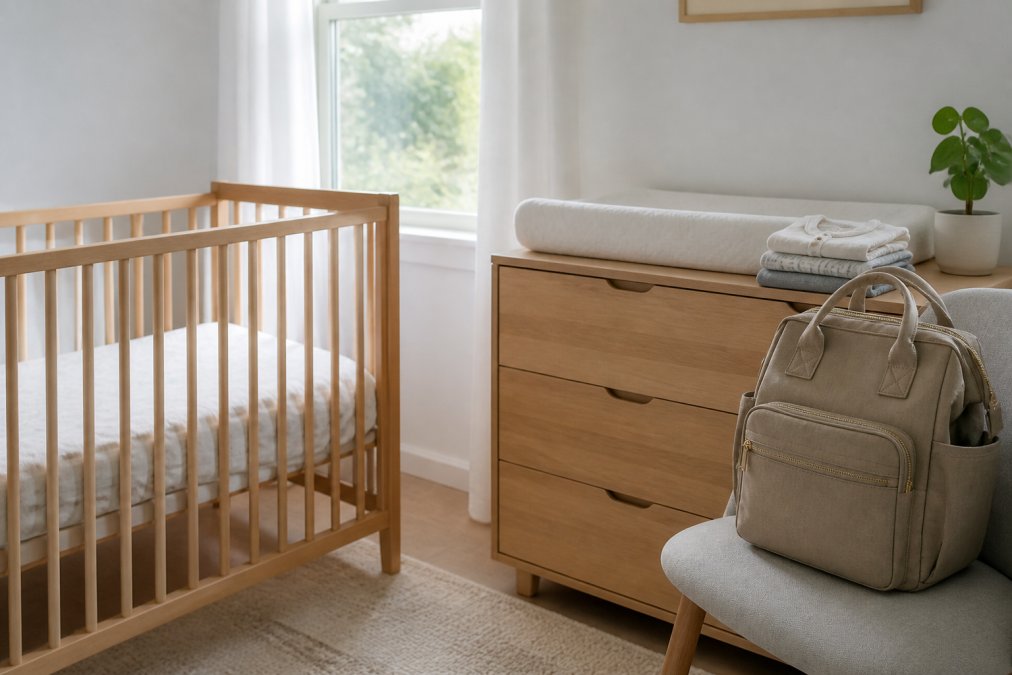
- Crib with fitted sheets
- Changing pad with a washable cotton cover
- Diaper backpack with insulated storage
- 5 to 7 bodysuits in current size
- One sleep sack
- Small storage basket for daily essentials
Eco-Friendly Baby Products 2026: What to Look For
Eco-friendly baby products in 2026 are judged on three things: material, lifespan, and end-of-life. A product made from organic cotton that lasts two years beats a "green" item that wears out in three months.
Look for:
- Fiber content stated plainly. Pure cotton over vague "natural blend" labels.
- Reusable over disposable. Washable covers, cloth wipes, refillable bottles.
- Durability. Gear that survives a second child is the most sustainable option available.
The Angle Most Guides Skip: Recovery and Fit
Sustainability and minimalism both come down to one question, will this item actually get used? For carriers and wearable gear, the answer depends less on the product than on the parent's body and the baby's fit. That is the part most registry guides leave out.
- Baby cries the moment they go in. Often a positioning problem, not a preference problem. Check that the baby's knees are higher than their bottom and that the head is close enough to kiss without leaning down.
- Legs dangle straight down. This usually means the seat is too narrow. A carrier with an adjustable seat panel that widens as the baby grows will keep the legs supported in the recommended spread-squat position.
- One shoulder aches after 20 minutes. The carrier is either too loose or is a one-shoulder design being used for too long. Tighten the straps and switch to a two-shoulder carrier for anything longer than a quick errand.
- Baby overheats. Fabric choice matters more than the carrier style. A breathable cotton or mesh panel is the difference between a 20-minute walk and a 90-minute one in warm weather. For cold weather, the fix is layering over the carrier, not inside it, bulky clothing between the baby and the carrier prevents a snug fit.
Common Mistakes That Make a Registry Feel Cluttered
Most cluttered registries share the same three mistakes, and each one is easy to fix before you publish the list.
A minimalist baby registry works because it forces a decision on every item: daily use, or it waits. That single rule prevents most clutter before it starts.
Frequently Asked Questions
What items are truly essential for a newborn in 2026?
A minimalist baby registry in 2026 typically includes a safe sleep space, a car seat, 8 to 10 bodysuits, a structured diaper bag, feeding supplies, and a few cotton layers. Parents who add multi-use items like a large-capacity diaper backpack with insulated bottle storage get more daily value than those who register for single-purpose gadgets. Skip wipe warmers, bottle sterilizers, and specialty clothing that only fits for a few weeks.
How do I avoid overbuying when creating a baby registry?
Set a hard cap on the number of items before you start adding anything. Group your list into sleep, feeding, diapering, clothing, and travel, then limit each category to three to five entries. Choose multi-functional pieces, such as a diaper bag that works for errands and travel, instead of two separate bags. Review the list after a week and remove anything you cannot explain in one sentence.
What are the benefits of a minimalist approach to baby gear?
A minimalist registry reduces clutter, saves money, and makes the newborn months easier to manage. Fewer items mean less to clean, store, and replace as your baby grows. Parents also report less decision fatigue when every product on the list has a clear purpose. A short, curated registry also helps gift-givers know exactly what you need instead of guessing.
How can I incorporate Montessori principles into my baby registry?
Montessori-inspired registries focus on natural materials, open-ended play, and items sized for your baby's current stage. Choose cotton clothing, simple wooden or fabric toys, and low shelves that let your baby reach what they need. Avoid battery-operated toys that do the playing for your child. A cotton onesie and a cotton newborn gift set fit this approach because they are soft, breathable, and free of loud characters.
Are multi-functional baby products worth the investment?
Yes, when they replace two or more single-use items you would otherwise buy. A diaper backpack with insulated bottle storage, dry and wet separation, and multiple compartments can cover outings, travel, and daycare drop-offs. That said, multi-functional does not mean complicated. If a product takes more than a minute to set up or clean, most parents stop using it within the first month.
What should I prioritize on a minimalist baby registry?
Prioritize safety, daily-use frequency, and durability. A safe sleep space and a properly installed car seat come first. Next, focus on items you will touch every day: bodysuits, a changing pad cover, a diaper bag, and feeding gear. Register for the sizes and quantities that match your baby's first three months, then add seasonal or growth items later once you know what your baby actually needs.
The hardest part of a minimalist registry isn't choosing less, it's trusting that less is enough. Tender Tots & Wellness stocks the daily-use essentials that make a short list work, from a structured diaper backpack with insulated storage to washable cotton changing pad covers and pure cotton clothing sets. Every item is chosen to fit a modern family's needs, with free worldwide shipping and high quality at a fair price. Shop now and build a registry you'll actually use.