

Best Convertible Cribs for Small Apartments: 2026 Guide
Table of Contents
- What to Look for in Convertible Cribs for Small Apartments
- Mini Crib vs Standard Crib: Which Fits Your Space?
- Convertible Crib Dimensions and Room Footprint
- Choosing the Best Convertible Mini Crib
- How Long Can a Child Sleep in a Convertible Crib?
- Conversion Kits, Parts Support, and Total Cost of Ownership
- Apartment Logistics: Delivery, Assembly, and Moving
- Frequently Asked Questions
Last Updated: October 21, 2026
What to Look for in Convertible Cribs for Small Apartments
A convertible crib changes into a toddler bed, daybed, or full-size bed as your child grows. For apartment families, the smartest choice is a compact convertible model with a small footprint, a firm mattress, and a conversion kit you can actually buy later.
The crib itself is rarely the expensive part, the mattress, conversion rails, and replacement parts are where budgets fall apart. Below, we break down how to choose a convertible crib for a tight floor plan, with measured layouts and common mistakes.
Space, Safety, and Conversion Versatility
Start with the room, not the crib. Measure the wall where the crib will sit, subtract the clearance you need to reach the mattress, and only then start shopping. A crib that fits but leaves you unable to lower a sleeping infant without banging your elbow is one you will resent.
Safety comes next, and it is not negotiable. In the United States, cribs sold today must meet the federal safety standard set by the Consumer Product Safety Commission, and full-size cribs must follow the rules laid out in 16 CFR Part 1219, the CPSC full-size crib standard. Look for a Juvenile Products Manufacturers Association certification seal, a firm mattress that fits with no gaps, and adjustable mattress height so you can lower the support as your baby learns to sit and stand.
Then think about versatility. A convertible crib should move through at least three stages, and the conversion kit should be available when you buy, not "someday."
Mini Crib vs Standard Crib: Which Fits Your Space?
A mini crib is the better choice for most apartments: it uses a smaller mattress and takes up noticeably less floor space while still carrying a newborn through the toddler years. A standard crib gives you a longer runway and a wider mattress, but demands more room and a full-size conversion footprint later.
The trade-off is straightforward:
- Mini crib: compact footprint, easier to move between rooms, smaller mattress to buy, shorter usable lifespan before the toddler transition
- Standard crib: more sleeping surface, broader mattress selection, longer use, but it dominates a small room and its full-size conversion needs real floor space
For a studio, one-bedroom, or shared bedroom, the mini crib usually wins. For a dedicated nursery with room to spare, a standard convertible crib makes more sense because the full-size bed stage is genuinely usable.
If you are weighing the best convertible mini crib for a tight room, prioritize models with locking casters and a mattress support that adjusts through at least three heights. Those two features matter more in a small space than decorative details.
Convertible Crib Dimensions and Room Footprint
Here are the numbers that actually decide whether a crib fits in a small apartment bedroom, plus the clearance math most guides skip.
Standard crib footprint. A standard crib is built around a full-size crib mattress, 28 inches wide by 52 inches long. The frame adds a few inches per side, so plan on roughly 30 to 32 inches wide and 54 to 56 inches long, about 11 to 12 square feet before clearance.
Mini crib footprint. A mini crib uses a smaller mattress, commonly around 24 by 38 inches, and the assembled frame typically lands near 26 to 28 inches wide and 40 to 42 inches long. That is roughly 7 to 8 square feet, about a third less than a standard crib. Confirm assembled dimensions on the spec sheet, not the mattress size alone.
The clearance math that matters. Budget for these clearances on top of the footprint:
- Long-side access: at least 24 inches of walking and bending room so you can lower a sleeping infant without contorting.
- Door swing: a standard interior door swings through roughly a 30-to-36-inch arc. Never place a crib inside that arc.
- Closet and dresser clearance: leave enough room to open drawers and closet doors fully; a crib that blocks a drawer is a daily annoyance.
- Heat and cord safety: keep the crib at least a few feet from radiators, space heaters, and any window with blind or curtain cords.
Measured Layouts for Real Apartment Floor Plans
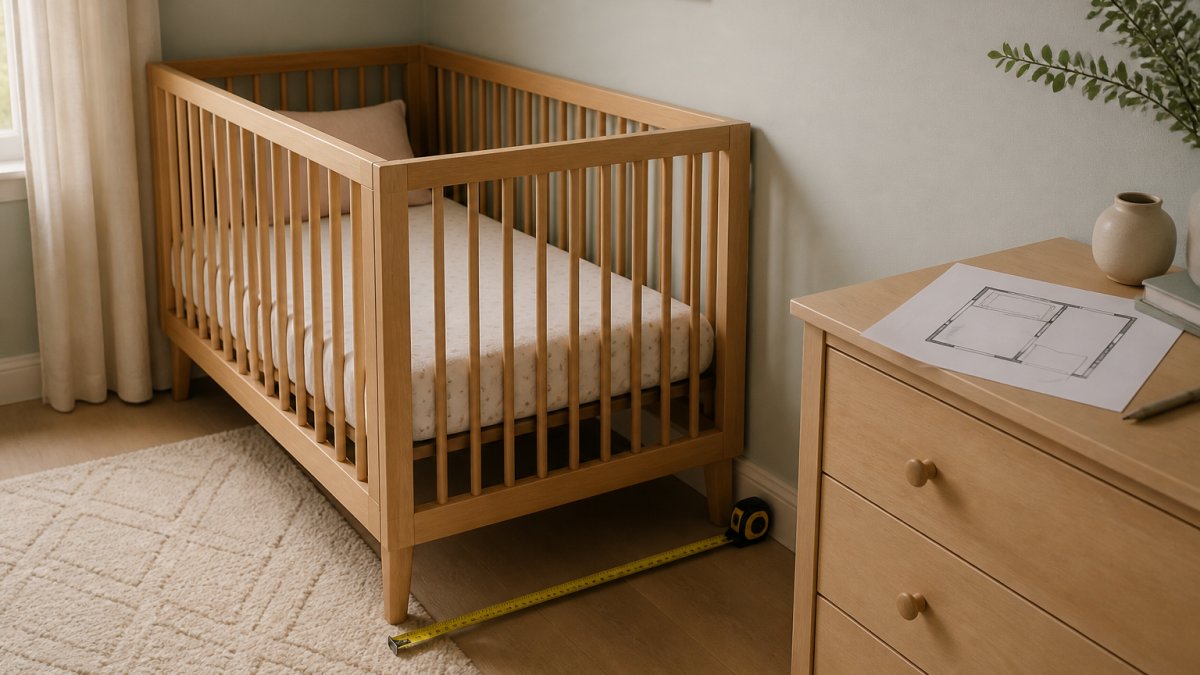
These three layouts use common apartment floor plans and real crib footprints so you can judge fit before you buy.
Layout 2: The shared primary bedroom. In a 12-by-12-foot bedroom with a queen bed (60 by 80 inches), place the crib on the wall opposite the bed. A mini crib against the far wall leaves a clear 3-to-4-foot path for night feeds and keeps the crib out of the door swing.
Layout 3: The studio with a defined sleeping zone. Treat the crib as a zone divider. A mini crib placed perpendicular to the bed, back to the living area, creates a visual boundary without a wall.
Choosing the Best Convertible Mini Crib
The best convertible mini crib for an apartment balances a compact frame with a real conversion path and parts you can still source later. Prioritize:
- Certification and mattress fit. Confirm the crib meets the federal standard and that the mattress sits flush with no gaps.
- Adjustable mattress height. Three positions let you keep the mattress high for a newborn and lower it as your baby pulls up.
- Locking casters. Wheels that lock let you roll the crib between rooms and then fix it in place. In a shared bedroom, this is the difference between convenience and a permanent obstacle.
- Conversion kit availability. Ask directly whether the toddler rail and any bed rails are in stock and how long they will be supported.
- Finish and material. A non-toxic finish and solid wood construction hold up better through multiple stages and multiple children.
One factor to consider is noise. A crib on hard flooring with loose casters can rattle every time you shift it. If the nursery shares a wall with your bedroom or a neighbor, choosing rubberized or locking wheels and assembling it tightly can be helpful.
How Long Can a Child Sleep in a Convertible Crib?
A child can typically sleep in a convertible crib in its crib configuration until roughly 35 inches tall or until they begin climbing out, for many children, between eighteen months and three years. After that, the toddler bed conversion takes over, then the daybed and full-size stages.
The age range depends on the child, not the calendar. Once a child can swing a leg over the rail, the crib stage is over regardless of age. Lower the mattress support as soon as your baby can sit up, and move to the toddler configuration when they start trying to escape.
This is why conversion stages matter in a small apartment: you are buying a piece of furniture that should serve a newborn, infant, toddler, and young child without replacing the whole thing.
Conversion Kits, Parts Support, and Total Cost of Ownership
The total cost of a convertible crib is the crib plus the mattress plus every conversion kit you will need, compare that total, not the sticker price.
Which stages need which parts. A four-in-one convertible crib moves through crib, toddler bed, daybed, and full-size bed. The crib stage needs only the frame and mattress. The toddler bed stage usually needs a toddler rail or guardrail; the daybed stage often reuses it with one side removed.
Build your own cost sheet. Use this structure and fill in the actual prices from the retailer and the manufacturer's parts page:
| Cost Item | When You Pay | What to Confirm |
|---|---|---|
| Crib frame | At purchase | Meets federal safety standard, JPMA seal |
| Mattress | At purchase | Correct size for mini or standard frame, firm |
| Toddler rail | 12-24 months in | Included in box or sold separately; price confirmed |
| Full-size bed rails | 3-4 years in | Available, plus a full-size mattress later |
| Full-size mattress | 3-4 years in | Standard full-size mattress cost |
| Replacement hardware | As needed | Manufacturer parts-support window |
Add the full-size mattress as its own line, a real cost many parents forget, and one that can rival the crib frame itself.
Parts support is the quiet differentiator. Ask the manufacturer two questions: how long do you stock conversion kits for this model, and how long do you support replacement hardware? A crib is only convertible if the parts exist when you need them.
Apartment Logistics: Delivery, Assembly, and Moving
Delivery and assembly trip up more apartment parents than any product feature. Before ordering, measure your building's elevator, stairwell, and doorways and check whether the box will fit. A crib box that will not clear a stairwell turn is a problem no return policy solves gracefully.
Assembly is usually a two-person job. Set aside an evening, lay out the hardware, and follow the instructions in order. Tighten every fitting at the end, then check the mattress support height before first use.
Moving is the other apartment reality. A crib that breaks down flat and stores compactly is worth more to a renter than one with elaborate decorative panels. Keep the hardware bag labeled and taped to the frame so the next move is not a scavenger hunt.
At Tender Tots & Wellness, we offer a curated selection of essential baby gear for modern families: pieces that look good, hold up through the stages, and ship free worldwide. If you are outfitting a small nursery from scratch, we aim to help you sort essential from nice-to-have.
Frequently Asked Questions
Are convertible cribs a good idea for small apartments?
Yes, when you pick the right size. A convertible cribs design lets one frame serve as a crib, toddler bed, and sometimes a daybed or full-size bed, so you avoid buying and storing multiple pieces in a tight space. The trade-off is that conversion kits for the later stages are often sold separately, so confirm availability before you buy. Measure your room first and leave at least two feet of clearance on the sides you use most.
How long can a child sleep in a convertible crib?
Most children use the crib stage until roughly 18 to 24 months, then move to the toddler-bed configuration once they can climb out or reach the height limit. Toddler stage typically lasts until around age 4 or 5, and full-size bed conversions can carry a child through the elementary years. Always follow the manufacturer's weight and height limits for each stage, and lower the mattress support as your child grows.
Are mini cribs safe for newborns?
Yes, provided the model meets current US safety standards and you use the mattress made for that specific crib. Mini cribs use smaller mattresses than standard cribs, so a standard mattress will not fit correctly and creates a gap hazard. Check that the crib is certified and that the mattress is firm and snug with no more than two fingers of space at the edges. Adjustable mattress height helps during the newborn months.
Do convertible cribs save money over time?
They can, but only if you factor in conversion kits. A crib that converts to a toddler bed and full-size bed replaces two or three separate purchases, which matters in a small apartment where storage is limited. Ask whether the guardrail and bed rails are included or sold separately, and confirm the parts are still stocked years later. Total cost of ownership, not the sticker price, is the number that counts.
Choosing a convertible crib for a small apartment is really a test of planning: measure the room, confirm the safety certification, and price out every conversion stage before you buy. Tender Tots & Wellness stocks thoughtfully chosen baby gear with free worldwide shipping, high-quality construction, and a curated mix of timeless and modern design, so outfitting a compact nursery does not mean settling. Shop now and build a nursery that grows with your child instead of crowding it.