

Is an Organic Sleep Sack Worth It for Newborns?
Table of Contents
- What an Organic Sleep Sack Actually Costs (and What You Get)
- Newborn Sleep Sack TOG Rating Guide: Match the Sack to Your Nursery
- GOTS Certified Baby Sleepwear Benefits: What the Label Proves
- Best Organic Sleep Sacks for Newborns: What to Look For
- Is an Organic Sleep Sack Worth It? The Honest Trade-Offs
- How Organic Sleep Sacks Fit Into a Newborn Sleep Routine
- Conclusion
- Frequently Asked Questions
Last Updated: September 26, 2026
What an Organic Sleep Sack Actually Costs (and What You Get)
An organic sleep sack is a wearable blanket made from certified organic fibers, designed to keep a baby warm without the loose bedding that increases sleep risk. Parents asking whether an organic sleep sack is worth it for newborns are really asking: does the material change anything measurable, or are you paying for a label? At Tender Tots & Wellness, the honest answer sits between the two extremes.

Organic vs. Conventional: The Real Price Gap
Conventional cotton sleep sacks sit at the lower end of the market. Organic versions cost more, and that premium comes from three places:
- Certification fees. A GOTS audit isn't free; the certifier charges for the supply-chain inspection, and those costs are amortized into every unit.
- Smaller batch production. Organic cotton is grown on a fraction of conventional acreage, so mills run shorter runs and lose the economies of scale that make conventional knits cheap.
- Farming without synthetic pesticides. Yields are lower and labor costs higher, which shows up in the raw fiber price before the fabric is knit.
What you actually get for the extra money:
- Fiber traceability from farm to finished garment, verified by a third party rather than self-declared
- Lower residue risk on a textile that sits against skin for ten-plus hours a night
- Better durability in many cases, because organic cotton is often processed with fewer harsh finishing treatments
A Break-Even Framework for Budget-Conscious Parents
If budget is the binding constraint, don't default to "organic or nothing." Run this three-question check:
- How many nights will this sack actually be worn? Newborns outgrow the smallest sizes in weeks, so the per-night math is worse than for a 6-12 month size that lasts most of a year.
- Does your baby have a known skin issue? With eczema or a family history of atopic dermatitis, the organic premium buys a lower-residue textile against broken skin, a different calculation than for a baby with no sensitivities.
- Will you pass it down? Organic cotton that holds its shape through repeated washing can go to a sibling or be resold; a sack that pills after ten washes can't. If you plan to reuse, the effective cost per baby drops.
The Sensory Case for Natural Fabrics
Texture matters more than most parents expect. Newborns have a strong startle reflex and immature sensory processing, so fabric feel against skin can affect how quickly they settle.
Newborn Sleep Sack TOG Rating Guide: Match the Sack to Your Nursery
A sleep sack TOG rating measures thermal resistance and is the single most important number on the tag. TOG stands for thermal overall grade, how much insulation the fabric provides. Ignore it and you risk overheating, a known contributor to sleep risk in infants.
| Room Temperature | Recommended TOG | What Baby Wears Underneath |
|---|---|---|
| 75-78°F | 0.5 TOG | Diaper or short-sleeve bodysuit |
| 68-74°F | 1.0 TOG | Long-sleeve cotton bodysuit |
| 61-67°F | 2.5 TOG | Bodysuit plus footie pajamas |
| Below 61°F | 3.5 TOG | Bodysuit plus warm footies |
GOTS Certified Baby Sleepwear Benefits: What the Label Proves
GOTS certification is the Global Organic Textile Standard, the label that actually means something. A GOTS certified garment must contain a minimum percentage of certified organic fibers and meet processing, dye, and wastewater standards across the entire supply chain.
Best Organic Sleep Sacks for Newborns: What to Look For
The best organic sleep sack for a newborn fits snugly at the chest, allows full leg movement, and matches your nursery temperature. Fit and construction matter more than the brand name.
Fit, Zippers, and Safe Sleep
A sleep sack should fit close across the chest so it doesn't ride up over the face, while leaving room at the hips and legs. The International Hip Dysplasia Institute notes that tight swaddling or restrictive leg positioning can affect hip development, so look for a wide, roomy leg area (Hip-Healthy Swaddling).
Check these before you buy:
- Chest fit: snug, no gaping at the neck opening
- Armholes: fitted enough that arms can't slip inside the sack
- Zipper: two-way, with a fabric guard at the top so the pull doesn't touch the chin
- Leg room: wide enough for hips to splay naturally
- No loose bedding: the sack replaces blankets entirely, per American Academy of Pediatrics safe sleep guidance
Washing, Durability, and Long-Term Value
Durability is where organic sleep sacks often win, and it's the angle almost no review covers. Organic cotton is processed with fewer chemical finishes, so these garments tend to hold shape and softness through repeated washing better than heavily finished conventional knits. But "better" isn't automatic, organic fabric has specific failure modes, and how you wash determines whether the premium pays off.
The organic-specific care rules:
Pure Cotton Newborn Baby Gift Set →
- Cold water, always. Hot water shrinks organic cotton faster than conventional because it lacks the anti-shrink resins conventional finishing applies. A sack that fits on night one can be two inches short after a hot wash.
- Skip fabric softener entirely. Softener coats the fibers and reduces breathability, defeating the purpose of a natural-fiber sack, and builds up until the fabric feels slick rather than soft.
- Skip bleach and oxy-boosters. Chlorine bleach is restricted under GOTS because it degrades cellulose fibers. To sanitize, use a fragrance-free detergent and a hot dryer cycle instead.
- Tumble low or line dry. High heat is the fastest way to kill an organic sleep sack. Line-dried fabric feels slightly stiff until worn once, normal for untreated cotton, and it softens with body heat.
- Wash before first use. New organic knits carry sizing and finishing residue from the mill. One wash removes it and pre-shrinks the garment so your size choice holds.
How to test durability before you commit:
- Double-stitched seams at the shoulders and zipper line, single stitching is the first thing to fail
- A zipper with a metal or high-quality resin pull, not a thin plastic one that snaps
- Fabric weight you can feel, a sack that feels paper-thin at the store will feel worse after ten washes
- No loose threads or skipped stitches along the hem
Is an Organic Sleep Sack Worth It? The Honest Trade-Offs
Yes, for most families, if your baby has sensitive skin, if the sack will be used nightly for months, or if you want a verifiable supply chain. No, if budget is the binding constraint and your baby tolerates synthetic blends without issue.
The case for buying organic:
- Certification you can verify, not just a claim on a tag
- Fewer chemical finishes against skin for ten-plus hours a night
- Better wash durability in most cases, which narrows the real cost gap
The case against:
- Higher up-front price
- Fewer print and color options
- No guarantee your specific baby will sleep better in it
How Organic Sleep Sacks Fit Into a Newborn Sleep Routine
A sleep sack works best as one consistent step in a repeatable bedtime sequence. Babies build sleep associations fast, and the sack becomes a cue that sleep is coming.
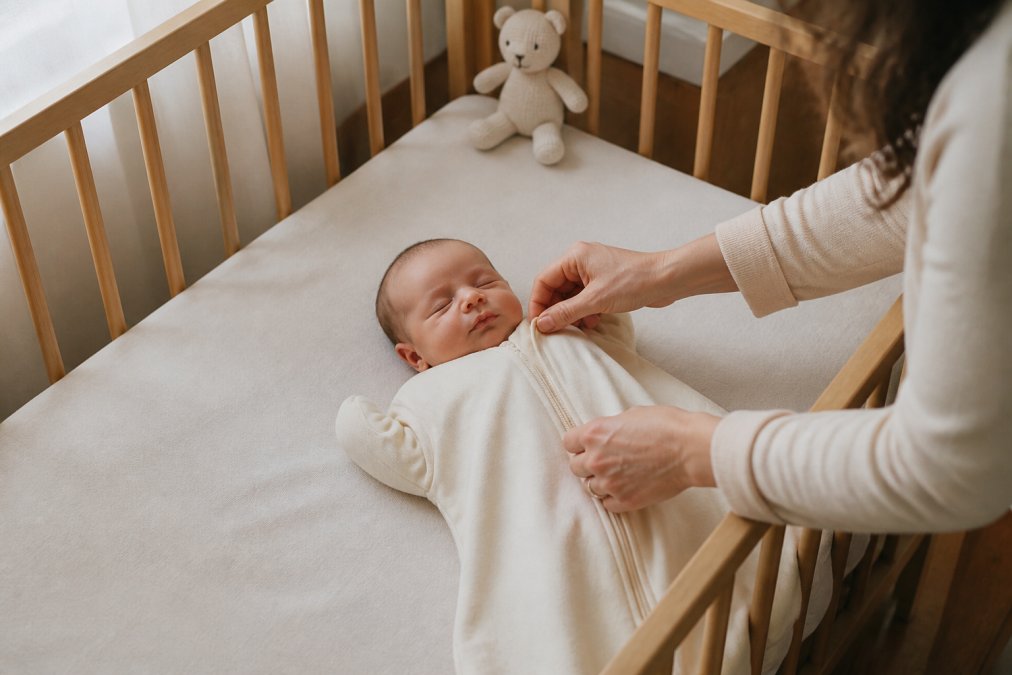
Build the routine in the same order every night:
- Feed and burp
- Diaper change into a fresh cotton base layer
- Dim the lights and lower your voice
- Zip the sleep sack on while your baby is drowsy but awake
- Place baby on their back in the crib
Conclusion
The real challenge with newborn sleep isn't finding a sack, it's cutting through unverified "organic" claims to find one that's actually certified, correctly sized, and matched to your nursery temperature. That's the gap Tender Tots & Wellness was built to close, with a curated selection of baby essentials at fair prices and free worldwide shipping. Start with a GOTS-verified sack in the right TOG for your room, layer it over soft cotton basics, and keep the routine identical every night.
Frequently Asked Questions
Are organic sleep sacks safe for newborns?
Yes. A properly fitted organic sleep sack is a wearable blanket that keeps a newborn warm without loose bedding in the crib, which supports a safer sleep environment. Look for a snug neck opening, arms that fit through armholes, and enough room for hip and chest expansion. Follow safe sleep guidance: place baby on their back, keep the crib free of pillows and blankets, and choose a TOG rating that matches your room temperature so overheating is less likely.
How do I choose the right TOG rating for a newborn sleep sack?
Match the TOG rating to your nursery's room temperature. A 0.5 TOG sack suits warm rooms around 75°F and up, 1.0 TOG fits roughly 68-74°F, and 2.5 TOG works for cooler rooms around 61-67°F. Start with 1.0 TOG for most heated homes, then adjust based on how baby feels at the back of the neck. Pair the sack with footie pajamas or a cotton onesie underneath rather than adding blankets.
Is it worth paying more for GOTS-certified organic baby gear?
GOTS certification verifies organic fiber content, restricted chemical use, and supply chain tracking, so you know the organic claim is real rather than marketing. For newborns with sensitive skin, that matters because the fabric sits against the body all night. The cost gap is real, often 20-40% more than conventional sleep sacks, but a certified sack typically holds up through repeated washing and can be handed down, which spreads the cost over years.
Do organic sleep sacks help babies sleep better?
There is no guarantee a sleep sack makes a baby sleep longer. What a sleep sack does is remove loose bedding and provide consistent warmth, which can reduce wake-ups from temperature shifts or the startle reflex. Organic cotton and bamboo viscose are breathable and moisture-wicking, so babies are less likely to wake up clammy. Pair the sack with a consistent nighttime routine to build sleep associations that support longer stretches.
When should a newborn transition out of a sleep sack?
Most babies move out of a swaddle-style sack around 8-12 weeks, when rolling begins, and out of a regular sleep sack between 18 and 24 months as they learn to use a blanket. Watch for signs like unzipping the sack, climbing out of the crib, or trying to walk in it. At that point, switch to footie pajamas or a toddler sleep sack with legs so movement stays safe.