

Modern Nursery Decor for Small Spaces: 2026 Ideas
Table of Contents
- Why Small Space Nurseries Need a Different Design Approach
- Small Nursery Layout Ideas That Maximize Every Square Foot
- Space-Saving Baby Furniture That Grows With Your Child
- Modern Nursery Decor for Small Spaces: Wall Storage and Vertical Solutions
- Light and Color: Making a Compact Room Feel Bigger
- Minimalist Nursery Organization Systems That Actually Work
- Rental-Friendly and Acoustic Solutions for Apartment Nurseries
- Conclusion: Building a Nursery That Works for Both of You
- Frequently Asked Questions
Last Updated: September 5, 2026
Designing a nursery with a compact footprint requires a shift in thinking. Modern nursery decor for small spaces is a strategy of vertical storage, multi-functional pieces, and a disciplined color palette that makes the room feel expansive. At Tender Tots & Wellness, we curated this guide to help you build a space that is safe for your baby and a calming retreat for you.
The biggest mistake parents make is treating a small nursery like a miniature version of a large one. Instead, rethink the room's architecture entirely. Below, we show you how to prioritize essentials, use vertical space, and select furniture that transitions from infancy to toddlerhood.
Why Small Space Nurseries Need a Different Design Approach
A compact nursery fails when it replicates the floor plan of a larger room (extension.umn.edu). The conventional arrangement of a crib, glider, and bulky dresser does not translate to a room under 100 square feet. The solution is a minimalist ethos where every item serves at least two purposes.
This approach is not just about aesthetics; it directly impacts functionality and safety. According to guidance on safe sleep and nursery setup from the AAP, maintaining a clear, uncluttered space around the crib is essential for reducing risks. By prioritizing visual space and decluttering, you create a calmer environment that supports better sleep for your baby and less stress for you during those 2 a.m. feedings.
Small Nursery Layout Ideas That Maximize Every Square Foot
Start layout planning by focusing on the floor plan before buying anything. The goal is smooth movement and clear sightlines, avoiding the cramped feeling of pushing furniture against every wall. Designate specific zones for sleep, feeding, and dressing, even if they are only a few feet apart.
Crib Placement and the Room's Focal Point
The crib should anchor the room but does not have to dictate the entire layout. Position it against the largest solid wall, away from windows to avoid drafts and direct sunlight, and clear of wall art or cords. This frees the opposite wall for a changing station or low bookshelf.
Creating Zones Without Walls
Instead of physical dividers, use a rug to define the play or feeding zone and lighting to separate sleep from activity areas. A plush rug softens the space for tummy time, while a floor lamp with a dimmer provides ambient light for nighttime feeds. This subtle division keeps the room feeling open and cohesive.
Space-Saving Baby Furniture That Grows With Your Child
Space-saving furniture is the cornerstone of a small nursery, but the key is longevity beyond the infant phase. A crib that converts to a toddler bed is wise, as is a dresser that doubles as a changing table. When you remove the changing pad, the dresser remains useful storage for years.
This aligns with the Tender Tots & Wellness philosophy: high-quality items that blend timeless elegance with modern trends. A neutral, gender-neutral palette will not look out of place as your child grows. Investing in convertible pieces is more economical than buying a single-purpose crib and separate toddler bed, reducing waste and saving floor space.
The 3-Stage Conversion Timeline: From Crib to Big-Kid Bed
The real value of a convertible crib is realized only if you understand the conversion timeline before buying. Most 4-in-1 cribs follow: infant crib (0-15 months) → toddler bed (15 months-5 years) → daybed (5+ years) → full-size bed (with a conversion kit) (cpsc.gov). Check the mattress height adjustment range, a quality crib has at least 3 positions. Converting to a toddler bed requires a separate rail, often sold as an accessory kit. Verify the kit is in stock and will remain available for 5 years. Brands like DaVinci and Graco support older models, while others discontinue kits quickly.
The Dresser-as-Changing-Table Trade-Off
Using a dresser as a changing table is a classic hack, but it has an ergonomic trade-off. A standard dresser is 32-36 inches tall, the correct height, but depth is the issue. Dedicated changing tables are 18-20 inches deep; standard dressers are 16-18 inches. A contoured pad (16-17 inches deep) will overhang a shallower dresser by 1-2 inches. This is acceptable if the pad has a non-slip bottom and you use the safety strap. Safer alternatives: a dresser at least 19 inches deep or a wall-mounted folding station. Measure your dresser depth against the pad before committing.

Modular Furniture Growth Charts: Planning for 24 Months and Beyond
Most guides stop at the toddler bed conversion, but the real challenge comes at age 2-3 when needs shift again. A modular furniture system, where pieces can be reconfigured, solves this. A low, open bookshelf (like the Kallax from IKEA) can serve as toy storage at age 1, a book display at age 2, and a clothing cubby at age 3. Buy pieces not nailed to a single function: a changing table with removable legs becomes a low bench; a glider with a removable ottoman becomes a child's seat. Planning for the 24-month mark avoids buying a second round of furniture outgrown by age 4. Sketch a 3-year floor plan showing where the crib, dresser, and seating will move.
| Furniture Type | Primary Use | Long-Term Use | Space-Saving Benefit | Key Measurement to Check |
|---|---|---|---|---|
| Convertible Crib | Safe sleep for infant | Toddler bed, daybed, full bed | Avoids buying a second bed | Mattress height positions (need 3+) |
| Dresser + Changing Top | Diaper changes | Clothing storage | Removes need for a separate changing table | Dresser depth (need 19+ inches) |
| Modular Bookshelf | Toy and book display | Study and decor storage | Frees up floor space entirely | Shelf height adjustability |
Modern Nursery Decor for Small Spaces: Wall Storage and Vertical Solutions
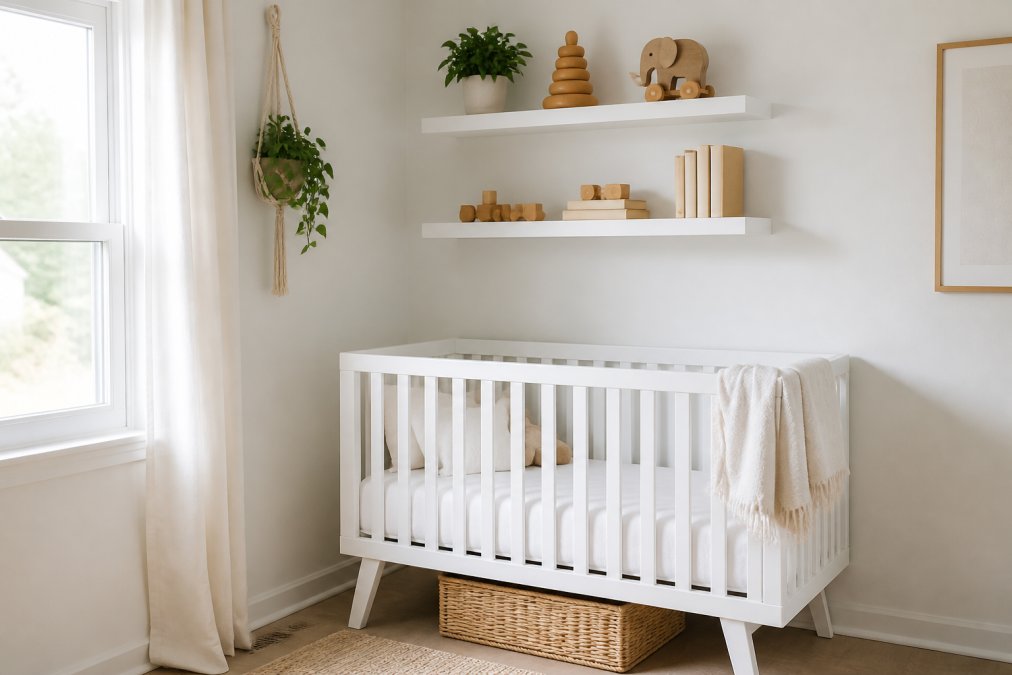
Once the floor is optimized, the walls become your best asset. Wall-mounted storage and floating shelves keep necessities within reach without sacrificing floor area. This vertical strategy draws the eye upward, making the ceiling feel higher and the room more expansive.
Floating Shelves and Wall-Mounted Organizers
Floating shelves display a few curated items, like a wooden toy or small plant, without visual clutter. Store books with covers facing out to encourage early literacy. For pacifiers, lotions, and socks, wall-mounted organizers or fabric bins keep the changing area tidy.

Using Vertical Space for Visual Interest
Vertical space is also a tool for visual interest. Consider a gallery wall that climbs high or a mobile that draws the eye upward. If floor space is short, a hanging book sling in a corner turns an unused nook into a reading station, keeping the floor clear for a play mat or glider.
Light and Color: Making a Compact Room Feel Bigger
Color palette and lighting are the most powerful tools for altering the perception of space. A light, neutral palette, soft whites, warm greiges, or muted pastels, reflects natural light and makes walls recede. Dark, saturated colors absorb light and make a small room feel like a cave.
Layer light with a few key fixtures: an overhead light for general illumination, a soft floor lamp for the glider area, and a wall-mounted sconce above the changing table. This allows you to adjust ambiance for a sleep routine. A dim, warm light signals wind-down time; bright, cool light suits playtime and dressing.
Minimalist Nursery Organization Systems That Actually Work
Minimalist organization is about creating a system that is easy to maintain, not a one-time decluttering session. The core principle is a designated home for every category of item, stored where it is used. This prevents the pile-up of baby gear that overwhelms a small room.
Under-Crib Storage and Multi-Functional Baskets
The space under the crib is prime real estate for storage bins. Use low, flat bins for out-of-season clothing, extra crib sheets, or bulk diapers. In the closet, a hanging organizer with clear pockets sorts socks, bibs, and burp cloths.
A common mistake is buying too many storage containers before sorting the items you actually own. Measure your space, take inventory of your baby essentials, and then purchase baskets and bins to fit that specific list. This prevents you from accumulating containers that simply become clutter themselves.
Rental-Friendly and Acoustic Solutions for Apartment Nurseries
For families in apartments or rentals, restrictions on painting or heavy fixtures are common. Rental-friendly decor uses peel-and-stick wallpaper for an accent wall, tension rods for curtains, and adhesive hooks for lightweight wall art, creating a personalized space without risking your security deposit.
Acoustic management is often overlooked in compact nurseries. Thin walls and hard flooring can make a space echo and startle a sleeping baby. A thick area rug, heavy curtains, and upholstered seating absorb sound. A white noise machine masks sudden sounds from other rooms, a simple solution many parents find essential.
Conclusion: Building a Nursery That Works for Both of You
Designing a small nursery is a balancing act between essential and nice-to-have, but the result is a space that feels intentional and calm. By focusing on vertical storage, multi-functional furniture, and a light color palette, you create a room that serves your baby's needs without overwhelming your living space.
At Tender Tots & Wellness, we understand the challenge of finding baby gear that fits a modern, minimalist aesthetic without sacrificing quality. Our curated selection, from educational toys to soft cotton essentials, complements a functional design and supports your family's well-being. Get started with Tender Tots & Wellness for pieces that blend timeless elegance with the practical needs of your compact nursery.
Frequently Asked Questions
How can I make a small baby room look bigger?
Use a light, neutral color palette on walls and large furniture pieces to reflect natural light. Mount curtains higher than the window frame to draw the eye upward, and choose multi-functional pieces like a dresser that doubles as a changing station. Keep the floor clear by using floating shelves and wall-mounted storage, which opens up visual space and makes the room feel larger.
What are the best space-saving baby furniture options for a compact nursery?
Look for furniture that serves multiple purposes: a crib with built-in drawers, a dresser with a removable changing topper, or a convertible crib that transitions to a toddler bed. Wall-mounted shelving and compact gliders with a smaller footprint also help. A mini crib is a practical choice for the first year if floor space is extremely tight.
What are the modern nursery decor trends for 2026?
The trend for 2026 focuses on warm, organic minimalism with natural wood tones, textured textiles, and muted earth palettes. Gender-neutral themes remain popular, with parents choosing functional decor that grows with the child. Multi-functional furniture and vertical storage solutions are key, as is incorporating educational wall art like the Tender Tots Phonics Learning Posters to blend style with early learning.
What are good small nursery layout ideas for an apartment?
Start by placing the crib against the longest wall, away from windows and radiators for safety and temperature control. Use a room divider or a tall shelving unit to separate the sleep zone from a small changing and feeding area. Maximize vertical storage with wall-mounted shelves and use the space under the crib for bins holding out-of-season clothing or extra diapers.
This article was written using GrandRanker