

Montessori Principles for Early Childhood Development
Table of Contents
- The Core Montessori Principles That Shape Early Learning
- How to Set Up a Montessori Home Environment That Works
- The Benefits of Montessori for Toddlers: What the Science Says
- Choosing Montessori Toys for 1 Year Olds: A Practical Guide
- Freedom Within Limits: Balancing Independence and Boundaries
- Common Misconceptions About Montessori Principles
- Frequently Asked Questions
Last Updated: September 25, 2026
The Core Montessori Principles That Shape Early Learning
Montessori principles for early childhood development rest on a simple but radical idea: children are not empty vessels waiting to be filled, but active builders of their own minds. This guide from Tender Tots & Wellness breaks down the core tenets, from respect for the child to the absorbent mind, and shows how to apply them at home without a teaching credential.
Respect for the Child
Respect for the child means treating even a toddler as a capable individual whose choices, pace, and concentration deserve protection. In practice, this looks like kneeling to eye level, letting a child finish a task without interruption, and offering real choices instead of commands. A common mistake is confusing respect with permissiveness. It is not.
The Absorbent Mind and Sensitive Periods
The absorbent mind is a young child's capacity to soak up language, movement, and order from their surroundings without formal instruction. Montessori identified sensitive periods, windows when a child is especially tuned to acquiring a specific skill such as vocabulary, coordination, or a sense of sequence. Miss the window and learning still happens, but it takes more effort.
How to Set Up a Montessori Home Environment That Works
A Montessori home environment is a space scaled to the child, where everything they need sits within reach and every object has a clear place. You do not need a dedicated playroom or expensive furniture. You need low shelves, a few well-chosen items, and the discipline to keep the space uncluttered.
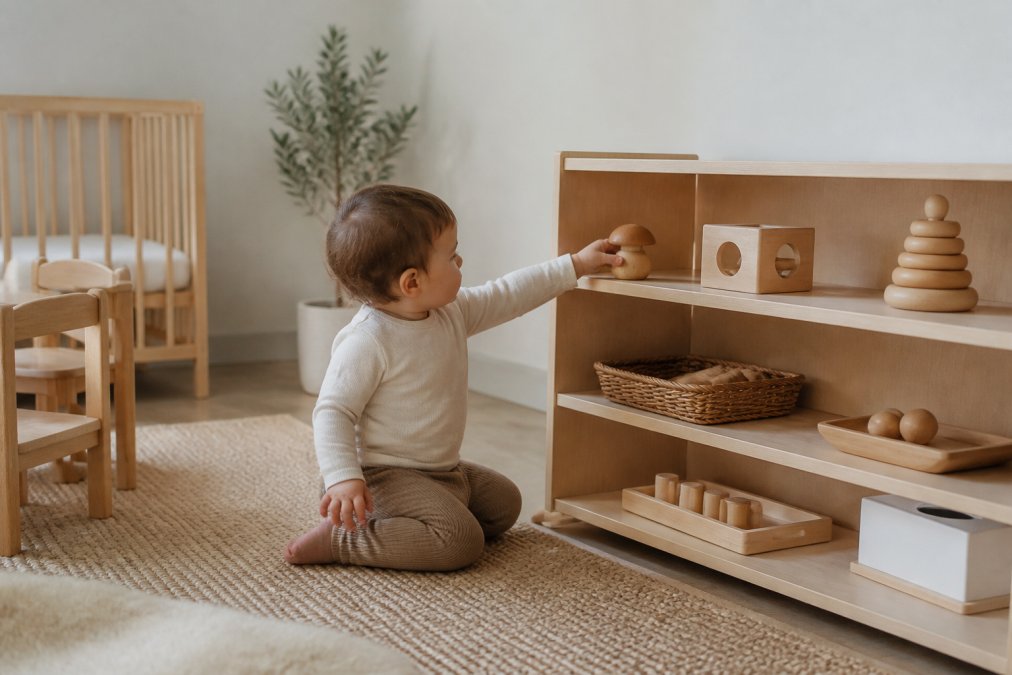
The Prepared Environment at Home
The prepared environment is the deliberate arrangement of space and materials so a child can act independently. Start with these steps:
- Lower shelves to your child's height so they can choose and return toys themselves.
- Rotate a small selection of materials, keeping the rest out of sight to reduce overwhelm.
- Add a child-sized table, chair, and step stool for practical life activities.
- Place a floor bed or low mattress to support independent rest.
- Keep a defined spot for every item so cleanup becomes part of the routine.
The Benefits of Montessori for Toddlers: What the Science Says
Most articles on Montessori principles stay in the realm of philosophy. That is a missed opportunity, because the core principles map cleanly onto what developmental scientists now understand about how young brains are wired. Below is a principle-by-principle translation, with the mechanisms that explain why the method works, and where the evidence is still catching up.
Self-directed activity and the developing prefrontal cortex
The prefrontal cortex, the region responsible for planning, working memory, and impulse control, develops rapidly between ages 1 and 5. It is also the region most responsive to "serve and return" interaction, back-and-forth exchanges where a child initiates and an adult responds. When a toddler chooses a pouring activity, repeats it, and self-corrects, they are running that loop independently.
The absorbent mind and sensitive periods, revisited
Montessori's sensitive periods align with what researchers call "windows of heightened plasticity." Language acquisition is the clearest example: infants discriminate sounds from every language, then prune the ones they do not hear. By around 12 months, that discrimination narrows. The practical takeaway is not to drill flashcards but to saturate the environment with rich, varied language, narration, songs, conversation, during the window when the brain is most receptive.
Executive function: the outcome parents actually care about
Executive function is the umbrella term for working memory, cognitive flexibility, and inhibitory control. It predicts school readiness better than IQ in many studies. Montessori practices that build it include:
- Choice within limits, the child decides what to do, which exercises decision-making and self-regulation.
- Multi-step practical life tasks, carrying a tray, pouring water, wiping a spill, require sequencing and error correction.
- Peer modeling in mixed-age groups, younger children watch older ones, and older children practice explaining, which reinforces their own understanding.
Social-emotional intelligence
Respect for the child is not just a nicety; it is a social-emotional intervention. When an adult kneels to eye level and waits for a toddler to finish a thought, the child learns that their inner world is legible and worth attending to. Over time, that becomes the foundation for empathy and self-advocacy. Mixed-age groupings add another layer: a 4-year-old who helps a 2-year-old put on shoes is practicing perspective-taking in a way no adult-led lesson can replicate.
Where the science is still catching up
It is worth being honest: Montessori is not a monolith, and study quality varies. Some research compares Montessori students to conventional peers and finds advantages in reading, math, and social skills; other studies find smaller effects or none. The most defensible claim is that the principles align with well-established developmental mechanisms, not that Montessori is uniquely proven.
Choosing Montessori Toys for 1 Year Olds: A Practical Guide
Most guides to Montessori toys for 1 year olds turn into shopping lists. That misses the point. The principles, respect, the absorbent mind, the prepared environment, freedom within limits, should drive what you buy, not the other way around. This section translates those principles into selection criteria, then shows how to apply them at home without spending much.
What makes a toy "Montessori", the four criteria
A toy earns the label when it satisfies four conditions:
Tender Tots Wooden Tool Disassembly →
- Single clear purpose. A stacking ring set teaches size and sequence. A battery-powered toy that sings, lights up, and moves teaches the child to watch, not act.
- Realistic and proportional. A wooden banana that looks like a banana supports the absorbent mind's drive for order and reality. A purple elephant that talks does not.
- Self-correcting. The toy should tell the child when they have it wrong. A knobbed puzzle piece that only fits one way does this without an adult saying "no."
- Open-ended within limits. The child chooses how to use it, but the material itself sets the boundary. A set of wooden blocks can become a tower, a road, or a house, but it cannot become a screen.
Matching toys to sensitive periods at 12-24 months
At this age, three sensitive periods dominate:
- Movement and coordination. Push-and-pull toys, a low step stool, and a small wheelbarrow build gross motor control. Fine motor work includes grasping, transferring, and posting objects through holes.
- Language. Board books with real photographs, a basket of familiar objects to name, and simple songs. Avoid electronic "learning" toys that speak in synthetic voices; the child's brain is tuned to human prosody.
- Order and sequence. A shape sorter, a nesting cup set, and a simple routine chart. The child is building an internal map of how the world is arranged.
A concrete starter set (and what to skip)
You do not need a dedicated playroom. A low shelf with five to seven items is enough. A practical starter set for a 1-year-old:
- A wooden object permanence box (ball drops through a hole and reappears)
- A set of three to five nesting or stacking pieces
- A small basket of board books with realistic images
- A posting toy with large knobs
- A set of two or three simple musical instruments (shaker, drum, xylophone)
- A push-along walker for children already pulling up
The prepared environment at home, on a budget
A prepared environment is not a purchase; it is an arrangement. Three low-cost moves:
- Lower the shelf. A $20 cube shelf from a discount store works as well as a branded one. What matters is that the child can reach and return items independently.
- Rotate, do not accumulate. Keep six to eight items visible; store the rest. Rotate every one to two weeks. This preserves novelty and keeps concentration high.
- Define a work space. A small rug or a low table signals "this is where we focus." The boundary itself is a limit that supports freedom.
The trade-off most guides avoid
Montessori materials are often more expensive upfront than plastic alternatives. A wooden object permanence box can cost $25-$40, while a plastic equivalent might be $10. The argument for the wooden version is not aesthetics; it is that natural materials provide richer sensory feedback (weight, temperature, grain) and tend to last through multiple children. If budget is tight, prioritize self-correcting and open-ended items over branded sets.
Freedom Within Limits: Balancing Independence and Boundaries
Freedom within limits is the balance that makes Montessori work: the child chooses what to do, but the boundaries of safety, respect, and order stay fixed. A child may pick any activity on the shelf, but they may not throw it or use it to hurt someone. This structure gives agency without chaos. The limit is not a punishment; it is the frame that makes real freedom possible.
Common Misconceptions About Montessori Principles
The biggest misconception is that Montessori means no structure. In reality, the method is highly structured, just child-led rather than adult-led. Another myth is that it only works in a classroom. Parents apply Montessori principles at home every day through practical life activities, order and routine, and observation. A third misconception is that Montessori toys must be expensive.
Frequently Asked Questions
What are the 5 principles of Montessori?
The five core principles are respect for the child, the absorbent mind, sensitive periods, the prepared environment, and self-directed activity (auto-education). These principles work together to create a learning approach that follows the child's natural development. Respect means treating children as capable individuals. The absorbent mind describes how young children soak up knowledge from their surroundings. Sensitive periods are windows when learning specific skills comes easily. The prepared environment supports independence, and self-directed activity lets children learn through hands-on exploration.
How do Montessori principles support early childhood development?
Montessori principles support development by matching learning experiences to a child's natural stages of growth. During sensitive periods for language, order, and movement, children are ready to absorb specific skills. The prepared environment gives them freedom to practice practical life activities, building fine motor skills, concentration, and independence. Research on executive function shows that child-directed learning with gentle scaffolding strengthens cognitive growth and intrinsic motivation. Multi-age grouping also supports social-emotional learning as younger children observe and learn from older peers.
How can I apply Montessori principles at home with my toddler?
Start by setting up a prepared environment with child-sized furniture, low shelves for toys, and accessible practical life materials like a small pitcher for pouring. Offer a few Montessori toys for 1 year olds at a time, such as wooden blocks or a simple shape sorter, and rotate them weekly to maintain interest. Allow freedom within limits: your toddler can choose activities but must follow simple ground rules. Observe your child's interests and sensitive periods, then provide materials that match. Include your toddler in daily tasks like wiping spills or putting away toys to build independence and agency.
What is the difference between traditional and Montessori education?
Traditional education often uses teacher-led instruction with set schedules and uniform lessons for all children. Montessori education emphasizes child-directed learning, where children choose activities from a prepared environment and learn at their own pace. In a Montessori classroom, you'll see multi-age groupings, hands-on sensorial materials, and self-correction built into the materials. The teacher acts as a guide and observer rather than a lecturer. Assessment happens through observation and portfolio work, not tests. Both approaches aim to educate, but Montessori prioritizes independence, intrinsic motivation, and holistic development.
What are the key areas of the Montessori curriculum for infants?
For infants, the Montessori curriculum focuses on five key areas: practical life (simple self-care and care of environment), sensorial exploration (textures, sounds, tastes), language (naming objects, songs, conversation), movement (grasping, crawling, pulling up), and social-emotional learning (respectful interactions, bonding). Materials are chosen to support developmental milestones like fine motor skills and spatial reasoning. Safe, natural materials such as wooden toys and soft fabrics allow mouthing and exploration. The goal is to support the absorbent mind during this critical period of rapid brain growth.
Are Montessori toys worth the investment for a 1-year-old?
Montessori toys for 1 year olds are designed to match developmental needs, so they tend to hold a child's attention longer than battery-operated alternatives. They encourage active exploration, problem-solving, and concentration. Because they are often made from durable, eco-friendly materials like wood, they can last through multiple children. The key is choosing open-ended toys that allow for multiple uses, such as stacking blocks or a wooden tool playset. These toys support fine motor skills and cognitive growth without overstimulation, making them a practical addition to a prepared environment.