

Safe Eco Friendly Toys for Toddlers: A Parent's Guide
Table of Contents
- What Makes a Toy Eco-Friendly and Safe for Toddlers?
- Materials to Look For and Avoid in Toddler Toys
- CPSC Toy Safety Guidelines for Parents: What to Check
- Our Top Picks: Safe Eco Friendly Toys for Toddlers
- Non-Toxic Wooden Toys for Toddlers: Why Wood Wins
- How to Choose Safe Toys for Toddlers: A Simple Checklist
- What About End-of-Life? Disposal and Recycling
- Final Thoughts: Building a Safer Playroom
- Frequently Asked Questions
Last Updated: September 9, 2026
Choosing safe eco friendly toys for toddlers feels like a minefield. Every package promises "natural" or "green," yet the fine print often hides plastics, glues, and paints you wouldn't want near your child. At Tender Tots & Wellness, we curate Montessori-inspired playthings, so we separate genuine quality from marketing fluff.

Safe eco friendly toys for toddlers boil down to a few verifiable factors: the raw materials, the finishes, and the third-party testing behind them. Below, we'll walk through the core checklist, share our top picks, and give you a simple framework for the store or online.
What Makes a Toy Eco-Friendly and Safe for Toddlers?
An eco-friendly toy is made from renewable or recycled resources without toxic chemicals, designed to withstand years of play rather than ending up in a landfill after a week. For toddlers, safety adds another layer: no small parts, no sharp edges, and no finishes that can chip off into little mouths.
Eco-friendly toys are those produced from sustainable materials with minimal environmental impact, using non-toxic finishes and ethical manufacturing processes. When shopping, look for three things: the base material, the finish or coating, and the assembly method. A toy can be made of wood but still fail the safety test if it uses solvent-based varnishes or formaldehyde-heavy glues. Solid wood with water-based finishes remains the gold standard.
Materials to Look For and Avoid in Toddler Toys
The material itself is only half the story; the certifications attached to it are the verifiable proof that the material was sourced and processed safely. Here is a deeper look at what each material means for a toddler and the labels that confirm its safety.
Solid Hardwood: The Gold Standard, But Not All Wood Is Equal
Solid hardwood like maple, beech, or rubberwood is the preferred base: it's dense, durable, and free of the plasticizers found in flexible plastics. However, the wood's origin and finish are where safety issues arise.
- The FSC Label: The Forest Stewardship Council (FSC) certification is not about toxicity; it's about responsible forestry. While it doesn't guarantee a toy is non-toxic, it does ensure the raw material came from a forest managed to strict environmental and social standards. For a truly eco-friendly choice, this is a non-negotiable baseline.
- The Finish Is the Real Test: The wood is safe, but the paint or varnish is what a toddler will mouth. You are looking for finishes that are explicitly labeled water-based and non-toxic. Many manufacturers use a simple beeswax or plant-based oil finish, which is ideal. If a product page doesn't specify the finish, treat that silence as a red flag. A common pattern is for cheaper imports to use a lacquer that may contain heavy metals as drying agents.
- The GREENGUARD Angle: While more common on furniture, some wooden toys carry the GREENGUARD Gold certification. This third-party standard tests for over 10,000 chemicals and volatile organic compounds (VOCs) to ensure a product has low chemical emissions. If you have a toddler with sensitivities or asthma, this is a label worth prioritizing over a generic "natural" claim.
Organic Cotton and Bamboo: Softness and the Hidden Glue Problem
For fabric toys, organic cotton is the clear winner over conventional cotton, one of the most pesticide-intensive crops grown. The Global Organic Textile Standard (GOTS) is the gold-standard certification. It verifies that the cotton is organic and that the entire supply chain meets strict environmental and social criteria, with the final product free of toxic heavy metals and formaldehyde.
Bamboo is trickier. Most "bamboo" toys are actually made from bamboo pulp processed into viscose or rayon, which requires heavy chemical processing. If choosing bamboo, look for solid bamboo pieces. The primary safety concern is the glue used to laminate layers; ensure the product specifies a non-toxic, water-based adhesive.
The Avoid List: Why PVC and Unknown Plastics Fail the Test
The avoid list is short but absolute. PVC (polyvinyl chloride) is the most problematic plastic in the toy industry. To make it soft and flexible, manufacturers add plasticizers called phthalates. The CPSC has permanently banned several specific phthalates (like DEHP, DBP, and BBP) in child care articles, but the safest approach is to avoid PVC entirely (cpsc.gov).
Beyond PVC, the issue with generic "plastic" is the lack of transparency. A toy might be made from polypropylene (PP) or polyethylene (PE), which are generally considered safer, but without a label, you cannot be sure. If a toy is plastic, it must explicitly state the type and confirm it is BPA-free, phthalate-free, and lead-free. If it just says "plastic," it is a gamble you should not take with a toddler.
CPSC Toy Safety Guidelines for Parents: What to Check
The Consumer Product Safety Commission (CPSC) is the primary federal agency overseeing toy safety in the United States. Its authority comes from the Consumer Product Safety Improvement Act (CPSIA) of 2008. Here is what the law requires, what it misses, and how to use it as a parent.
The Legal Baseline: CPSIA and Third-Party Testing
The CPSIA mandates that all toys designed for children 12 and under must undergo third-party testing by a CPSC-accepted laboratory before they can be sold. This testing verifies compliance with specific limits for:
- Lead: The limit for paint and surface coatings is 90 parts per million (ppm), and for accessible substrate materials (the plastic or wood underneath), it is 100 ppm.
- Phthalates: Eight specific phthalates are permanently banned in concentrations greater than 0.1% in child care articles.
- Mechanical Hazards: This includes testing for small parts, sharp edges, and other physical dangers.
This legal framework is your first layer of protection. If a toy is sold in the U.S., it has legally passed these tests. However, this baseline only covers a narrow set of known hazards. It does not test for the hundreds of other chemicals that could be present in a toy's finish or plastic.
ASTM F963: The Voluntary Standard That Is Now Mandatory
While the CPSIA sets the legal floor, the ASTM F963 standard is the comprehensive technical specification for toy safety. Since 2017, the CPSC has incorporated ASTM F963 into its mandatory regulations (federalregister.gov). It covers everything from the sound pressure level of toy rattles to the torque and tension required to pull apart a toy's parts.
When you see "ASTM F963" on a package, it signals that the toy has been tested against this rigorous, multi-point standard. For a parent, this is a more meaningful indicator than a generic "CE" mark. Look for the ASTM F963 designation on the packaging or product page; it is the single most important safety label you can verify.
How to Use the CPSC Recall Database Effectively
Even with mandatory testing, recalls happen. The CPSC maintains a publicly searchable database of recalled products. A quick search before a purchase takes seconds and can catch issues that slipped through initial testing.
- What to Search: Go to the CPSC's recall search tool and type in the toy's name, brand, or model number.
- What to Look For: Pay attention to the reason for the recall. Common issues include choking hazards discovered after a child's incident, excessive lead levels found in a specific batch, or a manufacturing defect that creates sharp edges.
- A Practical Pattern: Many parents check for recalls only when they hear about a high-profile incident. A more effective habit is to check the database every few months for any toys you already own, as recalls are often issued months after a product has been on shelves.
The Gap in the Law: What the CPSC Does Not Cover
The CPSC's regulations are robust for mechanical hazards and a short list of chemicals, but they are not a comprehensive health screen. The law does not require testing for the full universe of potential endocrine disruptors or carcinogens. This is precisely why the material choices discussed earlier matter so much. By choosing solid wood with a water-based finish, you are actively avoiding the entire class of unknown chemical risks that the CPSC does not yet regulate.
Our Top Picks: Safe Eco Friendly Toys for Toddlers
We offer a curated selection of safe eco-friendly toys for toddlers that combine genuine eco-friendly construction with the kind of open-ended play toddlers crave. Here are some of the safe eco-friendly toys for toddlers we recommend most.
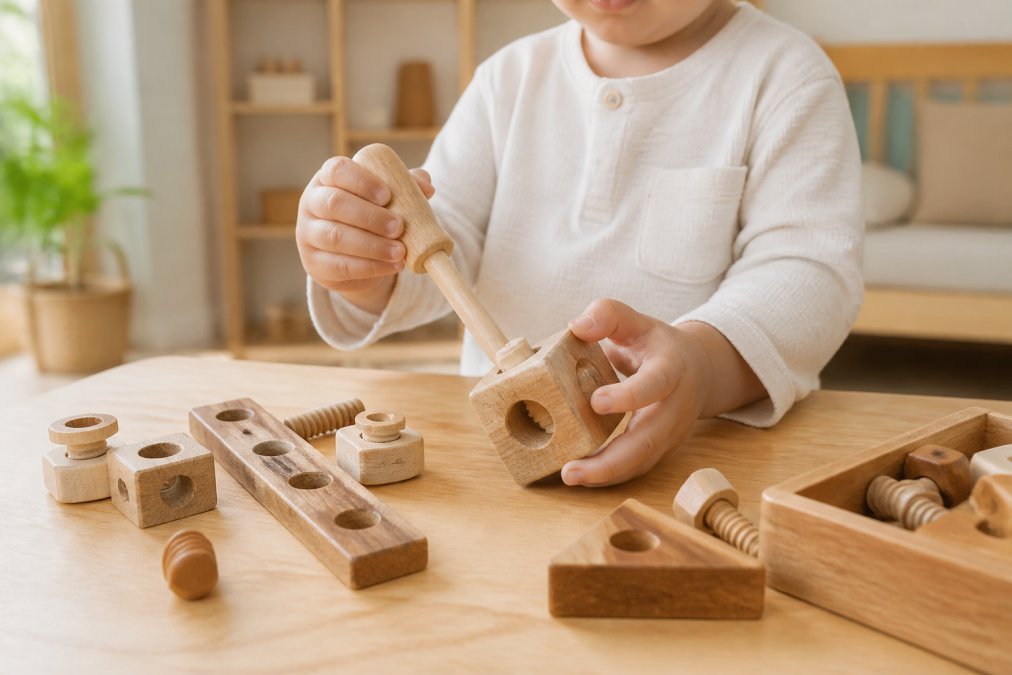
Tender Tots Wooden Tool Disassembly Playset
The Tender Tots Wooden Tool Disassembly Playset at $55.99 is a screen-free building set that lets little engineers take apart and reassemble pieces just like a real toolbox. The smooth wooden pieces are gentle on small hands, and the realistic tool simulation fuels imaginative pretend play while building fine motor skills and hand-eye coordination. Designed for ages three and up.
The disassembly and reassembly cycle gives toddlers a satisfying cause-and-effect loop, and the natural wood aesthetic fits a minimalist nursery far better than loud primary-colored plastic.
WordWise Blocks and Phonics Learning Posters
For early literacy, the WordWise Blocks set at $25.00 pairs colorful wooden blocks with 40 activity cards for hands-on spelling and word recognition. The sturdy, eco-friendly wooden construction ensures durability, and the interactive format keeps toddlers engaged far longer than flashcard drills alone. It's a smart complement to the Phonics Learning Posters set at $12.33.


Talking Flash Cards and Dinosaur Assembly Set
The Talking Flash Cards learning machine at $22.05 reads cards aloud, helping children connect words with sounds through repetition. It's lightweight and portable, ideal for car rides or waiting rooms. For STEM-minded families, the Kids Electric Drill 3D Puzzle Dinosaur Assembly Toy Set at $37.90 lets children aged four and up assemble their own dinosaur with a child-friendly drill.
Non-Toxic Wooden Toys for Toddlers: Why Wood Wins
Solid wood outperforms plastic on nearly every metric that matters for toddler toys. It's naturally non-porous when sealed properly, resisting bacteria better than fabric or unfinished surfaces. It doesn't leach plasticizers or require the chemical stabilizers found in many plastics. And when a wooden toy finally reaches the end of its life, it biodegrades rather than sitting in a landfill for centuries.
A well-made wooden toy can survive generations of rough play, while plastic equivalents often crack, chip, or break within months. That longevity translates directly to value: spending more upfront on a wooden toy frequently costs less per year of use than replacing cheap plastic versions repeatedly.
How to Choose Safe Toys for Toddlers: A Simple Checklist
You don't need to become a materials scientist to shop safely. This checklist condenses everything above into five quick checks you can run on any toy, whether in a store or scrolling on your phone.
- Check the base material. Solid wood, organic cotton, or bamboo? If it's plastic, verify it's free of PVC, BPA, and phthalates.
- Verify the finish. Water-based, non-toxic paint or varnish? The product page should say so explicitly.
- Look for third-party certifications. FSC for wood, GOTS for fabric, ASTM F963 compliance for safety.
- Confirm the age rating. For toddlers under three, ensure no small parts that could pose a choking hazard.
- Search for recalls. A quick check on the CPSC recall database takes seconds and catches known issues.
This framework works because it focuses on verifiable facts rather than vague "natural" labeling. If a manufacturer can't answer these basic questions, that silence tells you everything you need to know.
What About End-of-Life? Disposal and Recycling
Solid wood toys that are still in good condition deserve a second life: pass them to a younger sibling, donate them to a local preschool or daycare, or sell them through a consignment shop. Their durability makes them excellent candidates for resale, which is itself a sustainable act.
For toys that are genuinely worn out, disposal requires a bit of thought. Unfinished or water-based finished wood can go in your compost bin or green waste collection, since it will break down naturally. Toys with painted finishes should go in regular trash, as the coatings may contain trace metals. The EPA's guide on reducing waste from children's products recommends checking with local recycling programs, since some municipalities accept wooden toys through specialized collection events. Plastic toys, even "plant-based" bioplastics, generally can't go in curbside recycling, so confirm with your local facility before assuming they're recyclable.
Final Thoughts: Building a Safer Playroom
Building a safe, eco-conscious playroom isn't about buying everything at once. It's about making better choices one toy at a time, prioritizing natural materials, transparent manufacturing, and open-ended play that supports your toddler's development. Start with the checklist above, replace the most questionable plastic items first, and let quality guide your future purchases.
Finding safe eco friendly toys for toddlers requires more effort than grabbing the brightest box on the shelf, but the payoff is worth it: fewer toxins, less waste, and toys that actually support how young children learn. At Tender Tots & Wellness, we've done the vetting for you, curating Montessori-inspired, non-toxic wooden toys and learning tools that blend timeless elegance with modern trends at fair prices. Shop our collection today and build a playroom you can feel good about, with free worldwide shipping on every order.
Frequently Asked Questions
What makes a toy eco-friendly and safe for toddlers?
An eco-friendly toy is made from sustainable or renewable resources like wood, organic cotton, or bamboo, and uses non-toxic, water-based finishes. It is safe when it meets CPSC toy safety guidelines for parents, meaning it has no small parts that pose a choking hazard for children under 3, and is free from harmful chemicals like BPA, phthalates, and lead. Look for clear labeling and third-party certifications to confirm these claims.
Are wooden toys safer than plastic toys for toddlers?
Generally, yes. Non-toxic wooden toys for toddlers are often safer because they avoid the BPA, phthalates, and PVC found in some plastics. High-quality wood is durable and won't shatter into sharp pieces like brittle plastic can. However, you must still check that the toy is solid, has no splinters, and uses water-based, non-toxic paints and finishes. Always verify the toy meets current CPSC safety standards.
How do I identify non-toxic materials in children's toys?
Start by reading the label. Look for terms like 'BPA-free', 'phthalate-free', and 'PVC-free'. Choose toys made from solid sustainable wood with water-based finishes rather than varnishes. Be wary of strong chemical smells, which can indicate toxic coatings. For peace of mind, buy from brands that transparently state their materials and safety testing. Our wooden playsets, for example, use smooth, child-safe wood and non-toxic paints.
Do eco-friendly toys meet CPSC safety standards?
Yes, they absolutely can and should. The CPSC sets mandatory safety requirements for all children's toys sold in the US, regardless of the material. Eco-friendly toys must pass the same rigorous tests for choking hazards, sharp edges, and toxic substances as any other toy. When you see a CPSC-compliant label on a wooden or organic toy, it confirms that the product is both safe and environmentally responsible.