

Why Choose Wood Over Plastic Toys: A Parent's Guide
Table of Contents
- Why Wood Over Plastic Toys Matters for Your Child
- Durability and Longevity: Wood Toys Built to Last
- Safety and Non-Toxic Toy Safety Standards
- Benefits of Open-Ended Play With Wooden Toys
- Environmental Impact and Sustainability
- How to Build a Montessori Playroom With Wood Toys
- Sensory Development and Tactile Feedback
- Wood vs. Plastic: Direct Comparison
Last Updated: August 24, 2026
Why Wood Over Plastic Toys Matters for Your Child
When you're shopping for toys, the choice between wood and plastic feels like it should be simple. It's not. At Tender Tots & Wellness, we've watched parents wrestle with this decision for years, often defaulting to whatever's cheapest or most available. But the research and real-world experience tell a different story. The materials you choose in those early years shape not just how your child plays, but how their brain develops, what they're exposed to chemically, and whether those toys will still be around for their younger sibling, or grandchildren.

Why choose wood over plastic toys? The answer goes deeper than aesthetics. Wooden toys offer durability that plastic simply can't match, they eliminate exposure to synthetic chemicals like BPA and phthalates, and they support the kind of open-ended, imaginative play that developmental experts agree builds stronger cognitive skills. Beyond the immediate benefits, there's the environmental calculus: wood toys biodegrade; plastic accumulates in landfills for centuries.
This isn't about judgment. It's about understanding what you're actually buying and why it matters. Below, we'll walk through the specific advantages, show you how wood toys compare directly to plastic, and give you practical guidance on building a playroom that grows with your child.
Durability and Longevity: Wood Toys Built to Last
A wooden toy that survives five children and then gets passed to a friend's grandkid isn't rare, it's the norm. Plastic toys, by contrast, typically crack, fade, or break within two to three years of active play.
The reason comes down to material science. Wood is dense and naturally resilient. When a toddler throws a wooden block, it absorbs impact without shattering. Plastic is engineered to be lightweight and affordable, which means it's also brittle. UV exposure degrades plastic over time, causing discoloration and structural weakness. Wood ages gracefully, it might get scuffed, but those marks become part of its character.
Here's what this means practically: a wooden toy you buy today might cost more upfront, but the cost-per-use over five or ten years becomes dramatically lower than replacing plastic toys every couple of years. A wooden puzzle that costs $30 and lasts through three children works out to $10 per child. A plastic puzzle at $15 that breaks after one child costs $15 per child, and you've bought it three times.
This longevity also creates what we call heirloom quality, the ability to pass toys down through generations. Parents at Tender Tots & Wellness often tell us they're using wooden toys their own parents bought. That's not nostalgia; that's durability. Plastic toys from the 1990s are in landfills. Wooden toys from that era are in playrooms.
The structural integrity of wood also means fewer safety concerns over time. Plastic toys can develop sharp edges as they crack and splinter. Wooden toys, when properly finished with non-toxic sealants, remain smooth and safe even after years of use.
Safety and Non-Toxic Toy Safety Standards
This is where the conversation shifts from preference to protection. Plastic toys are manufactured with chemical additives, primarily phthalates and BPA, that make them flexible and durable but also potentially harmful if they leach into your child's system, especially since toddlers put everything in their mouths (the FDA).
The Consumer Product Safety Commission (CPSC) sets standards for toy safety, including limits on lead and phthalates in children's products. However, these are regulatory minimums, not endorsements of safety. The standards exist because the chemicals are known concerns, not because they're harmless.
Wooden toys, particularly those made from sustainably sourced materials and finished with non-toxic, water-based stains or oils, eliminate this entire category of risk. There's no chemical off-gassing. There's no concern about synthetic materials breaking down over time and releasing particles your child inhales or ingests.
When evaluating wooden toys, look for:
- Non-toxic, water-based finishes (not polyurethane or petroleum-based sealants)
- Sustainably sourced wood (FSC-certified is the gold standard)
- Toys that have been tested for heavy metals and chemical safety
- Transparent manufacturers who publish safety certifications
Tender Tots & Wellness products like the Wooden Rainbow Stacking Toy are designed with these standards in mind, prioritizing your child's safety through non-toxic materials and thoughtful construction.

The regulatory landscape for plastic toys continues to tighten, but the burden of verification falls on parents. With wood, the material itself is the safety feature.
Benefits of Open-Ended Play With Wooden Toys
Open-ended play is the foundation of cognitive development. It's play without predetermined outcomes, your child decides what the toy becomes and how it's used. A wooden block is a building material, a pretend phone, a bridge for toy animals, or a drumstick. A plastic toy with molded features and electronic sounds has one purpose: press the button, hear the sound.
Developmental psychologists have documented that open-ended play builds problem-solving skills, creativity, and resilience (peer-reviewed research). When a child builds a tower and it falls, they learn about physics and try again. When they invent a game with blocks, they're practicing executive function and imaginative reasoning.
Wooden toys are inherently open-ended. They have no "right" way to be used. This forces children to think, experiment, and create rather than follow programmed sequences. The Tender Tots Wooden Tool Disassembly Playset exemplifies this, children take tools apart, reassemble them, invent scenarios, and develop fine motor skills without being told how to play.
Screen-free play is another critical advantage. Wooden toys don't require batteries, apps, or digital interfaces. This means uninterrupted focus, deeper engagement, and no dependency on external stimulation to maintain interest. Research consistently shows that children who engage in sustained, screen-free play develop stronger attention spans and better emotional regulation.
The simplicity of wooden toys also reduces cognitive overload. A child surrounded by plastic toys with lights, sounds, and moving parts becomes overwhelmed by sensory input. Wooden toys create calm, focused play environments where one toy can sustain attention for 20 or 30 minutes instead of five.
Environmental Impact and Sustainability
The plastic toy industry generates millions of tons of waste annually. Plastic toys typically end up in landfills where they persist for 450-1,000 years (the EPA). During that time, they break down into microplastics that contaminate soil and water systems. Microplastic particles have been detected in human bloodstreams, and the long-term health implications are still being studied.
Wood, by contrast, is a renewable material. Sustainably harvested wood comes from forests managed specifically for regrowth. When a wooden toy reaches the end of its life, which, given their durability, might be decades or centuries later, it biodegrades completely, returning nutrients to soil.
The manufacturing footprint also differs. Plastic production requires petroleum extraction, chemical processing, and energy-intensive refinement. Wooden toy manufacturing, when done responsibly, relies on renewable resources and typically requires less energy-intensive processing. FSC-certified wood ensures that harvesting practices don't deplete forests or damage ecosystems.
Your choice to buy wooden toys contributes to market demand for sustainable materials. As more parents choose wood, manufacturers expand sustainable production, which drives down costs and makes eco-friendly options more accessible to more families. It's a market signal that works.
For environmentally conscious families, choosing wooden toys isn't just about what's better for your child, it's about what kind of world you're building for them.
How to Build a Montessori Playroom With Wood Toys
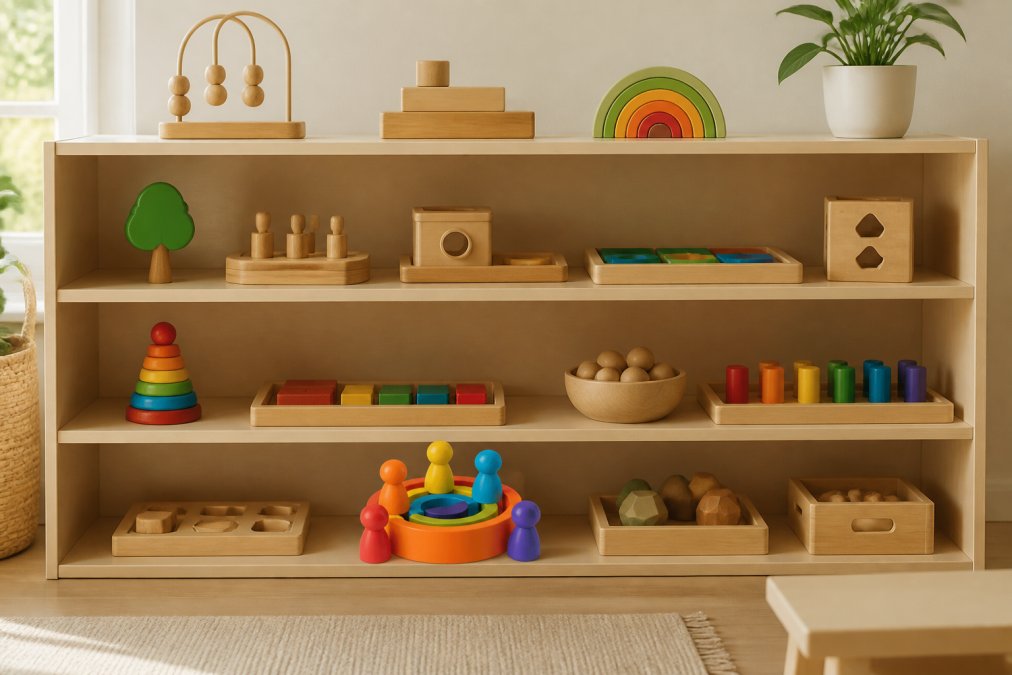
A Montessori playroom isn't about having more toys; it's about having fewer, better toys arranged intentionally. The goal is to create an environment where your child can make choices, engage deeply, and develop independence.
Start with the principle of simplicity. A Montessori space has 5-8 carefully chosen toys available at any time, rotated seasonally. This is the opposite of the typical playroom packed with 50+ plastic toys competing for attention. Fewer choices reduce overwhelm and allow deeper engagement with each toy.
Arrange toys at your child's eye level on low, open shelves. This teaches independence, your child can see options and select what they want without asking for help. Wooden toys work perfectly here because they're aesthetically cohesive. A shelf of wooden blocks, puzzles, and stacking toys creates a calm, organized visual environment rather than the chaotic impression of bright plastic toys.
Include toys that develop specific skills:
- Fine motor development: puzzles like the Montessori Wooden Tangram Puzzle Game, threading toys, and stacking rings
- Problem-solving: building blocks, construction sets, and open-ended manipulatives
- Sensory exploration: toys with different textures, weights, and natural materials
- Imaginative play: simple wooden figurines, play kitchen items, and pretend-play accessories
Rotate toys every 4-6 weeks. Store unused toys in closed bins so they're out of sight. When you reintroduce a toy after several weeks away, it feels new and captures your child's attention again. This extends the lifespan of engagement and reduces the need to constantly buy new things.

Keep the color palette natural. Wood tones, soft pastels, and natural finishes create a calming environment that supports focus. Avoid overstimulating bright primary colors and cartoon characters.
Finally, include at least one "messy play" station with materials like water, sand, or natural items. Wooden toys are durable enough to handle this without degrading, whereas plastic toys can become sticky or stained.
Sensory Development and Tactile Feedback
Touch is one of the primary ways young children learn. Wooden toys provide rich sensory feedback that plastic simply cannot replicate.
Wood has texture. You can feel the grain, the slight irregularities, the natural variations in the material. When a toddler holds a wooden block, they're receiving tactile input that stimulates nerve endings and builds sensory awareness. Plastic is uniformly smooth and often cold. It registers to a child's nervous system as "generic" rather than engaging.
Wood has weight and density. A wooden toy feels substantial in a child's hand. This proprioceptive feedback, the sense of where your body is in space and how much force you're applying, is crucial for developing motor control and coordination. Lightweight plastic toys don't provide this feedback as effectively, which is why children often throw them or handle them roughly. They're not getting enough sensory input to feel satisfied.
Wood responds to temperature. A wooden toy warms slightly in your hand; plastic stays cold. This thermal responsiveness creates a more dynamic sensory experience and signals to a child's brain that the toy is "alive" in a way that plastic never does.
The natural color variation in wood also supports visual development. Unlike the uniform, artificial colors of plastic toys, wood presents subtle gradations and natural hues. This trains a child's eye to perceive nuance rather than relying on high-contrast, artificial stimulation.
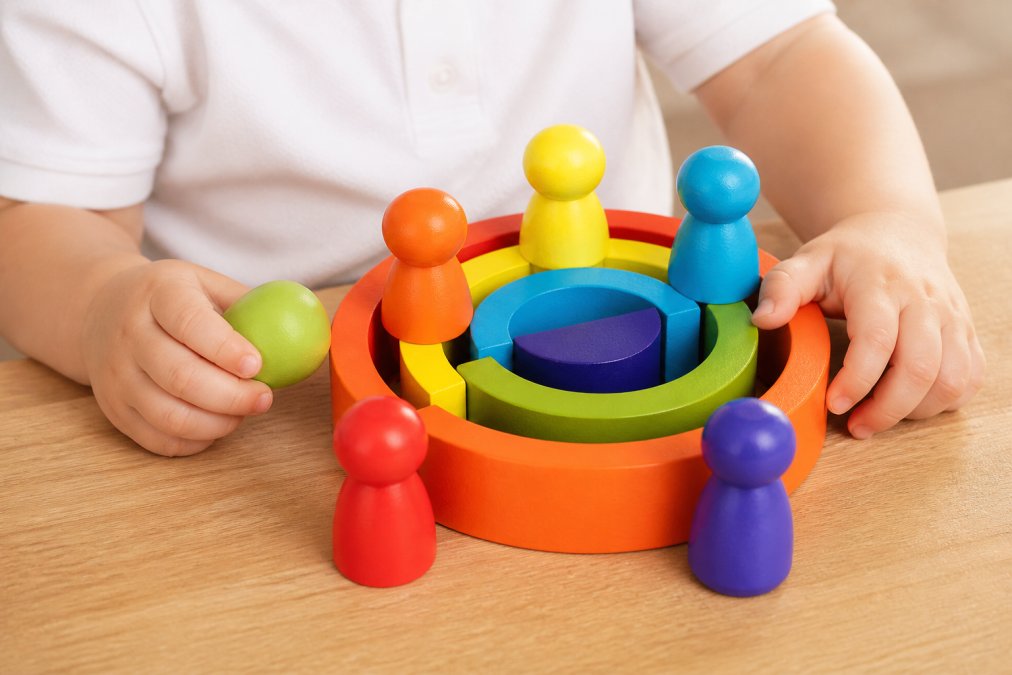
For children developing fine motor skills, wooden toys like the Tender Tots Wooden Tool Disassembly Playset provide the resistance and feedback necessary for building hand strength and dexterity. Manipulating wooden pieces requires more intentional motor control than snapping plastic parts together.
Wood vs. Plastic: Direct Comparison
| Factor | Wood Toys | Plastic Toys |
|---|---|---|
| Durability | 10-20+ years with proper care | 2-3 years typical lifespan |
| Chemical Safety | Non-toxic when finished with water-based sealants | May contain BPA, phthalates, or other synthetic chemicals |
| Environmental Impact | Biodegradable; from renewable sources when sustainably harvested | 450-1,000 year decomposition; microplastic pollution |
| Sensory Experience | Rich texture, natural weight, temperature responsiveness | Uniform smoothness, lightweight, cold |
| Open-Ended Play | Inherently open-ended; child-directed use | Often single-purpose or programmed |
| Cost-Per-Use | Higher initial cost, lower long-term cost | Lower initial cost, higher replacement costs |
| Aesthetic | Calm, cohesive, minimalist | Bright, visually stimulating, cluttered appearance |
| Heirloom Potential | High; passes through generations | Low; typically discarded after use |
| Fine Motor Development | Requires intentional control and coordination | Less resistance; less motor feedback |
| Maintenance | Minimal; occasional oiling or light cleaning | Staining, fading, accumulating dust in crevices |
The comparison reveals a consistent pattern: wooden toys excel in durability, sensory richness, environmental responsibility, and long-term value. Plastic toys offer lower entry cost and immediate availability, but that advantage erodes quickly when you factor in replacement cycles and the hidden costs of chemical exposure and environmental impact.
For most families, especially those planning to use toys across multiple children or seeking to minimize their environmental footprint, wood is the stronger choice.
Choosing wooden toys over plastic is an investment in your child's development, your family's health, and the environment your children will inherit. The decision compounds over time, one wooden toy becomes a collection, a playroom, a philosophy. Tender Tots & Wellness makes that transition easier by offering thoughtfully designed, sustainably sourced wooden toys that grow with your child and last for decades. Start with a single piece like the Wooden Rainbow Stacking Toy or the Montessori Wooden Tangram Puzzle Game, and experience the difference quality materials make in how your child plays and learns.
Frequently Asked Questions
Are wooden toys really safer than plastic toys regarding chemical exposure?
Wooden toys eliminate exposure to chemicals like BPA, phthalates, and other synthetic compounds found in many plastic toys. Quality wooden toys made from sustainably sourced materials and finished with non-toxic stains or oils meet strict safety standards, including CPSIA requirements. Plastic toys, especially cheaper imports, may leach microplastics and harmful chemicals during use. Wood's natural composition means no chemical off-gassing or degradation into microparticles that children might ingest.
How do wooden toys support open-ended play compared to plastic alternatives?
Wooden toys encourage imaginative, unstructured play because they lack built-in sounds, lights, or predetermined functions. A wooden block can become a house, a bridge, or a tool, the child decides. Plastic toys often have one intended use, limiting creativity. Open-ended play builds problem-solving, spatial reasoning, and cognitive growth. Our Wooden Rainbow Stacking Toy and Montessori Wooden Tangram Puzzle exemplify this approach, offering endless combinations and creative possibilities.
What makes wooden toys more durable than plastic toys?
Wood is naturally dense and strong, resisting cracks and breaks from rough play. Quality wooden toys, when properly finished and maintained, can last decades and pass through multiple children without deteriorating. Plastic becomes brittle over time, cracks from temperature changes, and pieces break off easily. The cost-per-use of wooden toys is significantly lower because they remain functional and safe for years, making them true heirloom-quality investments.
Are there specific safety standards for wooden toys in the United States?
Yes. Wooden toys must comply with the Consumer Product Safety Commission (CPSC) standards, including the Children's Product Safety Rule (CPSIA). They must be free from lead paint, meet flammability requirements, and have no sharp edges or small parts that pose choking hazards. Additionally, toys must be tested for chemical safety. Reputable wooden toy makers test for compliance with these standards and provide documentation. When shopping, look for toys that explicitly state CPSC compliance and non-toxic finishes.
This article was written using GrandRanker