

Why Montessori Experts Avoid Plastic Battery Toys
Table of Contents
- Why Montessori Experts Avoid Plastic Battery Toys: The Core Reasons
- What the Evidence Actually Says About Battery Toys and Development
- Wooden vs. Plastic Toys for Toddlers: What Changes in Play
- Battery-Free Toys for Toddlers That Build Real Skills
- Montessori Toys for 1-Year-Olds: Matching Toys to Skills
- Montessori Toy Safety: Batteries, Plastics, and What to Check
- When Battery Toys Can Still Be Useful (and How to Use Them Well)
- Conclusion: Simpler Toys, Deeper Play
- Frequently Asked Questions
Last Updated: October 12, 2026
Why Montessori Experts Avoid Plastic Battery Toys: The Core Reasons
Walk into most playrooms and you will hear the same thing: beeping, flashing, and a dozen plastic toys competing for attention. Many Montessori guides and educators push back on that scene, and their reasons are practical, not nostalgic. The short answer to why Montessori experts avoid plastic battery operated toys is that these toys do the playing for the child. A toy that sings, lights up, and moves on its own asks almost nothing of a toddler. Montessori principles work the other way: the child leads, the toy responds.
At Tender Tots & Wellness, we hear this question from parents every week. So here is the honest version, including where the research is weaker than headlines suggest.
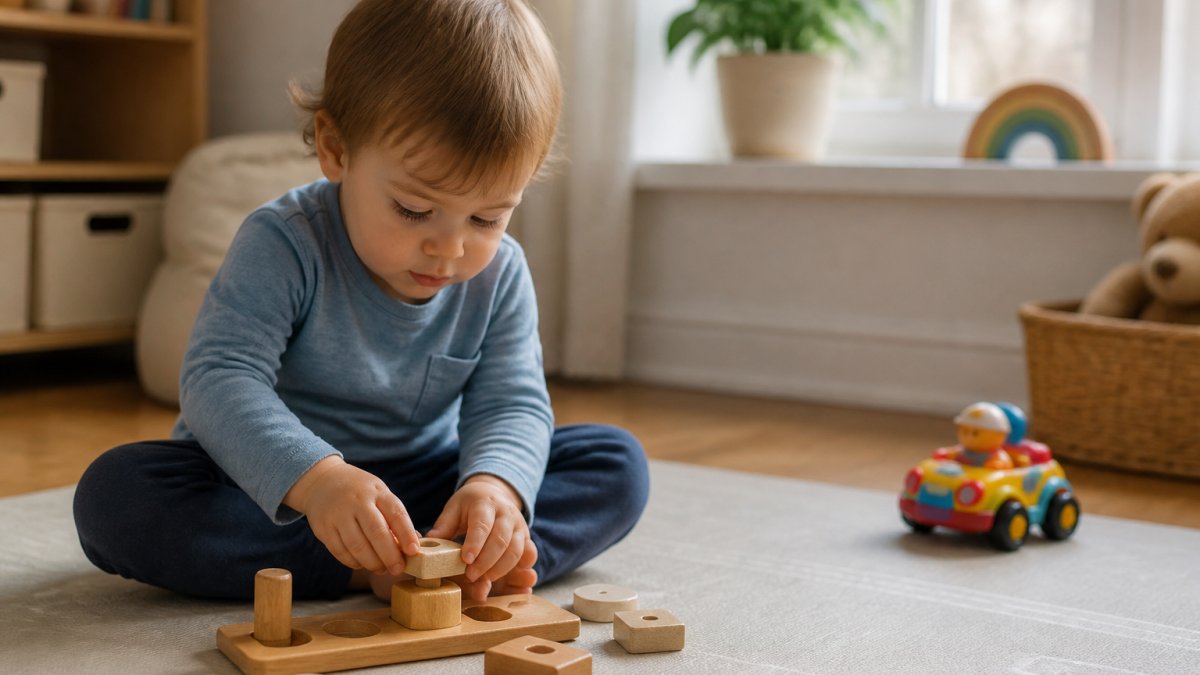
Passive entertainment versus active learning
A battery toy performs. Your child watches. That is passive entertainment, and it rarely holds attention for long. A plain wooden block does nothing until a child picks it up, stacks it, and knocks it down. That is active learning, and it builds fine motor skills and hand-eye coordination with every attempt.
How flashing lights and electronic sounds interrupt concentration
Flashing lights and electronic sounds pull a child's focus outward, away from the task in front of them. Montessori classrooms protect sustained attention on purpose. A calm play space with a few open-ended toys lets a toddler stay with one activity long enough to build real concentration.
What the Evidence Actually Says About Battery Toys and Development
The evidence here is real but narrower than most headlines admit. The most-cited study on this topic is a 2015 experiment published in JAMA Pediatrics by Anna Sosa, which compared parent-toddler play with electronic toys, traditional toys (like blocks and shape sorters), and books. Parents in the electronic-toy condition said fewer words, asked fewer questions, and produced fewer conversational turns than parents playing with books or traditional toys. The toddlers themselves also vocalized less. That is a meaningful finding because conversational turns, the back-and-forth exchanges between a child and a caregiver, are one of the strongest predictors of early language development.
But that study looked at one 15-minute play session with 26 toddlers. It did not follow children for years, and it did not test whether the toys caused any lasting difference. A separate line of research from the University of Washington (the 'Einstein Never Used Flashcards' work by Hirsh-Pasek, Golinkoff, and colleagues) argues that the quality of play, whether it is child-directed, imaginative, and socially interactive, matters more than the toy category itself. Their framework is useful because it explains why a battery toy used with a parent can still produce learning, while the same toy used as a babysitter does not.
What the research can and cannot tell you
- Can tell you: Electronic toys tend to reduce caregiver talk and turn-taking during solo play sessions.
- Can tell you: Child-directed, open-ended play is consistently associated with stronger language, problem-solving, and self-regulation outcomes.
- Cannot tell you: That any specific battery toy causes lasting developmental harm.
- Cannot tell you: That all electronic toys are equivalent, a talking phonics reader and a flashing plastic guitar are not the same stimulus.
A common pattern practitioners describe is that the novelty of lights and sounds drives initial attention, but that attention fades fast, often within minutes, because the toy, not the child, is generating the action. That is the mechanism behind the 'less engagement' finding, and it is why the practical takeaway is about how a toy is used, not a blanket ban.
Wooden vs. Plastic Toys for Toddlers: What Changes in Play
The honest answer is that material matters less than design, a simple plastic stacking cup can outperform a complicated wooden gadget. But material is not irrelevant, because it shapes three things toddlers rely on: tactile feedback, weight, and cause-and-effect clarity.
Tactile feedback. Wood has grain, temperature, and slight variation from piece to piece. Plastic is uniform and smooth. For a toddler still mapping the world through their hands, that variation gives the nervous system more to work with.
Weight and resistance. A wooden block has enough mass that stacking it requires real calibration of force. A hollow plastic block of the same dimensions is light enough that a toddler can knock the tower over by accident. The heavier object teaches cause and effect more reliably because the child has to adjust their own movement to succeed.
Cause-and-effect clarity. This is where battery toys diverge most. A wooden block does nothing until a child acts on it. A battery toy acts on its own, which means the child's action and the toy's response are decoupled.
| Feature | Wooden Toys | Plastic Battery Toys |
|---|---|---|
| Power source | None needed | Batteries required |
| Sound and light | Quiet | Flashing lights, electronic sounds |
| Play style | Child-led, open-ended | Toy-led, scripted |
| Tactile feedback | Grain, weight, temperature variation | Uniform, smooth, lightweight |
| Cause-and-effect link | Child's action drives all outcomes | Toy often acts independently |
| Durability | Long-lasting, repairable | Often breaks or loses charge |
| End of life | Repairable, resellable | Hard to recycle |
Natural materials also age well. A well-made wooden toy can pass between siblings, which cuts waste and cost over time.
Battery-Free Toys for Toddlers That Build Real Skills
Battery-free toys for toddlers do not limit play. They expand it. Blocks, shape sorters, stacking rings, and pretend-play sets all ask a child to move, think, and try again. That repetition is where problem-solving and creativity grow.
Our Wooden Tool Disassembly Playset is a good example. Kids take pieces apart and put them back together with realistic tools. It builds fine motor skills and hand-eye coordination, and it stays screen-free. It suits ages 3 and up, so it is a natural next step once simple stacking feels easy.

Montessori Toys for 1-Year-Olds: Matching Toys to Skills
Montessori toys for 1-year-olds should match what a child can already do, then stretch it slightly. At this age, that means big pieces, clear cause and effect, and no small parts. A one-year-old learns by grabbing, dropping, filling, and dumping.
Tender Tots Wooden Tool Disassembly Playset for Kids →
Try these:
- Chunky wooden blocks for stacking and knocking down
- A simple posting box for hand-eye coordination
- Stacking rings for size and order
- A first shape sorter with easy shapes
- Board books for language and turn-taking
Skip anything that needs batteries to be interesting. If the toy is boring with the power off, it is not teaching much with the power on.
Montessori Toy Safety: Batteries, Plastics, and What to Check
Montessori toy safety comes down to two things: small parts and power sources. Button batteries are the biggest risk with battery-operated toys. If a child swallows one, it can cause serious injury within hours, so the battery safety guidance from the Consumer Product Safety Commission is worth reading before you buy.
Plastic is not automatically unsafe. The concern is older or unlabeled plastic, which may contain chemicals that current rules restrict. Look for toys labeled as meeting ASTM F963, the federal toy safety standard, which covers lead, small parts, and other hazards.
A quick checklist for evaluating battery-operated toys
Run through this before you buy or keep any battery toy:
- Battery compartment has a screw or latch a child cannot open
- No loose or corroded batteries
- Volume has an off switch or low setting
- No small detachable parts for under-threes
- Toy still works as a toy with the power off
- Age label matches your child
If it fails two or more, it is probably not worth the shelf space.
When Battery Toys Can Still Be Useful (and How to Use Them Well)
Battery toys are not the enemy. Some earn their place. A talking flash card reader can help with phonics and vocabulary, and a child can use it alone at their own pace. That is guided learning, not passive entertainment.
Our Talking Flash Cards set reads each card aloud, which helps kids connect words with sounds. Use it in short sessions, then put it away. The same goes for any electronic toy: keep it to one at a time, keep the volume low, and pair it with hands-on play afterward.

Conclusion: Simpler Toys, Deeper Play
The case against plastic battery operated toys is not about banning fun. It is about giving toddlers room to lead their own play. Fewer lights, fewer sounds, and more hands-on learning tend to produce longer attention spans and deeper engagement. If you want to build that kind of play space, start small. Pick one open-ended toy, watch how your child uses it, and add from there.
That is where Tender Tots & Wellness can help. We stock Montessori-inspired toys chosen for real play, not shelf appeal. Shop now and find pieces that fit your family's needs.
Frequently Asked Questions
Do battery-operated toys limit a child's creativity?
They can. Battery toys often lead play by flashing lights, playing sounds, and directing what happens next. That leaves less room for a child to invent scenarios, build, or problem-solve. Open-ended toys like blocks or a wooden tool set let children decide what the toy becomes, which supports imagination and sustained attention. Battery toys are not automatically harmful, but they tend to replace child-led play with passive entertainment, especially when they are the main toys available.
Are plastic toys suitable for Montessori play?
Some plastic toys can fit Montessori play if they are simple, open-ended, and allow hands-on learning. The issue is not plastic alone but what the toy does. A plain plastic stacking cup set may work fine, while a plastic toy that only lights up and talks does not. Montessori guides look for toys that match a child's stage and invite them to act, not just watch. Natural materials like wood are common because they feel pleasant, hold up well, and keep the play space calm and uncluttered.
What toys are best for a 1-year-old using Montessori principles?
For a 1-year-old, choose toys that support movement, grasping, and early problem-solving. Good options include wooden stacking rings, a simple object permanence box, chunky wooden puzzles, and a wooden tool disassembly playset for slightly older toddlers. These battery-free toys for toddlers encourage fine motor skills, hand-eye coordination, and cause and effect through active learning. Keep the selection small and rotate toys so the play area stays organized and your child can focus deeply on one thing at a time.
How can parents choose safe toys for toddlers?
Check for secure battery compartments that need a screwdriver to open, no small parts that could come loose, and non-toxic finishes on wooden toys. For Montessori toy safety, look for smooth edges, sturdy joints, and age labels that match your child. If a battery toy is in the mix, inspect it often for cracks or exposed wires, and remove it if it breaks. Choosing fewer, well-made toys makes it easier to keep track of wear and reduce safety risks over time.
The hardest part of choosing toys is not finding options. It is knowing which ones will actually get used. At Tender Tots & Wellness, we curate Montessori-inspired toys and baby gear with high quality at a fair price, plus free worldwide shipping. Start with one open-ended toy and see how your child responds. Get started with Tender Tots & Wellness and build a calmer, more engaging play space.