

Affordable Montessori Toys for Small Budgets: 2026 Guide
Table of Contents
- What Makes a Montessori Toy Worth Buying
- How to Spot Affordable Montessori Toys That Are Actually Safe
- Best Montessori Toys for 1 Year Olds on a Budget
- DIY Montessori Toys for Toddlers You Can Make at Home
- A Simple Montessori Toy Rotation Guide for Small Spaces
- Where to Buy Affordable Montessori Toys Online
- Conclusion
- Frequently Asked Questions
Last Updated: September 10, 2026
What Makes a Montessori Toy Worth Buying
Affordable Montessori toys for small budgets share one trait: they do more with less. A toy earns the Montessori label when a child can use it in multiple ways, made from materials that hold up to daily handling. This guide from Tender Tots & Wellness walks through what to buy, what to skip, and how to stretch every dollar.

Montessori-inspired play is a child-led approach to learning in which open-ended materials and real-world tasks let children direct their own activity. The method prioritizes natural materials, simple forms, and toys that grow with the child.
The math works in your favor here. Fewer, better toys usually cost less over a year than a rotating pile of plastic novelties that break by spring.
Open-Ended Play and Natural Materials
Open-ended play means a toy has no single correct outcome. A set of wooden blocks becomes a tower, a bridge, a shop counter, or a road. That flexibility is why a small collection outperforms a large one.
Natural materials matter for two reasons. Wood, organic cotton, and bamboo feel different in small hands than plastic, and they tend to survive years of use instead of months. A common mistake is buying a big bundle of cheap plastic pieces to fill a play shelf. Ten durable wooden items will outlast and out-teach thirty flimsy ones.
Why Fewer Toys Can Cost Less and Teach More
A smaller toy collection lowers cost and increases focus. When children see fewer options, they play longer with each item, which builds attention and fine motor skills instead of scattering effort across a crowded shelf.
This is the core tension in toy shopping: parents buy more to give more, but the research-backed Montessori principle runs the other way. A sparse, well-chosen shelf beats a full one every time.
How to Spot Affordable Montessori Toys That Are Actually Safe
Safety is where cheap toys fail, and it is also where vague marketing does the most damage. The Consumer Product Safety Commission toy safety guidance sets the mandatory federal rules for toys sold here, and reputable sellers follow them. The trick is knowing which materials and certifications to check before you buy, and what each label actually proves.
Materials to Look For and Materials to Avoid
Choose sustainable wood with water-based finishes, organic cotton, bamboo, and plant-based plastics. These materials are durable, hypoallergenic, and free of the coatings that cause concern.
Avoid toys containing BPA, phthalates, and PVC. Look for BPA-free and phthalate-free labeling, and skip anything with a strong chemical smell or peeling paint. A non-porous surface on teethers and rattles makes cleaning easier and safer.
| Look For | Avoid | Why It Matters |
|---|---|---|
| Sustainable wood, water-based finishes | Toxic coatings, lead paint | Paint chips end up in mouths |
| Organic cotton, bamboo | PVC, phthalates | Soft plastics leach over time |
| BPA-free, plant-based plastics | Unlabeled recycled plastic | Unknown additives |
| Non-porous, easy-wipe surfaces | Porous fabric that traps moisture | Mold and bacteria growth |
One trade-off worth naming: plant-based plastics (often labeled PLA) are marketed as eco-friendly, but most still need industrial composting to break down and behave like conventional plastic in a home bin. For a toy that gets chewed, unfinished wood or organic cotton is the more honest choice.
What Third-Party Certifications Actually Mean
Most guides tell you to "look for certifications" and stop there. Here is what the common labels on a toy box actually verify, so you can tell a real safety claim from a decorative one.
- ASTM F963, the ASTM F963 toy safety standard is the voluntary standard most quality brands test against. It covers mechanical hazards (sharp edges, small parts), flammability, and heavy metals in surface coatings. A toy that passes it has been tested, not just labeled.
- CPSC compliance, mandatory, not optional. Every toy sold here must meet federal small-parts, lead-paint, and phthalate limits. "CPSC compliant" is the floor, not a selling point.
- FSC (Forest Stewardship Council), certifies that wood came from responsibly managed forests. It says nothing about the finish or the toy's safety, only the sourcing.
- GOTS (Global Organic Textile Standard), verifies organic fiber content and restricts the chemicals used in processing. Relevant for fabric toys, teethers, and soft blocks.
- GREENGUARD Gold, tests for low chemical emissions from the finished product. More common on furniture and mattresses than toys, but it appears on some wooden play items.
Child-safe means the toy has passed small-parts, sharp-edge, and finish testing for the stated age group. If a listing does not name a certification or an age range, treat it as unverified, "natural" and "non-toxic" are marketing words, not standards.
Best Montessori Toys for 1 Year Olds on a Budget
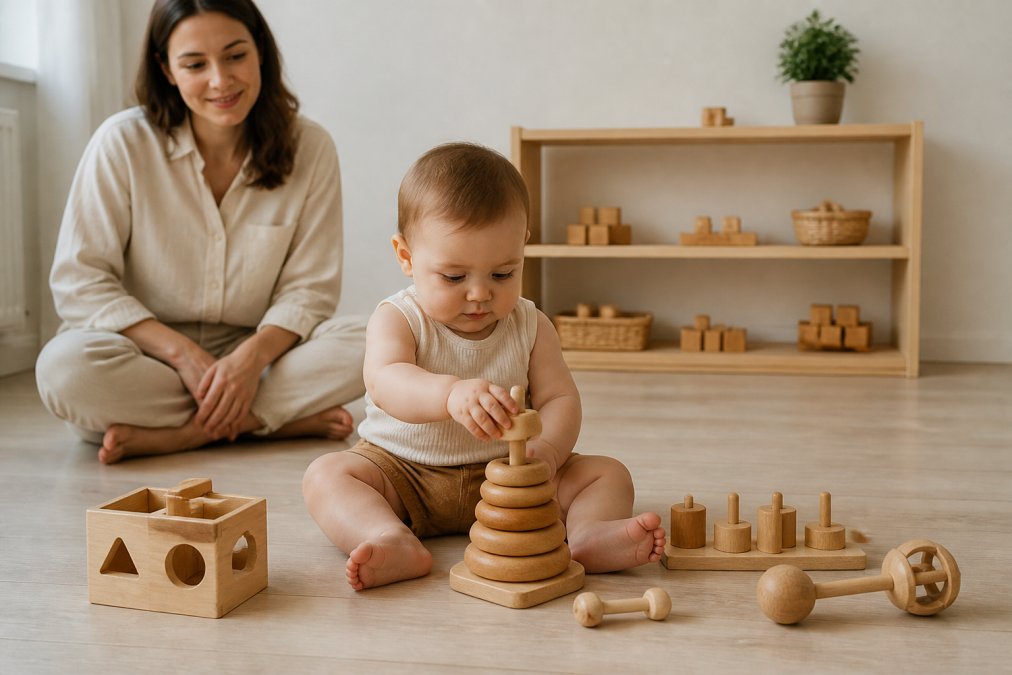
For 1-year-olds, the best budget Montessori toys target developmental milestones: grasping, stacking, and cause-and-effect. You do not need many. You need the right few, and you need to know which milestone each one serves so you are not buying three toys that do the same job.
Match the Toy to the Milestone
Around the first birthday, four developmental jobs matter most. A well-chosen shelf covers all four with three or four items.
- Grasping and releasing, chunky objects a whole hand can hold, like a wooden rattle or a fabric ball. This builds the grip that later supports feeding and drawing.
- Stacking and nesting, a ring stacker or nesting cups teach size order and cause-and-effect. Wooden versions hold up; cheap plastic ones crack at the seam within months.
- Object permanence, a posting box or a simple drop-and-retrieve toy shows a child that things still exist when out of sight, a core cognitive milestone.
- Cause-and-effect, anything that responds to a push, pull, or turn. This is where a disassembly toy earns its place, because the child controls the outcome.
A Budget-Tier Framework
Prices vary by brand and material, but the pattern is consistent. Here is how to think about spend at each tier.
- Under $15, single-purpose wooden items: a ring stacker, a set of nesting cups, a fabric ball. Buy one or two, not five.
- $15-$40, multi-part wooden sets that cover more than one milestone, such as a shape sorter or a simple posting box.
- $40-$60, a larger open-ended piece that spans a wide developmental window and stays on the shelf for years.
Our top pick for this age is the Tender Tots Wooden Tool Disassembly Playset. At $55.99, it sits in the top tier and earns it: toddlers can build, disassemble, and reassemble the pieces, which builds fine motor skills and confidence with every turn. It covers the cause-and-effect milestone and stretches well past age two, so the cost-per-month of use is low.
For a lower-cost add-on, the Tender Tots Phonics Learning Posters Set runs $12.33 and turns a wall into a learning space. Posters are not "toys" in the classic sense, but they support the same child-led, low-cost learning environment and sit comfortably in the under-$15 tier.

DIY Montessori Toys for Toddlers You Can Make at Home
DIY Montessori toys for toddlers are the cheapest legitimate route into this method, and they often outperform store-bought versions because you control the materials. A few proven builds:
- Treasure basket: a shallow bowl of safe household objects (wooden spoon, metal whisk, fabric scraps) for sensory exploration
- Posting box: a shoebox with a slot cut in the lid, plus large wooden discs to drop through
- Stacking rings: wooden curtain rings on a dowel, sanded smooth and finished with food-safe oil
- Sorting tray: an ice cube tray with large natural items (pinecones, large buttons) sorted by size
The catch: any DIY toy for a child under 3 must pass the same small-parts and finish standards as a store-bought one. Sand every edge, avoid loose small pieces, and skip paint entirely in favor of food-safe oil.
A Simple Montessori Toy Rotation Guide for Small Spaces
A Montessori toy rotation guide solves two problems at once: clutter and cost. Instead of buying more, you cycle a small set of toys in and out so each one feels new again.
The system is simple. Keep six to eight toys accessible on a low shelf. Store the rest out of sight. Every one to two weeks, swap two or three items. This keeps the shelf plastic-free where possible, uncluttered, and aligned with how young children actually focus.
For small spaces, the rotation doubles as storage strategy. A single lidded bin holds the "resting" toys, and the shelf stays sparse. Zero to Three's guidance on play and early learning notes that predictable, uncluttered play environments help toddlers engage more deeply with fewer materials.
Where to Buy Affordable Montessori Toys Online
The best place to buy affordable Montessori toys online is a retailer that names its materials, lists certifications, and prices fairly. That combination is rarer than it should be.
Tender Tots & Wellness stocks Montessori-inspired toys and baby gear chosen to fit a modern family's needs, with free worldwide shipping and items priced for a real budget. Real customers have noted the quality and speed of delivery, and the mix of timeless design with current trends means the toys do not look out of place in a minimalist nursery.
When you shop anywhere online, verify three things before checkout: the material list, the age rating, and the return policy. If a listing hides any of the three, keep looking.
Conclusion
Building a Montessori play space on a small budget comes down to choosing fewer, better toys and knowing what makes them safe. The pressure to buy more is constant, but the method rewards restraint.
Tender Tots & Wellness makes that easier with a curated selection of Montessori-inspired toys, fair prices, and free worldwide shipping, so you can build a thoughtful shelf without overspending. Shop now and give your child toys that teach more while costing less.
Frequently Asked Questions
Where can I find cheap Montessori materials that are actually good quality?
Online shops that specialize in Montessori-inspired toys often cost less than big subscription boxes because you buy only what you need. Look for solid wood, organic cotton, and water-based finishes. Tender Tots & Wellness, for example, sells a Wooden Tool Disassembly Playset for $55.99 and a Phonics Learning Posters Set for $12.33, with free worldwide shipping. Buying individual pieces instead of full kits keeps costs down while still giving your child open-ended play.
Are DIY Montessori toys effective for child development?
Yes, when they target a real skill. A simple posting box made from a shoebox and ping-pong balls builds fine motor skills and hand-eye coordination just as well as a store-bought version. The key is matching the toy to your child's current developmental stage. DIY options work best for sensory play, sorting, and practical life activities. For structured items like shape sorters or stacking rings, a well-made wooden version often lasts longer and holds up better to daily use.
What are some cheap Montessori-inspired toys under $20?
You can find several affordable options in this range. The Tender Tots Phonics Learning Posters Set costs $12.33 and turns any wall into a literacy corner. Other budget-friendly picks include wooden stacking rings, felt balls for sorting, and homemade sensory bins filled with rice or dried beans. A Montessori toy rotation guide helps you stretch a small collection further by swapping toys every one to two weeks, so your child stays engaged without needing new purchases.
How do I know if a toy is actually Montessori-inspired and not just marketing?
Check three things: material, purpose, and simplicity. Real Montessori toys are made from natural materials like sustainable wood or organic cotton, have a clear developmental purpose such as building fine motor skills or sensory development, and are simple enough for a child to use independently. If a toy has flashing lights, plastic characters, or does the playing for the child, it is not Montessori-aligned regardless of the label.
This article is for general information only and is not a substitute for professional advice. Always check current safety guidance and product labels before buying toys for young children.