

Baby Swing vs Bouncer Pros and Cons 2026: Which to Buy
Table of Contents
- Baby Swing vs Bouncer: Quick Comparison for 2026
- Motion and Mechanics: Motorized Swing vs Manual Bounce
- Pros and Cons of Baby Swings
- Pros and Cons of Baby Bouncers
- How Long Can a Baby Be in a Bouncer or Swing?
- Safe Sleep Guidelines for Infant Gear: What Parents Must Know
- Best Minimalist Baby Gear for Small Spaces: Swing or Bouncer?
- Conclusion: Choosing the Right Gear for Your Baby
- Frequently Asked Questions
Last Updated: October 2, 2026
Baby Swing vs Bouncer: Quick Comparison for 2026
Choosing between a baby swing and a bouncer comes down to one question: do you need hands-free soothing or active, portable play? A baby swing vs bouncer decision shapes your daily routine, your nursery layout, and how much floor space you surrender. This guide from Tender Tots & Wellness breaks down the motion, mechanics, safety rules, and long-term value of each so you can buy once and buy right.
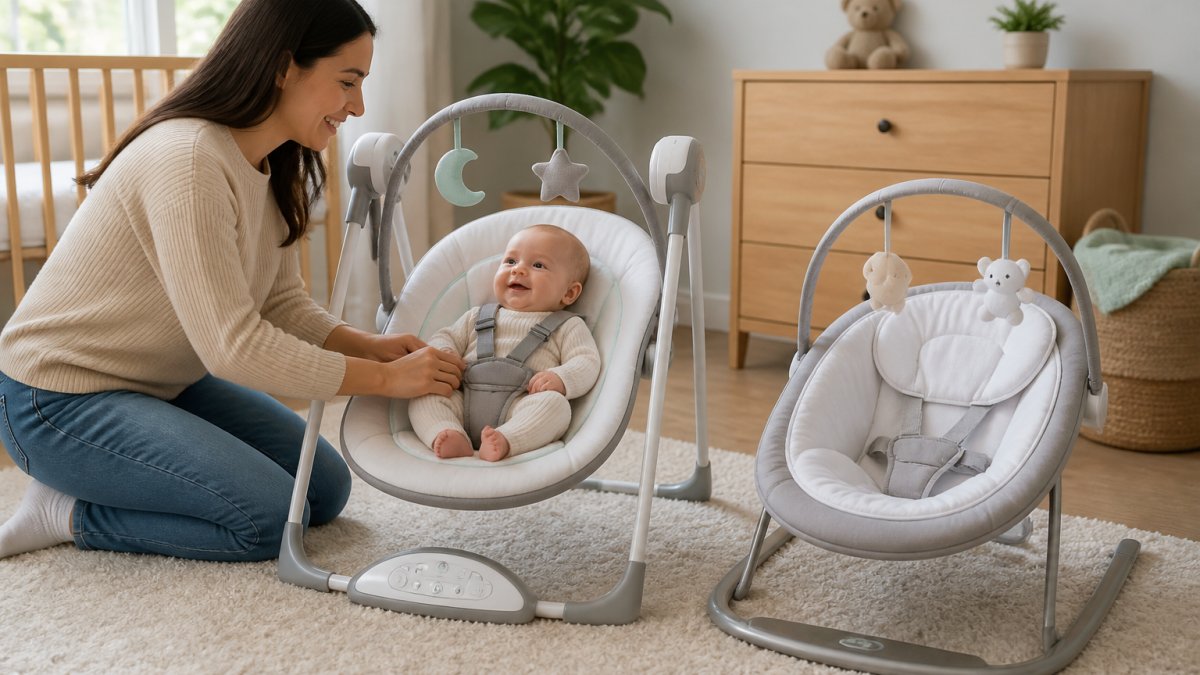
Here is the short answer. Swings deliver continuous, motorized motion that frees your hands for chores or rest. Bouncers rely on your baby's own movement or a gentle manual nudge, which builds body awareness.
What Is a Baby Swing?
A baby swing is a motorized or battery-powered seat that rocks an infant in a smooth, repetitive arc or side-to-side motion. The steady movement mimics the calming rhythm babies felt in the womb, which is why swings are a go-to tool for a fussy baby.
Most models offer adjustable speed settings, a harness system, and a timer. The trade-off is size: a full-size swing claims real floor space and rarely folds flat.
What Is a Baby Bouncer?
A baby bouncer is a lightweight, low-profile seat that responds to your baby's own kicking and wiggling, or to a gentle manual bounce from a parent. There is no motor and no plug-in power.
Bouncers shine for portability. You can carry one from room to room, and many fold flat for storage. The motion is subtle, so a bouncer soothes some babies and bores others.
Motion and Mechanics: Motorized Swing vs Manual Bounce
The core difference is who supplies the energy. A motorized swing generates continuous automated rocking, while a bouncer depends on your baby or your own hand for movement.
That single distinction drives everything else. Automated rocking buys you hands-free time, which matters most during the witching hour.
| Feature | Baby Swing | Baby Bouncer |
|---|---|---|
| Motion source | Motorized, automated rocking | Baby's movement or manual bounce |
| Motion type | Arc or side-to-side | Gentle vertical bob |
| Power | Battery or plug-in power | None required |
| Portability | Low, bulky frame | High, lightweight frame |
| Best for | Hands-free soothing | Short, supervised play |
A common mistake is assuming a swing does the work of a bouncer. It does not.
Pros and Cons of Baby Swings
Swings win on soothing power. The continuous motion has a genuine calming effect, and the hands-free time it creates is the reason many parents call it a lifesaver.
Pros:
- Automated rocking soothes a fussy baby without you standing there
- Adjustable speed and vibration settings suit different temperaments
- A timer and harness system add a layer of supervised-use safety
- Frees your hands for meals, chores, or a much-needed break
Cons:
- Large footprint that eats into floor space
- Heavy and awkward to move between rooms
- Reliance on battery life or a nearby outlet
- Some babies outgrow the motion quickly
Pros and Cons of Baby Bouncers
Bouncers reward parents who value flexibility. The lightweight frame and low price point make them an easy first purchase, and the motion teaches cause and effect as your baby learns that kicking produces a bounce.
Pros:
- Lightweight frame that moves room to room with one hand
- No batteries, no cords, no plug-in power
- Compact and easy to store when not in use
- Encourages active movement and developmental milestones
Cons:
- Motion stops the moment your baby stops moving
- Less effective for a deeply fussy baby
- Shorter useful life as babies gain weight
- Washable fabric covers vary widely in quality
How Long Can a Baby Be in a Bouncer or Swing?
There is no single federal rule that caps container time, but pediatric physical therapists and the American Academy of Pediatrics guidance on container baby syndrome converge on a practical ceiling: keep any one session under about 30 minutes, and keep total container time across a day well under two hours. The reason is mechanical, not moral. In a swing or bouncer, a baby's spine is held in a curved C-shape and their hips are often locked in a narrow, legs-together position. That is fine for a short stretch. Held there for hours, it limits the free movement that builds neck control, trunk strength, and the hip rotation that supports crawling and walking.
The real signal is your baby, not the clock. A content baby who is looking around, kicking, and tracking you is getting something useful out of the session.
Weight limits are a hard stop, not a suggestion. Every swing and bouncer lists a maximum weight on the label, commonly in the 20 to 30 pound range for bouncers and higher for full-size swings.
Safe Sleep Guidelines for Infant Gear: What Parents Must Know
The safest place for a baby to sleep is a firm, flat surface in their own space, with no inclined seats involved (Safe Sleep). This is the single rule that matters most, and it applies to every bouncer and swing on the market.
The American Academy of Pediatrics safe sleep recommendations are clear that inclined products are not sleep surfaces. A swing or bouncer is infant gear for play and soothing, not a bed. Parents who treat it as one are taking a risk they cannot see.
Why the incline is the problem. When a baby's head is elevated and their chin drops toward the chest, the airway narrows.
Here is what to do instead:
- Use the swing or bouncer only while your baby is awake and supervised
- Move a sleeping baby to a crib or bassinet immediately
- Keep the device clear of blankets, pillows, and toys
- Never leave a baby unattended in either device
- Check the product label for the manufacturer's own recline and sleep warnings, which often go further than the general rule
If your baby has reflux, talk to your pediatrician before relying on an inclined seat. Reflux management is a medical question, and a swing is not a treatment.
The transition problem nobody warns you about. The hardest part of safe sleep is not knowing the rule, it is getting a baby who has learned to fall asleep in motion to fall asleep still.
Best Minimalist Baby Gear for Small Spaces: Swing or Bouncer?
For a small nursery, the bouncer usually wins on floor space. It folds, it stores, and it tucks into a closet between uses. A full-size swing needs a permanent corner, and that corner rarely comes back.
The exception is a hybrid device. Some modern models convert between a compact swing and a bouncer, which solves the storage problem without forcing you to choose. If you have room for exactly one piece of gear, a hybrid is worth the search.
Storage beats footprint for most families. A bouncer that disappears into a closet is more useful than a swing that dominates the living room, especially in an apartment.
Match the device to your space first, then to your baby's temperament. A swing that does not fit your home becomes clutter, no matter how well it soothes.
At Tender Tots & Wellness, our selection blends timeless elegance with modern trends, so a swing or bouncer can sit in your living room without clashing with everything else.
Conclusion: Choosing the Right Gear for Your Baby
The honest answer is that most families end up wanting both a swing and a bouncer, because each solves a different problem. If you must choose one, start with the device that matches your space and your baby's temperament, and let the other wait until you know your routine.
The right gear should feel like a helper, not another thing to manage. Tender Tots & Wellness offers a curated range of essential baby gear at fair prices, with free worldwide shipping and products chosen to fit a modern family's needs. Shop now and find the piece that makes your days a little easier.
Frequently Asked Questions
Is a baby swing or bouncer better for a newborn?
For newborns, a bouncer often works better in the early weeks because it is lighter, more portable, and easier to move from room to room. A baby swing can be soothing for a fussy baby who needs continuous motion, but many swings have a minimum weight requirement. Many parents use a bouncer for supervised daytime lounging and introduce a swing later. Always follow the manufacturer's age and weight guidelines for either device.
Are baby swings and bouncers safe for sleeping?
No. The American Academy of Pediatrics recommends that babies sleep on a firm, flat surface in a crib or bassinet. Swings and bouncers are not safe sleep environments because they keep a baby in a inclined position, which can restrict breathing. Use these devices only for supervised awake time. If your baby falls asleep in a swing or bouncer, move them to a safe sleep space right away.
How long can a baby stay in a bouncer or swing?
Most manufacturers recommend limiting use to 30 minutes at a time, and no more than two hours total per day. The exact time depends on your baby's age, weight, and the device's weight limit. For a bouncer, many models support babies up to 20-25 pounds; swings often go up to 25-30 pounds. Always check your specific product manual and never leave your baby unattended.
Do I need both a baby swing and a bouncer?
Not necessarily. If you have a small space or a tight budget, a bouncer alone can handle supervised play and lounging. A swing is better for babies who need prolonged rhythmic motion to calm down. Some parents start with a bouncer and add a swing if their baby is consistently fussy. If you do buy both, look for a foldable swing and a lightweight bouncer to save floor space.
Choosing gear for a new baby is overwhelming, and the swing versus bouncer question is only the start. Tender Tots & Wellness makes it simpler with a curated selection of essential baby gear, high-quality products at fair prices, and free worldwide shipping on every order. Browse the collection and find gear chosen to fit your family's real life.