

Montessori Inspired Toys for Infant Development: 2026 Guide
Table of Contents
- What Makes a Toy Montessori Inspired?
- The Benefits of Montessori Toys for Infants
- Age-by-Age Guide: Montessori Inspired Toys for Infant Development
- How to Choose Safe Montessori Baby Toys
- Montessori Play Shelf Ideas for Babies
- DIY Montessori Toy Alternatives and Toy Maintenance
- Frequently Asked Questions
Last Updated: September 11, 2026
What Makes a Toy Montessori Inspired?
A Montessori inspired toy is any play object designed to support a child's natural development through simple, open-ended, self-directed activity. These toys typically share a few defining traits: they are made from natural materials, they do one thing well, and they invite the child to act rather than entertain them passively. At Tender Tots & Wellness, we curate our collection around exactly that standard.

Key Features of Authentic Montessori Toys
Authentic Montessori toys share predictable traits. Look for these before anything else:
- Natural materials: unfinished or non-toxic finished wood, cotton, wool, and other materials safe for mouthing
- One skill per toy: a wooden rattle develops grasping; stacking rings develop sequencing, never both at once
- No batteries, no flashing lights: the toy responds to the child, not the other way around
- Simple, realistic forms: real shapes and neutral tones instead of cartoon characters
- Self-correcting design: the child notices the mistake without an adult pointing it out
The American Academy of Pediatrics guidance on toy selection makes a related point: the best toys for infants are simple, open-ended, and require the child to do the work.
The Benefits of Montessori Toys for Infants
The benefits of Montessori toys for infants come down to one idea: they let the child lead. A toy that does the entertaining for a baby removes the exact effort that builds a neural pathway. A toy that asks the baby to reach, grip, turn, or track creates it. The difference shows up in four specific areas during the first year.
Cognitive and Sensory Development
Every reach for a wooden rattle is a small exercise in cause and effect: the baby moves, the rattle sounds, the baby does it again. That loop, repeated hundreds of times across weeks, is how early problem-solving and object permanence take root. Object permanence, the understanding that a toy still exists when it is out of sight, typically begins to emerge between 4 and 8 months and solidifies through the second half of the first year, which is why simple containers, peekaboo cloths, and hide-and-find toys become magnetic around 6 months (peer-reviewed research).
High-contrast mobiles and tactile toys do similar work for visual tracking. Newborns see best at roughly 8 to 12 inches and respond most strongly to black-and-white or high-contrast patterns; a still mobile or card held in that range gives them a target to follow with their eyes, which is the earliest form of visual development. Sensory exploration matters here too: a single toy that offers one texture, one sound, or one weight teaches the baby to isolate that sensation instead of being flooded by a dozen at once.
Fine Motor Skills and Independent Play
Fine motor skills develop through repetition, not instruction. The sequence is fairly predictable: a newborn's grasp is reflexive, intentional grasping appears around 3 to 4 months, hand-to-hand transfer around 5 to 6 months, a raking grasp around 7 to 8 months, and a pincer grasp (thumb and forefinger) around 9 to 12 months. A baby practicing a pincer grasp on a small wooden disc is building the same hand control they will later use to hold a spoon or turn a page. Each stage needs a toy sized for the hand that is currently developing, too small and it is a choking risk, too large and the baby cannot close their fingers around it.
Independent play matters just as much. When a toy is simple enough that a baby can succeed with it alone, they learn to occupy themselves, which is the foundation of concentration. A common pattern is that a baby given one open-ended toy will engage longer than a baby given five toys at once, the single toy invites repetition, while a pile invites scattering. That is the practical case for a small, rotating selection rather than a full toy bin.
Age-by-Age Guide: Montessori Inspired Toys for Infant Development
The right Montessori inspired toys for infant development change roughly every three months in the first year. A toy that captivates a newborn will bore a six-month-old within seconds, and a toy built for a nine-month-old is a choking hazard for a three-month-old. Match the toy to the milestone, not the calendar.
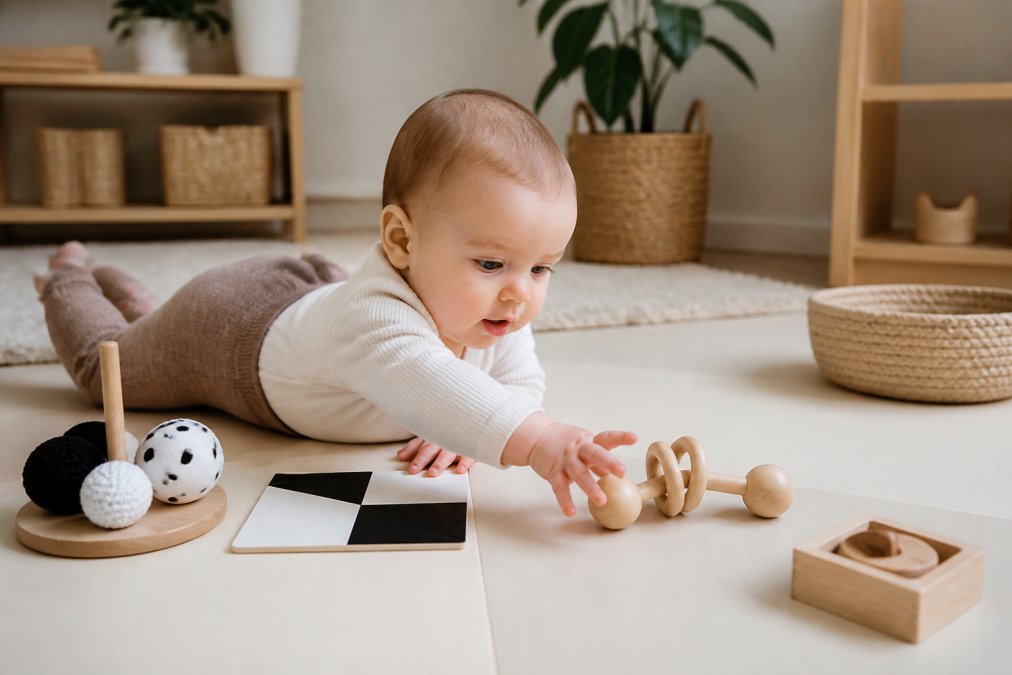
0-3 Months: Visual Tracking and High-Contrast Mobiles
Newborns see best at close range and in high contrast. A simple black-and-white mobile or a high-contrast card held about 25-30 centimeters away gives them something to track, which is the earliest form of visual development. Skip anything with music, motion, or characters; a still, high-contrast object is the whole point. This is also the age when a grasping reflex is present but not yet deliberate, so toys should be light and easy to brush against.
3-6 Months: Grasping Reflex and Wooden Rattles
Around three to four months, the grasping reflex becomes intentional. A lightweight wooden rattle is the ideal tool here: it is easy to hold, it makes a soft sound when shaken, and it teaches the baby that their own hand caused the noise. This is also when hand-to-hand transfer begins, so a second small toy helps them practice passing an object from one hand to the other. Our Tender Tots Wooden Tool Disassembly Playset for Kids ($55.99) is built for the slightly older end of this stage and beyond, with pieces sized for hands that are still learning to grip and turn.
6-12 Months: Object Permanence and Stacking Rings
The second half of the first year is when object permanence clicks: the baby understands that a toy still exists when it is out of sight. Stacking rings, interlocking discs, and simple containers become fascinating because the baby can now hide, find, and rearrange them. A stacking ring set also introduces size sequencing and spatial awareness, both early math skills in disguise. This is the age range where a toy rotation pays off most, because attention spans are short and novelty drives engagement.
| Age | Key Milestone | Best Toy Type | What It Builds |
|---|---|---|---|
| 0-3 months | Visual tracking | High-contrast mobile | Visual development |
| 3-6 months | Grasping reflex | Wooden rattle | Fine motor control |
| 6-12 months | Object permanence | Stacking rings | Spatial awareness |
| 12+ months | Pincer grasp | Interlocking discs | Problem-solving |
How to Choose Safe Montessori Baby Toys
Safety comes before aesthetics, every time. When you are choosing safe Montessori baby toys, check three things: material, finish, and size. Wood should be smooth and free of splinters, with a non-toxic finish rather than a painted surface that can chip. Any toy small enough to fit entirely inside a cardboard toilet paper tube is a choking risk for a baby under three, so skip it until the child is older. Soft cotton and wool toys should be washable, because everything ends up in a baby's mouth during this stage.
The Consumer Product Safety Commission guidance on infant toy safety is worth checking before any purchase, particularly for recalls and age-labeling standards. A reputable seller will always list the recommended age range and the materials used, and will not hide behind vague "baby-safe" language.
Montessori Play Shelf Ideas for Babies
A Montessori play shelf is a low, open shelf that holds a small number of toys at the baby's eye level, so they can choose and reach for what they want without help. The shelf itself matters less than what goes on it. Keep it to three or four toys at a time, rotate them every week or two, and place each item where a crawling or sitting baby can see it clearly. This setup supports child-led discovery and makes independent play far more likely, because the baby is not overwhelmed by a bin of forty toys.
Preventing Overstimulation Through Rotation
Most guides assume more toys equal more learning. The opposite is usually true for infants. A baby surrounded by a dozen options tends to flit from object to object without settling into the deep repetition that builds a skill. Signs of overstimulation in an infant include turning the head away from a toy, arching the back, fussing shortly after play begins, yawning, or staring blankly past an object instead of reaching for it. When you see those cues, the fix is not a new toy, it is fewer toys.
A practical rotation system looks like this: keep three or four toys on the shelf, store the rest out of sight in a closed bin, and swap one or two items every week or two rather than replacing the whole set. The goal is novelty without volume. A toy that disappears for two weeks and then returns often reads as brand new to a baby this age, which means a small collection can stay interesting for months. This costs nothing and is a highly effective change most parents can make.
Setting Up a Montessori Corner in a Small Space
You do not need a dedicated playroom. A single low shelf against one wall, roughly 24 to 30 inches tall so a sitting or crawling baby can reach the top surface, does the job in a nursery, a bedroom corner, or the side of a living room. Look for a shelf that is stable enough that a baby pulling up on it will not tip it; anchoring it to the wall is the simplest safeguard. Open-front shelves work better than bins or deep baskets because the baby can see the whole selection at a glance.
In a tight apartment, a few substitutions work well: a low windowsill cleared of breakables, the bottom shelf of a bookcase with the upper shelves emptied of anything reachable, or a shallow wooden crate turned on its side. A small woven basket or tray on the floor can hold two or three toys and be moved out of the way when the space is needed for something else. The point is not the furniture, it is that the baby can see, reach, and choose without an adult handing them something.
DIY Montessori Toy Alternatives and Toy Maintenance
You do not need to buy everything. Some of the best Montessori inspired toys are things you already have: a clean wooden spoon, a small basket of fabric scraps, a set of measuring cups, or a simple container with a few large objects to drop in and shake out. DIY alternatives work because they follow the same principle as the store-bought version: simple, open-ended, and safe for mouthing.
Wooden toys need occasional care to stay safe. Wipe them with a damp cloth and mild soap, never soak them, and dry them completely before storing. Avoid harsh disinfectants and dishwashers, both of which can warp wood or strip a non-toxic finish. A light rub with food-grade oil every few months keeps the surface smooth and splinter-free.
The hardest part of buying Montessori inspired toys for infant development is not finding them; it is filtering out the noise of every brand claiming the label. Start with the milestones, not the marketing, and buy one good wooden toy at a time. Tender Tots & Wellness stocks a curated range built around natural materials, simple forms, and fair prices, with free worldwide shipping and a mix of timeless and modern pieces that fit a real nursery. Get started with Tender Tots & Wellness and find products chosen to spark joy and foster well-being for both parents and children.
Frequently Asked Questions
How do Montessori toys differ from traditional plastic baby toys?
Montessori inspired toys focus on simplicity and natural materials like wood and cotton, while traditional plastic toys often rely on flashing lights, loud sounds, and cartoon characters. The Montessori approach emphasizes child-led discovery, so toys are designed to be open-ended and encourage active exploration rather than passive entertainment. This supports longer attention spans and independent play.
Are Montessori-inspired toys safe for infants to mouth?
Yes, if they are made with non-toxic finishes and safe for mouthing. Look for toys painted with water-based, lead-free dyes and made from solid wood without small detachable parts. Always check that the toy is large enough to prevent choking and inspect it regularly for cracks or loose pieces. Teething infants benefit from wooden rattles and teethers specifically designed for mouthing.
What are the benefits of Montessori toys for infants?
The benefits of Montessori toys for infants include improved fine motor skills, enhanced sensory development, and better problem-solving abilities. Because these toys are simple and self-correcting, babies learn cause and effect through hands-on play. They also support cognitive development by allowing infants to focus on one skill at a time, such as grasping, tracking, or hand-to-hand transfer.
How can I set up a Montessori play shelf for my baby in a small space?
Use a low, open shelf that your baby can reach from a sitting or crawling position. Place just two to three toys on it at a time and rotate them every week to keep interest high. In small spaces, a wall-mounted shelf or a single-tier unit works well. Keep the area uncluttered and ensure the shelf is anchored to the wall for safety.
What are some good Montessori items for newborns?
For newborns, high-contrast mobiles, a simple wooden rattle, and a soft cotton ball are ideal. These items support visual tracking and early grasping reflexes. Avoid overstimulating toys with lights or music. A Montessori play gym with a wooden frame and hanging objects made from natural materials also helps develop focus and sensory exploration.
How do I clean and maintain wooden Montessori toys?
Wipe wooden toys with a damp cloth and mild soap, then dry immediately. Avoid soaking them in water or using harsh chemicals. Once a month, treat unpainted wood with a food-grade oil like coconut or olive oil to prevent drying and cracking. Check for splinters or loose parts regularly, especially if your baby is teething and mouthing the toys.