

Montessori-Inspired Toys for Newborns: A Parent's Guide
Table of Contents
- What Are Montessori-Inspired Toys for Newborns?
- Benefits of Montessori Toys for Infants
- Montessori Sensory Toys for Newborns: What Works
- How to Set Up a Montessori Play Area for Newborns
- Montessori Toys by Age: Birth to 12 Months
- Safety, Materials, and Maintenance
- DIY Montessori Toy Alternatives
- Conclusion
Last Updated: August 27, 2026
What Are Montessori-Inspired Toys for Newborns?
Montessori-inspired toys for newborns are carefully designed play objects that follow the principles of the Montessori education method, adapted for infants from birth through 12 months. These toys prioritize natural materials, simple designs, and purposeful play over bright colors and electronic stimulation. The core philosophy centers on supporting a child's natural developmental stages rather than forcing learning through flashy features.
Unlike mass-produced toys cluttered with unnecessary features, Montessori-inspired toys focus on what infants actually need: tactile exploration, visual tracking, grasping practice, and sensory input through high-contrast patterns and natural textures. These toys typically feature wooden construction, minimal decoration, and open-ended play potential. A wooden rattle isn't just a rattle, it's an invitation for a newborn to explore cause and effect, practice their grip, and engage their auditory senses.
The Montessori approach recognizes that newborns don't need entertainment. They need opportunities to practice the skills their bodies are naturally developing: tracking moving objects, grasping and releasing, transferring objects hand-to-hand, and building spatial awareness. A prepared environment filled with thoughtfully selected toys creates the conditions for this independent, child-led exploration.
Benefits of Montessori Toys for Infants
Research on child development consistently shows that babies learn through sensory exploration and repetition. Montessori-inspired toys align with this reality by removing distractions and focusing attention on fundamental skills.
Sensory development accelerates when toys provide varied textures, weights, and visual stimuli without overwhelming the infant. A wooden toy with different grain patterns and natural color variations engages the developing brain more effectively than a plastic toy with identical molded surfaces.
Fine motor skills improve through repeated grasping, releasing, and manipulating objects. When a baby practices transferring a lightweight wooden disc from one hand to the other, they're building neural pathways that support later writing and precise hand movements.
Gross motor development benefits from a prepared environment where toys are positioned at the right height to encourage reaching, rolling, and eventually crawling. Babies naturally reach for objects placed slightly beyond their current grasp, this stretch is where growth happens.
Concentration and focus improve dramatically in minimalist play environments. When a baby's play space contains five carefully chosen toys instead of fifty, they spend longer periods engaged with each object, building stronger neural connections.
Reduced overstimulation is perhaps the most underrated benefit. Many parents notice their babies become calmer, sleep better, and play more independently when toys are simplified. A quiet wooden rattle doesn't compete for attention; it invites focused exploration.
Montessori Sensory Toys for Newborns: What Works
High-Contrast Visuals and Tracking
Newborn vision develops rapidly in the first months. Babies are born with limited color perception and can only focus clearly on objects 8-12 inches from their face (peer-reviewed research). High-contrast patterns, particularly black-and-white combinations, are the most visually stimulating because they create the sharpest possible contrast against the developing retina.
Montessori-inspired toys incorporate this science through high-contrast cards, simple geometric patterns, and black-and-white wooden toys. A newborn tracking a high-contrast object with their eyes is practicing the eye movements that support later reading and visual processing. By 2-3 months, babies begin distinguishing colors, and introducing primary colors alongside high-contrast patterns supports this transition.
Tactile Stimulation Through Natural Materials
Touch is a newborn's primary learning tool. Babies explore the world through their mouths and hands, gathering information about texture, weight, temperature, and shape. Natural materials like wood, cotton, and linen provide varied tactile input that plastic cannot match.
Wooden toys warm slightly in the hand, offering temperature feedback that engages more sensory neurons than cold plastic. The grain patterns create subtle texture variations. A baby who spends a week exploring one wooden rattle develops more sensory awareness than one who touches ten different toys once each.
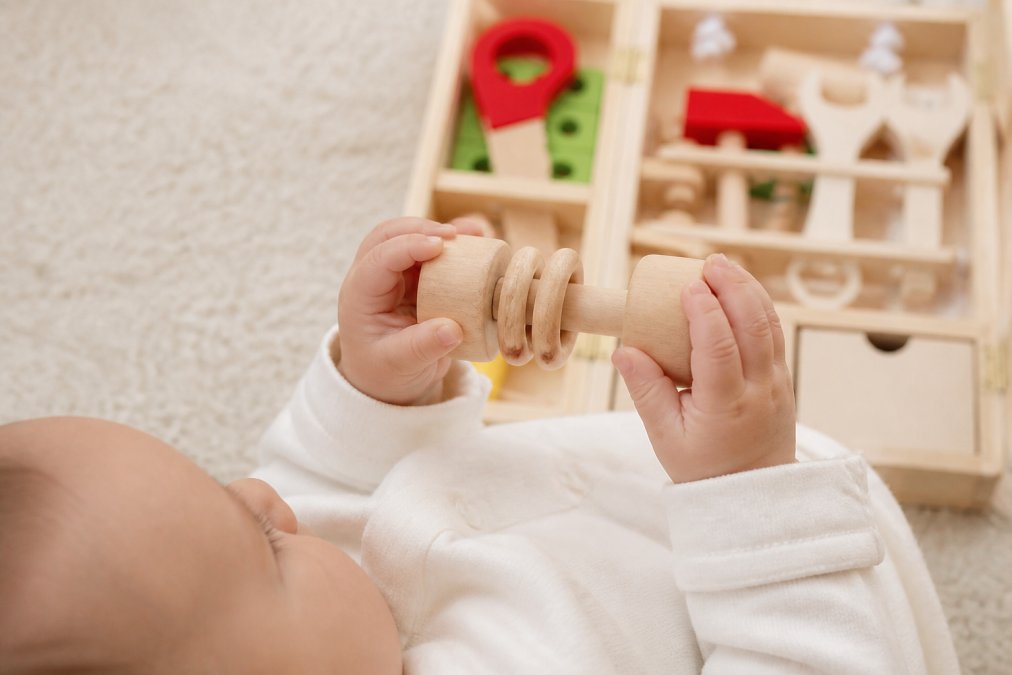
Grasping and Hand-to-Hand Transfer
The grasping reflex is present at birth but requires practice to develop into intentional, controlled grasping. Montessori-inspired toys support this progression through thoughtful design: handles sized for small hands, weights that provide feedback without being too heavy, and shapes that naturally invite gripping.
Hand-to-hand transfer, the skill of moving an object from one hand to the other, emerges around 3-4 months and represents a major cognitive milestone (the CDC). Lightweight wooden toys with interesting shapes encourage this transfer naturally. At birth, a baby needs toys that are easy to grasp reflexively. By 3-4 months, toys that require slightly more effort encourage stronger, more intentional grip. By 6 months, toys that can be manipulated in multiple ways support growing cognitive complexity.
How to Set Up a Montessori Play Area for Newborns
Creating a Prepared Environment
The Montessori method emphasizes the "prepared environment," a thoughtfully designed space that invites independent exploration. For newborns, this means intentional simplicity.
Start with a low play mat or blanket in a quiet corner of your home, positioned near a window if possible. The play area should be free from household traffic, away from loud appliances, and separate from general living spaces. The prepared environment includes a low play mat with good cushioning, a low shelf or basket holding 4-6 toys, soft natural lighting, minimal visual distractions, and a temperature-controlled space. This setup allows a baby to explore safely while you remain nearby, respecting the baby's need for freedom within safe boundaries.
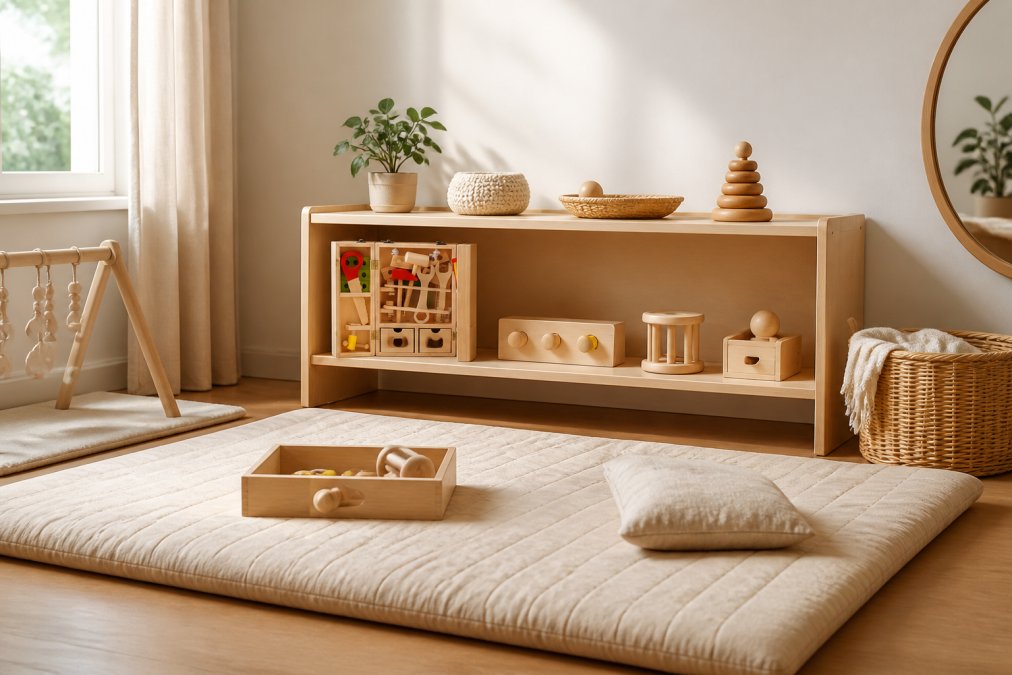
Rotation and Minimalist Principles
The minimalist principle in Montessori practice isn't about deprivation, it's about depth. A baby with five toys available for extended exploration develops deeper understanding than one surrounded by fifty toys they barely touch.
Rotate toys every 1-2 weeks. Remove three toys and introduce three new ones. This rotation prevents boredom, keeps toys novel, and maintains a visually calm play space. When a baby returns to a toy after two weeks away, they often engage with it at a more advanced level. The minimalist approach also reduces decision fatigue for parents and creates a calmer environment overall.
Montessori Toys by Age: Birth to 12 Months
0-3 Months: Visual Stimulation and Reflexes
Newborns are reflex-driven. Toys for this stage should support these reflexes while beginning to build intentional skills. High-contrast cards or boards held 8-12 inches from the baby's face will capture their attention through contrast alone. Wooden rattles with high-contrast rings combine visual stimulation with auditory feedback. Soft, lightweight toys are essential, as newborns have minimal strength.
By 3 months, babies begin showing preference for certain objects and can track moving items across their visual field. Toys that move slowly support this emerging tracking skill.
3-6 Months: Grasping and Object Permanence
This period marks the transition from reflexive to intentional grasping. Wooden rattles with varied handle shapes encourage different grip positions. Interlocking discs and wooden rings on a central post allow babies to grasp one ring while seeing others, supporting the understanding that multiple objects can exist simultaneously.
Soft fabric toys with crinkly inserts provide auditory feedback that reinforces cause-and-effect understanding. Object permanence begins emerging around 4-5 months (peer-reviewed research). Partially hiding a toy under a blanket and encouraging the baby to find it supports this cognitive development.
6-12 Months: Independent Play and Cognitive Growth
By 6 months, babies are developing sitting balance and increased hand control. Wooden blocks support stacking and knocking down, building spatial awareness and understanding of cause and effect. Toys with moving parts, wheels that roll, and hinged lids invite repeated exploration and problem-solving.
By 9-12 months, babies are crawling, pulling to stand, and developing pincer grip. Toys should support these skills: small objects safe for grasping, toys at varying heights, and toys that reward persistence. Babies begin understanding sequences, developing memory, and showing preferences. Toys with multiple steps or sequences sustain engagement.
Safety, Materials, and Maintenance
Natural Materials vs. Plastic
Wooden toys develop tactile awareness through varied grain patterns, natural temperature regulation, and subtle weight variations that plastic cannot replicate. Wood also naturally resists bacterial growth better than porous plastics. Wooden toys age beautifully, developing character rather than becoming dingy.
For newborns specifically, natural materials are the stronger choice. Babies mouth everything, and wood is safer than plastic when it comes to chemical exposure. The sensory input from natural materials supports development more effectively than the uniform feel of plastic.
Cleaning Wooden Toys Safely
Wooden toys require different care than plastic. The key is preventing water from penetrating the wood, which causes warping and mold.
Wipe wooden toys with a damp cloth rather than submerging them. Use mild soap and warm water, then dry immediately. For deeper cleaning, use equal parts white vinegar and water. Avoid harsh chemicals, bleach, and dishwashers. Store wooden toys in a dry location, as humidity causes swelling and mold.
Recognizing Overstimulation
Overstimulation is often caused by too many toys or toys that are too stimulating. Signs include difficulty sleeping, excessive crying, and loss of interest in play.
When a baby shows these signs, reduce the number of toys available to two or three and remove any toys with sounds or lights. Create a quieter play environment with softer lighting. Often, a baby's behavior improves within days when the environment becomes calmer. Montessori-inspired toys prevent overstimulation because they're designed to be engaging without being overwhelming.
DIY Montessori Toy Alternatives
Creating your own Montessori-inspired toys costs little and teaches you exactly what your baby responds to.
High-contrast cards: Print black-and-white geometric patterns on cardstock and laminate them.
Sensory baskets: Fill a small basket with safe household items like a wooden spoon, metal measuring cup, soft cloth, and wooden clothespin.
Crinkle toys: Cut two identical pieces of cotton fabric, place crinkled paper between them, and stitch around the edges.
Treasure baskets: For babies 6+ months, fill a basket with safe natural objects like smooth stones, large wooden beads, a pinecone, or bark. Rotate items weekly.
Interlocking rings: Thread wooden beads onto a wooden dowel, sand everything smooth, and finish with food-grade oil.
The advantage of DIY toys is that you can customize them to your baby's interests. Tender Tots & Wellness offers carefully curated Montessori-inspired toys like the Tender Tots Wooden Tool Disassembly Playset ($55.99), which supports hands-on learning and fine motor development. For newborns specifically, simple wooden rattles and high-contrast toys offer the best foundation.

Conclusion
Montessori-inspired toys for newborns aren't about having the most expensive items or the trendiest collection. They're about understanding how babies actually develop and providing the right tools for each stage. A high-contrast card, a wooden rattle, and a prepared play environment create the conditions for deep learning and healthy development.
The shift from overstimulation to purposeful simplicity often surprises parents. Babies sleep better, play longer, and show greater contentment when surrounded by fewer, better toys. This approach aligns with what child development research consistently shows: depth of exploration matters more than breadth of options.
Ready to create a calm, developmentally supportive play space for your newborn? Tender Tots & Wellness offers a curated selection of natural, Montessori-inspired toys designed for modern families. Our products blend timeless elegance with developmental science, and every item is chosen to support your baby's growth while keeping your nursery beautifully minimalist. With free worldwide shipping and a commitment to quality at fair prices, we make it easy to build an environment where your baby thrives. Shop now and discover toys that spark genuine learning and joy.
Frequently Asked Questions
Q: What makes a toy truly Montessori-inspired versus just a regular toy with marketing?
A: Montessori-inspired toys prioritize child-led, purposeful play with minimal distraction. They feature natural materials, open-ended design, and support specific developmental milestones. They encourage concentration and independent exploration. Look for wooden construction, simple designs, and toys that grow with your child rather than toys that do things for them.
Q: How do montessori sensory toys for newborns actually support development?
A: Montessori sensory toys engage your baby's senses in purposeful ways. High-contrast visuals support tracking and visual development. Natural textures build tactile awareness. Wooden rattles and grasping toys strengthen fine motor skills and the grasping reflex. Toys designed for hand-to-hand transfer develop coordination. This sensory input directly supports cognitive growth, spatial awareness, and object permanence, all critical milestones in the first year.
Q: What should I prioritize when choosing montessori toys for my newborn?
A: Start with age-appropriate toys that match your baby's developmental stage. For 0-3 months, focus on high-contrast visuals and simple grasping toys. For 3-6 months, introduce toys supporting object permanence and hand-to-hand transfer. For 6-12 months, choose toys encouraging independent play and problem-solving. Prioritize natural materials, safety, and toys without batteries or excessive features. Quality matters more than quantity.
Q: Are wooden Montessori toys worth the investment over plastic alternatives?
A: Wooden toys offer durability, non-toxic safety, and aesthetic appeal that supports a prepared environment. They're sustainable and often last through multiple children. While they cost more upfront, they hold value and can be passed down or resold. For a Montessori approach focused on minimalism and purposeful play, wooden toys align better with the philosophy and offer better long-term value.
This article was written using GrandRanker