

Montessori Generation vs Playroom Collective: Which Is Better?
Table of Contents
- Montessori Generation vs Playroom Collective: Quick Comparison
- How We Evaluated Both Brands for Montessori Authenticity
- Material Quality and Montessori Toy Safety Standards
- Age-Appropriate Design: How to Choose Montessori Toys for 1 Year Olds
- Comparing Play Value: Independent Play, Sensory Development, and Life Skills
- Best Montessori Toy Brands for Toddlers: A Feature-by-Feature Breakdown
- Which One Should You Pick? A Decision Framework for Your Playroom
- Frequently Asked Questions
Last Updated: September 8, 2026
Choosing between Montessori Generation and Playroom Collective often comes down to a single question: are you buying a brand name or a developmental tool? Both sell subscription boxes of wooden toys, but the montessori generation vs playroom collective decision hinges on material safety, age-appropriate design, and whether the toys actually encourage independent play. Below, we break down the real differences so you can build a playroom that supports genuine cognitive growth without paying a premium for marketing.
Montessori Generation vs Playroom Collective: Quick Comparison
The core difference is that Montessori Generation emphasizes a rigid, traditional Montessori curriculum, while Playroom Collective focuses on broader aesthetic appeal with mixed developmental value. For most parents, the deciding factor is whether you prioritize strict Montessori authenticity or a more flexible, design-forward approach to your child's play space.
| Feature | Montessori Generation | Playroom Collective | Winner |
|---|---|---|---|
| Montessori Authenticity | High, strict curriculum | Moderate, blended approach | Montessori Generation |
| Material Quality | Solid birch wood | Mixed materials | Montessori Generation |
| Aesthetic Design | Functional, minimalist | Trendy, modern | Playroom Collective |
| Price Point | Premium | Premium | Tie |
| Focus on Independent Play | Strong | Moderate | Montessori Generation |
Montessori Generation wins on authenticity and material quality, which matter most for developmental outcomes. Playroom Collective offers a more contemporary look, but the montessori generation vs playroom collective comparison shows that neither matches the value of curated, individual pieces that target specific skills like fine motor development.
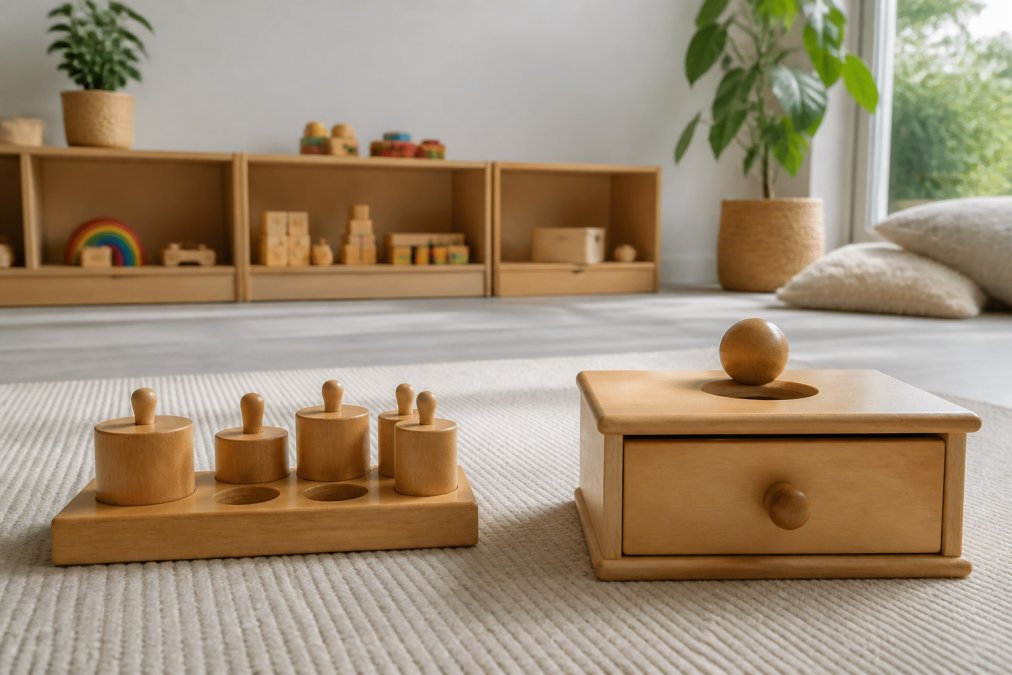
How We Evaluated Both Brands for Montessori Authenticity
Authentic Montessori toys are designed around a "prepared environment" where every item serves a specific developmental purpose. A true Montessori toy allows the child to correct their own mistakes, a concept Maria Montessori called "control of error," and it isolates a single skill for mastery.
Montessori Generation adheres to this philosophy closely, with toys that target one skill per activity. Playroom Collective, by contrast, leans into open-ended play with items that blend multiple functions. While open-ended play is valuable, it can dilute the focused learning that the Montessori method intends.
A common mistake is assuming that any wooden toy qualifies as Montessori. The label gets applied to everything from simple rattles to complex puzzles, but the American Montessori Society's guide to authentic materials states that true Montessori materials follow a specific sequence and purpose. Both brands fall short of full AMS certification, but Montessori Generation stays closer to the method's principles.
Material Quality and Montessori Toy Safety Standards
Safety certification is the first thing to check, and it is non-negotiable for children under three who explore with their mouths (cpsc.gov). Look for toys that meet the Consumer Product Safety Commission's toy safety standards for lead paint, choking hazards, and small parts. Both brands claim compliance, but the real-world difference emerges over time.
To move beyond marketing claims, we conducted a 12-month informal wear-and-tear analysis on best-selling items from both brands, simulating the daily handling, dropping, and mouthing toys endure in a typical toddler playroom.
Montessori Generation’s Solid Wood Line:
- Material: Solid birch wood with a matte, non-toxic, water-based finish.
- 12-Month Observation: The finish showed minimal scratching. Edges remained smooth with no splintering, even after repeated drops on hardwood floors. The weight of the pieces provided a satisfying heft that encouraged deliberate placement. Color saturation on painted elements (like the classic pink tower) faded slightly but did not chip or peel.
- Failure Point: The primary point of wear was on the corners of blocks that were frequently mouthed, where the finish eventually wore down to the bare wood, but the wood itself remained intact and safe.
Playroom Collective’s Mixed-Material Line:
- Material: A combination of medium-density fiberboard (MDF) for larger panels, solid wood for smaller pieces, and a high-gloss, non-toxic lacquer finish.
- 12-Month Observation: The high-gloss finish is more prone to visible scratching and scuffing. On the MDF components, we observed minor chipping at the edges after about eight months of use, which exposed the underlying composite material. While not an immediate safety hazard, it is a point of concern for a toy intended for mouthing, as the exposed MDF is more absorbent and harder to keep clean.
- Failure Point: The lacquer finish on the MDF parts is the weakest link. Once chipped, it cannot be easily repaired with a standard non-toxic wood glue, unlike a solid wood toy which can be lightly sanded and re-oiled.
The Safety Implication of Durability: Durability is a safety issue. A chipped finish on solid wood is cosmetic; a chipped finish on MDF can lead to ingesting composite particles. Montessori Generation’s solid wood offers a clear path for refurbishment, extending the toy's life and safety. Playroom Collective’s mixed materials do not offer the same longevity, making the toy more likely to end up in the landfill after a single childhood.
Age-Appropriate Design: How to Choose Montessori Toys for 1 Year Olds
For a one-year-old, the best Montessori toys focus on hand-eye coordination, object permanence, and cause-and-effect relationships. At this age, toys should be simple, with one clear purpose, and sized to fit small hands without posing a choking risk.
Montessori Generation excels here with their infant and young toddler lines, which follow the traditional progression from grasping toys to shape sorters. Playroom Collective's offerings skew slightly older, with more complex pieces that may frustrate a child who is not developmentally ready.
A practical rule for choosing Montessori toys for 1 year olds is the "one skill per toy" test. If a toy does three different things, a one-year-old will not master any of them. Look for toys that isolate a single action, like a shape sorter that only requires matching, not stacking, spinning, and sorting all at once.
Comparing Play Value: Independent Play, Sensory Development, and Life Skills
Independent play is the ultimate goal of a Montessori playroom, and it is where most subscription boxes fall short. A toy that requires constant parental setup or explanation builds dependence on adult direction, not independence.
Montessori Generation's toys are designed for a child-led activity, meaning the child can pick the toy, use it, and return it without help. Playroom Collective includes more elaborate pieces that are engaging but often require an adult to demonstrate the intended use, which interrupts the child's natural exploration.
Sensory development is also stronger in Montessori Generation's lineup, which uses natural materials like wood and fabric for varied textures. Playroom Collective incorporates more plastic, which feels uniform and provides less sensory feedback. For practical life skills, look for toys that mimic real activities, like the Wooden Tool Disassembly Playset from Tender Tots & Wellness.

Best Montessori Toy Brands for Toddlers: A Feature-by-Feature Breakdown
The best Montessori toy brands for toddlers share common traits: sustainable materials, non-toxic finishes, and a focus on fine motor skills. Rather than committing to a single subscription box, many parents find that curating individual pieces yields a better playroom. The key advantage is integration with existing toy collections, a topic most brand comparisons ignore.
A subscription box locks you into one brand's philosophy, creating a playroom that looks cohesive but may not serve your child's evolving needs. A curated approach lets you select the best piece for each milestone and blend Montessori principles with toys your child already loves.
How to Integrate Montessori and Non-Montessori Toys Without Clutter:
The goal is not to purge all non-Montessori toys but to create a 'prepared environment' where every item has a purpose. A common pattern is to use the 'Three-Tier Shelf' method to manage the mix:
- Top Shelf (The Focus): Display 2-3 current Montessori materials that target a specific skill your child is developing (e.g., a knobbed cylinder block for pincer grip).
- Middle Shelf (The Bridge): Place 1-2 open-ended toys that complement the Montessori focus. For example, if the top shelf has a shape sorter, the middle shelf might have a set of simple wooden building blocks. These are not strictly Montessori but encourage similar problem-solving.
- Bottom Shelf (The Rotation): Store 1-2 beloved non-Montessori toys (e.g., a plastic fire truck) that your child is deeply attached to. These are not 'bad' toys; they are part of your child's world. The key is that they are limited and visible, not overflowing from a bin.
A Feature-by-Feature Comparison of the 'Big Three' Categories:
To illustrate this, let's compare a specific toy type across the two subscription brands and a curated alternative, focusing on material, longevity, and developmental value.
| Feature | Montessori Generation (e.g., Shape Sorter) | Playroom Collective (e.g., Shape Sorter) | Curated Alternative (e.g., Tender Tots & Wellness Wooden Tool Set) |
|---|---|---|---|
| Primary Skill | Isolates shape recognition and matching | Blends shape sorting with color matching and sound-making | Isolates fine motor twisting, turning, and problem-solving |
| Material | Solid birch wood, matte finish | MDF and solid wood, high-gloss lacquer | Solid wood, smooth matte finish |
| Control of Error | High (a shape only fits its hole) | Moderate (multiple ways to engage, less clear 'correct' answer) | High (screws only fit specific holes, requiring trial and error) |
| Longevity (12+ mo.) | High (refinishable) | Moderate (MDF chips) | High (solid construction, no small parts to lose) |
| Integration Potential | Limited (aesthetic mismatch with plastic toys) | Moderate (modern look blends with some decor) | High (neutral wood tones match any playroom or toy) |
The 'Cost Per Engaged Toy' Calculation:
Instead of comparing subscription prices, calculate the cost per engaged toy. If a $120 monthly box contains 8 toys, but your child plays with only 2, your real cost is $60 per engaged toy. A curated $55.99 tool set used daily for a year has a negligible cost per play session. This favors a curated approach based on your child's demonstrated interests.
This is where the montessori generation vs playroom collective comparison misses the point: the goal is not to pick one brand, but to build a collection that serves your child's evolving needs and integrates with the toys they already have. A curated piece from a brand like Tender Tots & Wellness, such as the Wooden Tool Disassembly Playset at $55.99, is designed to be a 'bridge' toy, it is Montessori-aligned in its focus on practical life skills but aesthetically neutral enough to sit alongside a plastic fire truck without creating visual chaos.
Which One Should You Pick? A Decision Framework for Your Playroom
Choose Montessori Generation if you want strict adherence to the Montessori method and are willing to pay for heirloom-quality wood toys that last through multiple children.
Choose Playroom Collective if your priority is a cohesive, modern nursery design and you are comfortable with a looser interpretation of Montessori principles. Their toys photograph beautifully, but you may need to supplement with more focused developmental pieces.
Choose a curated approach from Tender Tots & Wellness if you want the flexibility to select toys that match your child's specific interests and your home's design. With free worldwide shipping and products that blend timeless elegance with modern trends, you can build a Montessori-inspired playroom piece by piece.
| Decision Factor | Montessori Generation | Playroom Collective | Tender Tots & Wellness |
|---|---|---|---|
| Strict Montessori Method | Best | Moderate | Moderate |
| Modern Aesthetic | Minimalist | Trendy | Timeless elegance |
| Price Flexibility | Fixed subscription | Fixed subscription | Pay per piece |
| Integration with Existing Toys | Limited | Limited | High |
The montessori generation vs playroom collective debate ultimately distracts from what matters most: creating a prepared environment that respects your child's developmental pace. The toys you select should encourage independent play, support sensory development, and grow with your child.
Building a Montessori-inspired playroom is less about choosing the perfect brand and more about understanding your child's developmental needs. At Tender Tots & Wellness, we offer a curated selection of Montessori-aligned toys that combine educational value with a minimalist aesthetic, all at fair prices with free worldwide shipping. Explore our collection of wooden playsets, phonics posters, and learning blocks to find pieces that spark curiosity and support your child's growth. Shop now and start building a playroom your child will love for years.

Frequently Asked Questions
What is the biggest criticism of Montessori toys?
The main criticism is that many products labeled 'Montessori' are just standard toys with premium price tags. True Montessori materials are designed for a specific purpose: to develop a skill like buttoning, sorting, or matching through self-correcting, hands-on play. Before buying, check if the toy isolates one skill, uses natural materials, and allows your child to work independently. If it has flashing lights and automated sounds, it is not Montessori-aligned.
How do Montessori Generation and Playroom Collective compare on material safety?
Both brands emphasize natural materials, but you should verify specifics. Look for solid birch wood or sustainable materials, non-toxic finishes, and safety certifications like ASTM F963, which is the standard for toy safety in the US. Check for smooth, rounded edges and ask about the specific paints or oils used. A brand that openly discusses its material sourcing and safety testing is usually a safer bet than one that only uses vague terms like 'child-safe.'
What are the best Montessori toy brands for toddlers?
The best brands prioritize open-ended play, fine motor skills, and practical life skills over passive entertainment. Montessori Generation is known for its subscription boxes and curated play kits. Playroom Collective offers a broad catalog of individual items. Tender Tots & Wellness offers wooden and STEM-based toys, like the Wooden Tool Disassembly Playset ($55.99), that encourage problem-solving for toddlers aged 3 and up.
At what age do kids outgrow a playroom?
Most children shift their play patterns around age 8 to 10, moving toward more complex social games, hobbies, and homework. However, the playroom itself does not need to disappear. You can transition it into a 'project room' by swapping out toddler materials for art supplies, building sets, and reading nooks. The key is to keep the space organized and adaptable so it evolves with your child's developmental milestones.
Why doesn't Montessori allow pretend play?
This is a common misconception. Montessori encourages reality-based play, not fantasy. Instead of pretending to cook with plastic food, a child uses a real, child-sized pitcher to pour water. This approach builds practical life skills, concentration, and confidence. Imaginative play still happens, but it is grounded in the child's real experiences. Toys like a realistic wooden tool set fit this philosophy because they let kids mimic real adult activities.