

Are Montessori Toys Worth the Cost? A Real Parent's Analysis
Table of Contents
- Are Montessori Toys Worth the Cost? The Verdict
- What Makes Montessori Toys Different From Traditional Toys
- The Real Financial Case: Cost Per Use and Long-Term Value
- Montessori Toys for 1 Year Olds: What Actually Develops Skills
- Montessori Toy Safety Standards and What You Need to Know
- Affordable Montessori Alternatives That Actually Work
- How to Spot Fake Montessori Marketing and Choose Wisely
- Conclusion: The Smart Parent's Approach to Montessori Toys
- Frequently Asked Questions
Last Updated: September 4, 2026
Are Montessori Toys Worth the Cost? The Verdict
Many parents wonder if Montessori toys justify their cost against cheaper plastic alternatives. The answer: yes, when you account for durability, developmental value, and sustained engagement. These toys are designed on a simple principle, children learn best through self-directed, hands-on activity with real-world materials.
This guide breaks down the financial picture, developmental milestones by age, and where to save money without sacrificing quality.
The verdict: buy selectively with age-appropriate pieces that encourage independent play, and cost-per-use often beats cheaper alternatives abandoned within weeks.
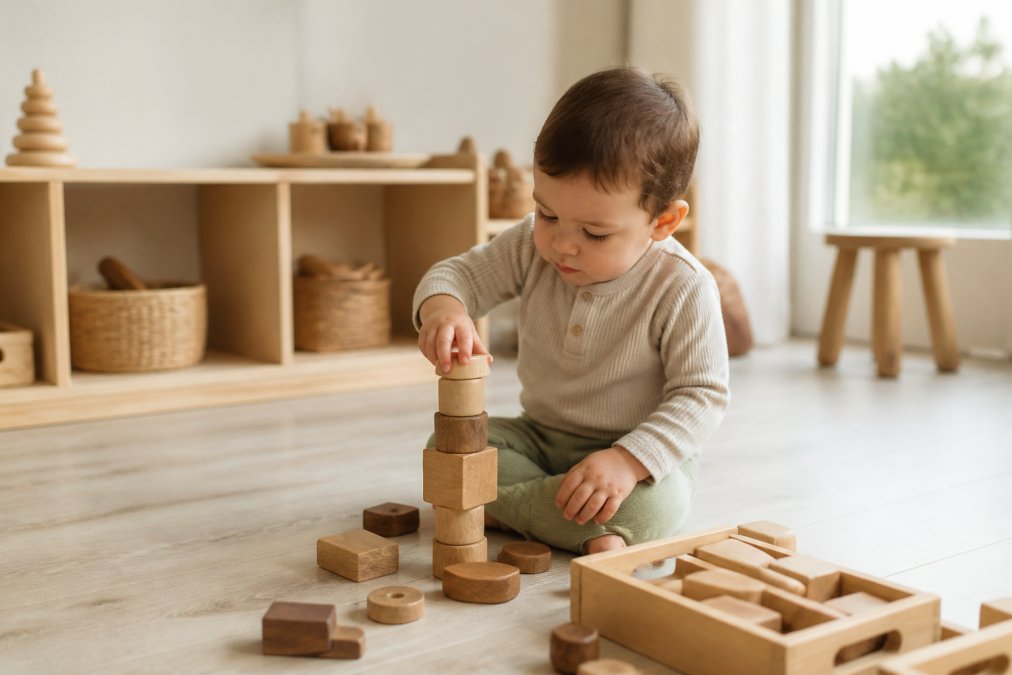
What Makes Montessori Toys Different From Traditional Toys
Montessori toys prioritize discovery over passive entertainment. Traditional toys do the thinking for the child with buttons and pre-programmed sounds; Montessori materials require active problem-solving, building intrinsic motivation and cognitive development.
Wooden toys offer sensory experiences plastic cannot replicate, weight, texture, temperature, developing spatial awareness and hand-eye coordination through trial and error.
| Feature | Montessori Toys | Traditional Toys |
|---|---|---|
| Primary goal | Skill development | Entertainment |
| Materials | Wood, metal, fabric | Plastic, electronics |
| Play style | Open-ended | Fixed function |
| Adult role | Observer and guide | Director |
| Typical lifespan | Years to heirloom | Months to landfill |
Dr. Maria Montessori observed that children prefer real, purposeful activity over fantasy. Toys reflect practical life skills, pouring, sweeping, buttoning, and support milestones through scaffolding: slightly challenging but achievable tasks.
The Real Financial Case: Cost Per Use and Long-Term Value
Parents comparing a $55.99 wooden playset to a $20 plastic toy miss the full picture. True analysis requires examining cost-per-use, durability across children, and resale value, factors that shift the math dramatically in favor of Montessori toys.
Cost Per Use: The Hidden Advantage
A well-made wooden toy engaging a child for three years delivers hundreds of uses; a plastic toy abandoned after two weeks does not. Divided by actual play sessions, the Montessori option frequently wins.
Resale Value and the Circular Economy
Montessori toys hold resale value because they last. The secondary market for used wooden toys is robust, with families recouping 40-60% of their original investment, a circular economy plastic toys rarely participate in.
A $56 wooden toy used 2-3 years and sold for $25-$30 reduces true cost to $26-$31. A $20 plastic toy has no resale value and ends in landfill.
Total Cost of Ownership Across Multiple Children
For families with multiple children, the financial case strengthens. A wooden toy serving three children amortizes cost across years and users.
A $45 wooden stacking toy used by three children ages 1-3 costs $5 per child per year. Three plastic toys at $20 each = $60 total with no resale value and landfill waste.
The Minimalism Factor
Montessori philosophy encourages a curated environment with fewer, better items. A minimalist playroom with ten quality pieces costs less than fifty disposable ones, and research supports simplified play spaces.
Curated collections reduce decision fatigue. Children with too many options experience choice paralysis and shorter play sessions. Fewer, higher-quality toys encourage deeper engagement and longer independent play.
Real-World Financial Scenario
With a $300 annual budget: Path A (Montessori) nets $300-$400 over three years for a curated, durable collection. Path B (plastic) nets $900 with minimal resale value. Over a decade, the Montessori approach delivers better outcomes at lower cost.
Montessori Toys for 1 Year Olds: What Actually Develops Skills
For one-year-olds, Montessori toys target object permanence, cause-and-effect, and fine motor skills. Object permanence boxes, stacking rings, and shape sorters directly support these milestones.
For one-year-olds, choose toys encouraging grasping, dropping, and manipulating. Natural materials provide tactile feedback supporting sensory integration during this critical period.
Quality of interaction matters most. Ten minutes of focused play with a wooden rattle teaches more than an hour of passive electronic exposure. Independent play develops concentration.
Follow the child's interests. If ignored, set the toy aside and retry in a month. Development happens in leaps, not linear progression.
Montessori Toy Safety Standards and What You Need to Know
U.S. Montessori toys must meet the Consumer Product Safety Improvement Act, which limits lead, phthalates, and hazardous materials (cpsc.gov). Look for federal compliance and testing certifications.
Wood toys require different safety considerations than plastic. Look for non-toxic, water-based finishes rather than unknown varnishes.
The U.S. Consumer Product Safety Commission guidance on toy safety recommends checking for sturdy construction, securely attached parts, and age-appropriate sizing. Montessori toys, with their emphasis on real materials, must meet the same federal standards as any other children's product sold in the United States.
Many quality brands voluntarily submit products for independent safety testing beyond federal requirements. Look for explicit statements about testing and materials sourcing.
Affordable Montessori Alternatives That Actually Work
Montessori toys don't require a large budget. Many effective alternatives cost little because the philosophy emphasizes real objects from daily life.
A hybrid approach works well: invest in a few high-quality core pieces for years of use, then supplement with safe DIY alternatives. This reduces spending while maintaining developmental integrity.
DIY Object Permanence Box
The object permanence box teaches that hidden objects still exist. Commercial versions cost $30-$50. DIY: drill a 2.5-3 inch hole in a wooden box, sand thoroughly, add a ball. The child drops the ball through, hears it land, retrieves it, and repeats, teaching cause-and-effect and object permanence for under $10.
DIY Sensory Treasure Basket
A "treasure basket" filled with household objects provides sensory and exploratory benefits. Safe items: metal whisk, wooden spoon, sea sponge, fabric scraps, napkin ring, measuring cup, sock ball, river stone. Place 6-8 items in a low basket and rotate every 3-5 days. Cost: $0-$15.
Cost Comparison: DIY vs. Commercial
A hybrid budget for ages 6-18 months: 2-3 wooden toys ($80-$120), DIY object permanence box ($8-$12), DIY sensory basket ($0-$15), household items ($0-$20), literacy materials ($12-$25). Total: $100-$192. Ten plastic toys cost $150-$250 with less developmental value.
When to Invest vs. When to DIY
Invest in commercial toys when precision engineering, safety certifications, or multi-child use is critical. DIY when teaching single concepts, sourcing safe home materials, or items will be outgrown within 6-12 months.
The goal is creating opportunities for child-led learning. Sorting laundry teaches classification; measuring ingredients teaches early math. These moments cost nothing and often outperform store-bought toys.
How to Spot Fake Montessori Marketing and Choose Wisely
"Montessori" has no legal protection in the U.S., so any manufacturer can use the label. Fake marketing features loud colors, electronics, or single-purpose plastic, contradicting the philosophy.
Authentic Montessori toys feature natural materials, single focused purpose, self-correction, and realistic design. Batteries and noise indicate non-alignment. Look for simplicity, quality, and clear developmental intent.
Ask three questions: Does it allow open-ended play? Is it natural and durable? Can the child use it independently? If any answer is no, it fails the Montessori test regardless of branding.
The Tender Tots & Wellness collection applies these principles with timeless elegance and modern trends. Items range from wooden tool playsets developing fine motor skills to phonics materials supporting early literacy. Free worldwide shipping ensures accessibility.

Conclusion: The Smart Parent's Approach to Montessori Toys
Montessori toys are worth the cost when chosen intentionally. Combine quality investment pieces with DIY alternatives and household objects for a rich learning environment without overspending.
Start with one or two items matching your child's developmental stage. Observe engagement, then expand gradually. A curated collection serves better than an overflowing toy box.
Tender Tots & Wellness offers high-quality products at fair prices, from the $55.99 Wooden Tool Disassembly Playset to budget-friendly Phonics Learning Posters at $12.33. Each item is selected to support developmental milestones while maintaining the aesthetic parents want in their homes. Get started with Tender Tots & Wellness and build a play space that grows with your child.
Frequently Asked Questions
Why are Montessori toys so expensive compared to regular toys?
Montessori toys cost more because they're designed for specific developmental stages, use natural materials like wood, and prioritize durability and longevity. A single wooden toy may cost $30-60, but families report using the same piece for years across multiple children. The investment reflects quality materials, safety standards, and educational design rather than marketing or branding. Budget alternatives exist, but they typically sacrifice durability or educational value.
Are Montessori toys for 1 year olds actually better for development than cheaper alternatives?
Research shows open-ended toys, the hallmark of Montessori design, support cognitive development, fine motor skills, and independent play more effectively than toys with preset functions. For 1-year-olds specifically, items like wooden grasping toys, stacking rings, and sensory materials develop hand-eye coordination and object permanence. However, the benefit depends on how toys are used. A $50 Montessori toy gathering dust provides no advantage over a $10 toy your child actively plays with daily.
What are Montessori toy safety standards I should look for?
Look for toys that meet ASTM F963 (toy safety standards) and CPSIA compliance for lead and phthalate testing. Many Montessori toys use natural wood finished with non-toxic stains. Check product listings for safety certifications and materials. Avoid toys with small detachable parts for children under 3. Reputable sellers like Tender Tots & Wellness provide clear material information and certifications, reducing the risk of purchasing unmarked or untested products.
What's the best way to build a Montessori playroom on a budget?
Start with affordable Montessori alternatives like wooden blocks, stacking toys, and DIY sensory bins filled with safe household items. Invest in one or two quality pieces, like a wooden tool set or learning blocks, that will last years. Shop secondhand for gently used wooden toys, which retain value well. Combine budget pieces with strategic purchases like Tender Tots' Wooden Tool Disassembly Playset ($55.99) or WordWise Blocks ($25.00) that deliver high developmental value without excessive cost.
This article was written using GrandRanker