

What Montessori Sensory Play Ideas Suit One-Year-Olds?
Last Updated: October 27, 2026
Quick Summary
Montessori sensory play for one-year-olds uses a few simple, real materials and a safe space, with the adult observing instead of directing. Treasure baskets, scooping, pouring, stacking and shallow sensory bins suit the 12 to 24 month stage. Keep sessions to ten to fifteen minutes and skip small choking hazards.
- Match activities to the stage: 12 to 15 months need large objects and cause-and-effect play.
- Use a rimmed tray or tub no deeper than about 3 inches for a first sensory bin.
- Add only two or three tools, such as one scoop, one cup and one small bowl.
- Skip beads, coins, water beads and small pom-poms until past the mouthing stage.
- Keep sensory bin sessions to ten to fifteen minutes and empty the bin after play.
Table of Contents
- Montessori Sensory Play Ideas for One-Year-Olds: What Actually Works
- Why the 12 to 24 Month Range Matters
- Montessori Principles in Plain Terms
- Sensory Activities for 1-Year-Olds That Build Real Skills
- Sensory Bins for Toddlers: How to Set One Up Without the Mess
- Easy Sensory Play at Home with What You Already Own
- Safe Sensory Play Ideas for Babies and Toddlers: Choking Risks and Supervision
- Low-Mess and Accessible Options for Busy Households
- Choosing Montessori-Inspired Sensory Toys at Tender Tots & Wellness
- Frequently Asked Questions
Montessori Sensory Play Ideas for One-Year-Olds: What Actually Works
Montessori sensory play ideas for one year olds work best when they match how a child this age actually learns: by touching, moving, pouring, and repeating.
A one-year-old does not need a shelf full of gadgets. They need a few well-chosen materials, a safe space, and an adult who steps back.
Below, we break down ideas for the 12 to 24 month range, how to set them up, and safety and cleanup considerations.
Why the 12 to 24 Month Range Matters
Twelve to 24 months is a distinct developmental window. During this time, babies shift from mouthing objects to exploring with their hands.
A common mistake is treating a 12-month-old and a 23-month-old the same. They are not. A younger toddler tests cause and effect.
Match the activity to the stage:
- 12 to 15 months: large objects, simple cause-and-effect, lots of mouthing
- 15 to 20 months: scooping, stacking, filling and dumping
- 20 to 24 months: pouring with some control, arranging, early pretend play
Montessori calls this sensitive period for order and movement. In plain terms, your child is wired to practice the same motion until they master it.
Montessori Principles in Plain Terms
Montessori sensory play is a child-led approach where toddlers explore real materials with their hands, at their own pace, in a prepared and safe space. For a deeper plain-language explanation, read our guide to Montessori principles for early childhood development.
Three principles drive everything:
Follow the child. If your toddler wants to dump the bin ten times, let them. Repetition is the lesson.
Use real, natural materials. Wood, fabric, metal, water, and food over flashing plastic. Real objects give honest feedback through touch, weight, and sound.
Prepare the environment, not the child. A low shelf, a small tray, and a mat do more than any toy. The setup invites independent exploration.
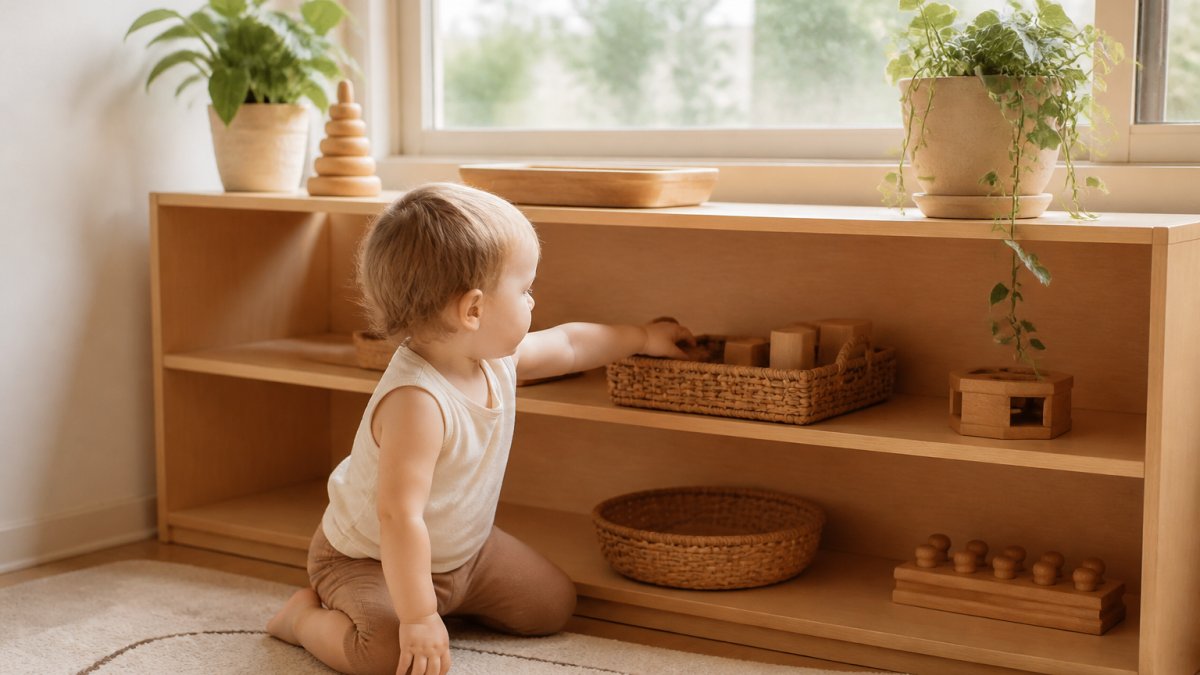
Sensory Activities for 1-Year-Olds That Build Real Skills
Here are sensory activity ideas, grouped by the skills they may involve.
Fine Motor and Hand-Eye Coordination
- Treasure basket. Fill a shallow basket with safe household objects: a wooden spoon, a fabric square, a metal whisk, a large cork. Let your baby pull them out and mouth the safe ones. This builds grip and texture awareness.
- Stacking and knocking down. Soft blocks or wooden rings teach stacking, then the joy of knocking them down. That crash is hand-eye coordination practice.
- Posting and dropping. A large slot in a box lid lets your toddler drop in big pom-poms or wooden discs. This is early problem-solving.
- Fabric pull. Tie scarves loosely through a slotted lid or a cardboard tube and let them pull each one free.
Practical Life: Pouring, Scooping, and Arranging
Practical life activities are real tasks scaled down for small hands.
- Scooping. Give two bowls and a scoop. Put large dry pasta or oats in one bowl and let your toddler transfer it to the other. Start with a big scoop and a wide bowl.
- Pouring water. At bath time, offer two small cups and let your child pour back and forth. Water play is the easiest place to practice pouring without a big cleanup.
- Arranging. Set out a muffin tin and large objects to sort into the cups. Arranging builds order and matching.
Sensory Bins for Toddlers: How to Set One Up Without the Mess
Sensory bins for toddlers are shallow containers filled with a material and a few scooping tools. Here are some setup and cleanup considerations.
Establishing these simple, contained sensory experiences provides a foundational rhythm that naturally complements the broader scope of Montessori activities for toddlers.Set up in six steps:
- Pick a shallow base. Use a rimmed tray or a tub no deeper than about 3 inches. Deeper bins invite dumping and make it harder for small hands to reach the bottom. A baking sheet with a lip works for a first bin.
- Choose a filler by mouthing stage. For a 12- to 15-month-old who still mouths everything, use large dry oats, big pom-poms (larger than a golf ball), or shredded paper. For a 20- to 24-month-old who has stopped mouthing, you can introduce dry rice or lentils, but only under direct supervision. Skip water beads, beads, coins, and small buttons entirely at this age.
- Add two or three tools, not a set. One scoop, one cup, one small bowl. Too many tools overwhelm a one-year-old and turn the bin into a dumping exercise.
- Lay down a containment layer. A washable mat, an old shower curtain, or a large beach towel under the bin catches the spill. On carpet, use a vinyl tablecloth; on hard floor, a towel is enough.
- Set a boundary and model it. "The oats stay in the bin" is the rule. Scoop once yourself, then step back. A one-year-old learns the boundary by watching you keep it, not by being told.
- Cap the session. Ten to fifteen minutes is plenty at this age. End on a calm note before fatigue turns into dumping.
Cleanup: Keep a handheld vacuum or a dustpan and brush within reach before you start. Oats and pom-poms sweep up in under a minute on a hard floor.
Tender Tots Wooden Tool Disassembly Playset for Kids →
Containment alternatives if a bin keeps getting dumped:
- A rimmed baking sheet with a thin layer of oats, harder to dump than a deep tub.
- A sealed sensory bottle, no spill at all.
- A water-only bin in the bathtub, the tub contains the splash, and cleanup is a drain.
Here is the six-step setup at a glance, with the reason behind each step.
| Step | What to do | Why it matters |
|---|---|---|
| Pick a shallow base | Rimmed tray or tub no deeper than about 3 inches | Deeper bins invite dumping |
| Choose a filler by mouthing stage | Large oats, big pom-poms, shredded paper for 12-15 months | Dry rice or lentils only for 20-24 months |
| Add two or three tools | One scoop, one cup, one small bowl | Too many tools overwhelm a one-year-old |
| Lay down a containment layer | Washable mat, shower curtain, or beach towel | Catches the spill under the bin |
| Set a boundary and model it | "The oats stay in the bin" | Toddler learns by watching you keep it |
| Cap the session | Ten to fifteen minutes is plenty | End before fatigue turns into dumping |
Easy Sensory Play at Home with What You Already Own
Some sensory play ideas use household items.
- Water and cups in the bath or a shallow tub
- Dry pasta or rice in a bowl with a scoop
- Fabric scraps with different textures in a basket
If you want step-by-step projects, our guide on DIY Montessori materials for fine motor skills walks you through making simple tools at home.
Safe Sensory Play Ideas for Babies and Toddlers: Choking Risks and Supervision
Safe sensory play ideas for babies start with one rule: nothing small enough to fit through a toilet paper tube. That tube is a simple choking-hazard test used by safety advocates, if an object passes through the tube, it is too small for a one-year-old.
Choking-risk guidance by material type:
- Dry fillers (oats, rice, lentils, pasta): Safe to touch and scoop, but a toddler who puts a handful in their mouth can gag. Use large dry pasta or oats for mouthing children, and keep the bin at arm's reach so you can sweep a handful out of the mouth if needed.
- Water: Never leave a one-year-old alone with any container of water, even an inch in a shallow tub. Drowning can happen in very little water. Water play belongs in the bathtub or with an adult's hands in the tub the whole time.
- Food-based play (play dough, cooked pasta, cereal): Check for allergens before the first session, and discard any dough or food that has been mouthed and left out. Flour-and-water dough is safe if tasted but should be refrigerated and replaced every few days.
Supervision levels, match the level to the activity:
- Within arm's reach (constant hands-on): water play, any food-based play, and any bin with a filler small enough to gag on. You are not playing, but you are close enough to intervene in a second.
- In the same room, watching: large-object treasure baskets, stacking and knocking down, fabric pull, and posting with large discs. You can step back, but you keep your eyes on your child.
- Independent exploration with a check-in: a sealed sensory bottle, a texture board, or mirror play. These are safe enough for a toddler to explore while you fold laundry nearby, as long as the materials are intact.
Setup checks before every session:
- Check materials first. No sharp edges, no loose parts, no peeling paint, no loose threads.
- Use food-safe or non-toxic materials. Toddlers mouth everything, and a finish that is safe to touch is not always safe to taste. Our guide on how to pick safe non toxic toys walks through what to look for.
- Empty bins after play. Store fillers out of reach in a sealed container, a toddler who finds a stored bin unsupervised is the real risk.
For the developmental side of matching activities to your child's stage, see the age-band breakdown above.
Low-Mess and Accessible Options for Busy Households
Some days you need sensory play that cleans up in one minute. These low-mess options deliver the developmental benefit without the floor covered in oats.
- Sealed sensory bottles. Fill a bottle with water, a drop of food coloring, and large objects. Glue the lid shut. No spill, all the visual tracking.
- Edible play dough. A simple flour-and-water dough is safe if tasted and easy to sweep.
- Fabric and texture boards. A board of different fabrics gives touch input with zero cleanup.
Choosing Montessori-Inspired Sensory Toys at Tender Tots & Wellness
When you do buy, choose toys that earn their place. Look for open-ended materials, natural finishes, and a clear developmental purpose. Avoid anything that does the playing for your child.
A wooden disassembly playset is one option for older children. The Tender Tots Wooden Tool Disassembly Playset for Kids is listed for ages 3 and up. Shop the playset for $55.99.

If you are ready to shop, browse our collection.
Frequently Asked Questions
What are some Montessori sensory activities for a one-year-old?
Some activity ideas include a treasure basket of fabric scraps and wooden spoons, scooping oats from one bowl to another, stacking blocks, and pushing a small basket across the floor.
How do you set up sensory play for a one-year-old safely?
A shallow tray or bin, a washable mat, and a small selection of materials are possible setup choices.
How long should sensory play last for a one-year-old?
Ten to fifteen minutes is plenty for most one-year-olds, and some will engage for only five. Follow your child rather than a timer: stop when they lose interest or start mouthing materials. Short, frequent sessions work better than one long one, and repeating the same activity across a week builds familiarity and confidence.
What household items can a one-year-old use for sensory play?
Possible household items include wooden spoons, fabric scraps, scarves, plastic cups, metal bowls, and dry oats or uncooked pasta.
The gap between a stressful activity and a calm one usually comes down to setup and the right materials. We built Tender Tots & Wellness to make that choice easier, with Montessori-inspired toys, free worldwide shipping, and a curated mix of timeless and modern pieces. Get started with Tender Tots & Wellness and find sensory play essentials that fit your family's real life.
