

9 Must-Have Baby Travel Accessories for Long Flights
Last Updated: October 25, 2026
Quick Summary
Baby travel accessories are essential tools that address the specific challenges of long flights, including ear pressure changes, sleep disruption, feeding complications, and diaper changes in cramped spaces. The right gear, from organized diaper backpacks to spill-proof feeding bowls, transforms a stressful flight into a manageable experience.
- Pack one diaper per hour for newborns or one every two to three hours for older babies, plus one full pack of wipes per 24 hours of travel.
- Organize carry-on supplies into four zones: diaper changes, feeding, comfort and sleep, and entertainment, using your diaper backpack compartments for quick access.
- Realistic expectations for in-flight sleep are two to four hours on a 10-hour flight; use familiar comfort items and consistent pre-sleep cues from home.
- Introduce toys one at a time throughout the flight and avoid screens for the first few hours to maintain your baby's interest and rest.
- Gate-check bulky strollers instead of bringing them into the cabin to save space for essential feeding and diaper supplies.
Table of Contents
- Why Baby Travel Accessories Matter on Long Flights
- Diaper Bags and Changing Essentials
- Flying with a Baby Checklist: Feeding and Hydration
- Baby Carry-On Packing List: What Fits and What Stays Behind
- Baby Travel Sleep Accessories for Rest at 30,000 Feet
- Long-Haul Flight with a Baby Tips: Entertainment and Comfort
- Preparing Your Carry-On Before Takeoff
- Frequently Asked Questions
Why Baby Travel Accessories Matter on Long Flights
Flying with a baby over several hours demands preparation that goes beyond typical day trips. Long-haul flights expose your infant to pressurized cabins, limited mobility, extended feeding windows, and unfamiliar sleep environments, all while you're confined to a narrow seat with limited access to supplies. The right baby travel accessories transform these challenges from stressful to manageable.
Babies experience ear pressure changes during takeoff and landing. Their sleep patterns disrupt in unfamiliar spaces. Feeding becomes complicated when you're seated upright for hours. Diaper changes happen in airplane lavatories barely larger than a closet. Without the right tools, you'll spend the flight improvising, stressed, and exhausted before you land.
The difference between a difficult flight and a smooth one often comes down to having the right gear. This guide covers nine must-have baby travel accessories that actually make a difference on long flights, organized by category so you can pack strategically and travel with confidence.
Diaper Bags and Changing Essentials
A standard diaper bag won't cut it on long flights. You need something designed for travel, organized compartments, insulated sections for bottles, and a backpack design that keeps your hands free while navigating airports and narrow aisles.
The Large Capacity Mummy Baby Backpack is built for exactly this scenario. Its insulated bottle compartment maintains feeding supply temperatures, the dry/wet separation keeps accidents contained, and multiple storage areas let you access diapers, wipes, and supplies without unpacking everything. At 31 cm × 20 cm × 41 cm, it holds enough for a 12+ hour flight. The backpack straps keep your hands free during security lines and airport walks, critical when you're also managing a baby and luggage.

Watch out: Check your airline's carry-on dimensions before departure. Some regional carriers enforce stricter limits than major airlines, and a bag that fits one carrier might not fit another.
A pure cotton changing pad cover from Tender Tots & Wellness is easy to remove, wash, and replace. At 32 × 16 × 4 cm, it folds small enough to tuck into any diaper bag.
Flying with a Baby Checklist: Feeding and Hydration
Feeding on a long flight requires supplies that fit in tight spaces and handle the realities of airplane service. Bottles need to stay insulated, formula needs to stay organized, and breastfeeding parents need privacy and comfort.
Pack more diapers and wipes than you think you'll need, airplane lavatories are cramped, and spills happen. Include a portable changing mat for layover rest stops. Bring backup feeding supplies: extra bottles, formula packets, or nursing pads. Airlines serve meals on long flights, but timing rarely aligns with your baby's hunger schedule.
For babies eating solids, the 360° Rotate Spill-Proof Baby Bowl prevents messes during meal service. Its self-righting design keeps food contained even when the plane hits turbulence, and the BPA-free PP plastic is dishwasher safe for cleaning between flights. At 17 × 17 × 7 cm, it packs flat into a diaper bag.
Hydration matters on flights. Cabin air is dry, which affects babies as much as adults. Bring empty bottles through security, then fill them at airport water fountains before boarding. For breastfeeding mothers, stay hydrated yourself, dehydration affects milk supply even more at altitude.
Baby Carry-On Packing List: What Fits and What Stays Behind
Airline carry-on limits force difficult choices. Most major carriers allow one personal item plus one standard carry-on bag, and a diaper backpack typically counts as your personal item. That means your other bag must hold everything else: clothes, feeding supplies, entertainment, and sleep gear.
Start with a quantity formula based on total travel time, including layovers and a two-hour delay buffer. Review essential newborn feeding supplies to ensure you have everything needed for breastfeeding or bottle-feeding on long flights.
Organize by use case, not by item type. Use packing cubes or the compartments in your diaper backpack to create four zones: diaper changes, feeding, comfort and sleep, and entertainment.
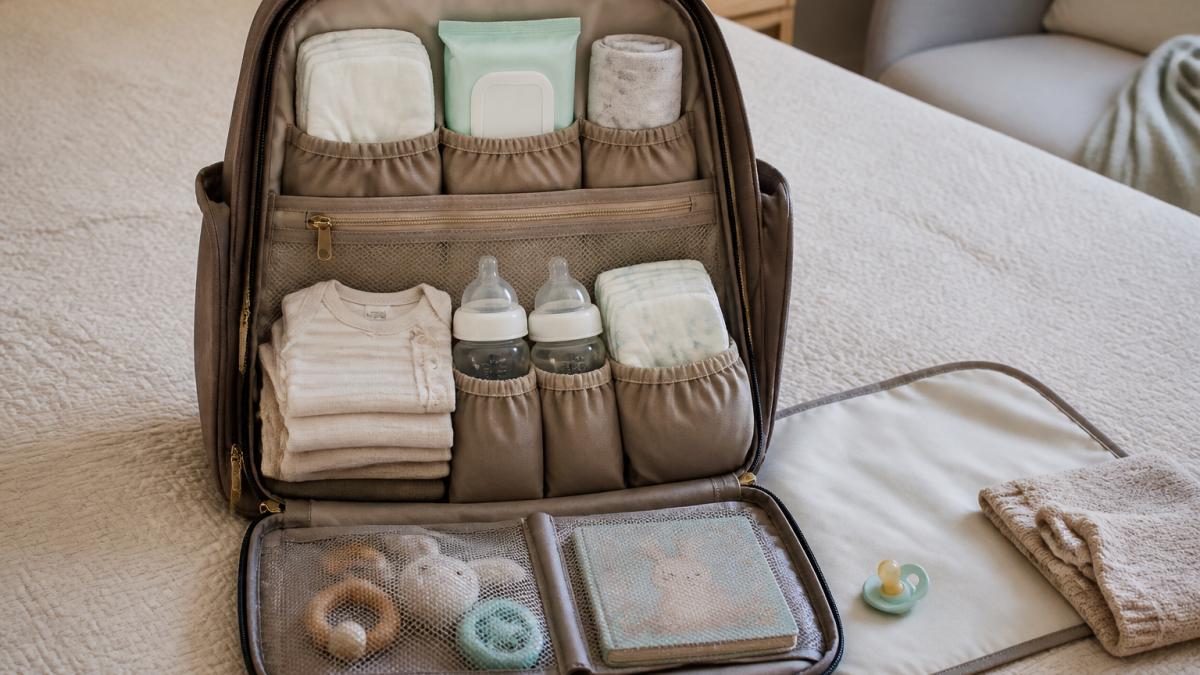
Essential carry-on items with quantities for a 10-hour flight plus buffer:
- Diapers: 12 for newborns, 5 to 6 for older babies
- Wipes: one full pack plus a spare
- Changing pad and changing pad cover
- Two to three full outfits for baby, one extra shirt for you
- Feeding supplies: bottles, formula packets, or nursing cover
- Pacifiers: two to three, plus a pacifier clip
- Comfort item: small blanket or stuffed animal
- Three to four small toys or board books
- Portable sleep aid if your baby uses one
- Plastic bags for soiled items and trash
- Hand sanitizer and a small first-aid kit
Leave behind bulky strollers (gate-check instead), heavy toys, large books, and anything you won't use during flight hours. Learn about compact stroller alternatives that fit travel constraints. Gate-checking a stroller means you get it back at your destination without taking up cabin space.
Large Capacity Mummy Baby Backpack – Insulated, Waterproof & Multi-Function →
Here's how much of each essential item to pack for a 10-hour flight with a two-hour delay buffer.
| Item | Newborns | Older Babies | Notes |
|---|---|---|---|
| Diapers | 12 | 5 to 6 | Based on one per hour or one per two to three hours |
| Wipes | One full pack plus spare | One full pack plus spare | Per 24 hours of travel |
| Baby outfits | Two to three | Two to three | Plus one extra shirt for parent |
| Bottles or formula | One bottle per three hours | One bottle per three hours | Plus one spare formula packet |
| Nursing pads | Two to three extra | N/A | For breastfeeding parents |
| Pacifiers | Two to three | Two to three | Plus a pacifier clip |
| Toys or board books | Three to four small items | Three to four small items | Rotate throughout flight |
Baby Travel Sleep Accessories for Rest at 30,000 Feet
Sleep on a plane is difficult for babies. Unfamiliar environments, cabin noise, and pressure changes disrupt their usual patterns. Realistic expectations help: your baby might sleep two to four hours on a 10-hour flight instead of their normal eight to ten hours at home. The goal is not to replicate home sleep but to create enough familiarity that your baby can settle between feedings and wake windows.
Plan naps around your baby's normal schedule where possible, but build in flexibility. If your baby typically naps at 9 a.m. and 1 p.m., aim to start the first nap about 30 minutes after takeoff and the second after the first feed. Dim the cabin lights when you want your baby to sleep, and use a white noise app on your phone to mask cabin sounds.
Sleep accessories are tools, not solutions. A lightweight blanket and one comfort toy are usually enough. Some babies sleep better in a baby carrier against your chest, which also keeps them secure during turbulence. If your baby uses a sleep sack at home, bring a travel-friendly version that packs small. Avoid bulky travel-specific sleep gear unless you have tested it at home first; unfamiliar products can backfire on a flight.
Long-Haul Flight with a Baby Tips: Entertainment and Comfort
Babies under 12 months have limited entertainment needs, they're entertained by new textures, sounds, and movement. Older babies and toddlers need strategic distraction to survive 8+ hours confined to a seat.
Bring small toys your baby hasn't seen recently. Introduce them one at a time, spaced throughout the flight. Board books with different textures keep attention longer than smooth pages. Sticker books work for toddlers. Avoid screens for the first few hours; save tablets and shows as a last resort when your baby is genuinely restless and you need 30 minutes of peace.
Comfort items matter more than entertainment. A favorite blanket, pacifier, or stuffed animal provides security in an unfamiliar environment. Babies often sleep better when they feel secure, which means less active entertainment time and more rest.
Walk the aisles during the flight. Movement helps digestion, prevents cabin-induced fussiness, and gives your baby a change of scenery. Most airlines allow this, and flight attendants expect it with infant passengers.
Preparing Your Carry-On Before Takeoff
Organization determines whether you can access supplies quickly during the flight. A disorganized diaper bag means fumbling through layers while your baby cries and other passengers wait for the lavatory.
Sort supplies by use case: diaper changes, feeding, comfort, and entertainment. Use the compartments in your diaper backpack strategically. Keep diapers and wipes in the front pocket for quick access. Store bottles in the insulated section.
Bring plastic bags for trash and soiled items. Airplane lavatories have limited space, and you'll need somewhere to dispose of used diapers and wipes. Pack more bags than you think you'll need.
Check your airline's specific policies on baby gear before departure. Policies vary on what you can bring into the cabin, how gates handle strollers, and whether bassinets are available on your aircraft.
Tender Tots & Wellness offers carefully curated baby gear designed for real family needs.
Flying with a baby on a long flight is manageable when you have the right accessories. The nine essentials covered here, from organized diaper bags to spill-proof feeding gear, address the real challenges you'll face at 30,000 feet.
Frequently Asked Questions
What should I pack in a baby's carry-on for a long flight?
Pack diapers (at least one per hour of flight time), wipes, changing pad, extra clothes, feeding supplies, bottles or nursing pillow, pacifiers, comfort items, and entertainment toys. Keep medications, important documents, and valuables in a separate small bag. Use a diaper backpack like the Large Capacity Mummy Baby Backpack ($69.99) to stay organized and keep your hands free during the flight.
How many diapers should I bring on a long flight with a baby?
Bring one diaper per hour of flight time, plus five to ten extras for delays or emergencies. For a 6-hour flight, pack 11-16 diapers in your carry-on. Store additional diapers in checked luggage as backup. Airlines allow diaper bags as a personal item, so you won't count this toward your carry-on limit.
What are the best practices for flying long haul with a baby?
Book direct flights when possible to minimize disruption. Dress your baby in comfortable, layered clothing like our Baby Cotton Onesie ($29.99) that allows easy temperature adjustment. Feed during takeoff and landing to help equalize ear pressure. Maintain sleep routines with familiar comfort items and a portable changing pad. Pack extra clothes for both you and baby in case of spills or accidents. Arrive early to avoid rushing, which stresses both parent and child.
What baby travel accessories help reduce spills and messes during flights?
The 360° Rotate Spill-Proof Baby Bowl ($30.99) is designed to self-right from any angle, helping reduce food spills during meal service. Bring disposable bibs, wet bags for soiled clothes, and extra clothes in accessible pockets of your diaper bag. Pack paper towels or cloth wipes separately. A waterproof changing pad cover protects airplane seats during diaper changes and keeps your supplies organized.
