

Safe Materials for Montessori Infant Toys: A Parent's Guide
Table of Contents
- What Makes Materials Safe for Montessori Infant Toys
- Non-Toxic Montessori Baby Toys: Material Standards and Certifications
- Safe Wooden Toys for Babies: Sourcing and Finishing
- Baby-Safe Silicone Toys: Benefits and What to Check
- Natural Materials Beyond Wood: Cotton, Cork, and More
- How to Clean Wooden Baby Toys and Maintain Safety
- Inspection, Damage Detection, and When to Replace Toys
- Frequently Asked Questions
Last Updated: October 14, 2026
What Makes Materials Safe for Montessori Infant Toys
At Tender Tots & Wellness, we know parents need to know exactly what goes into the toys their infants touch, mouth, and explore, which is why understanding safe materials for montessori infant toys is essential.

Safe materials for montessori infant toys meet strict safety standards and contain no harmful chemicals: natural, non-toxic, gentle on developing mouths, free from choking hazards, and built to last.
Montessori toys follow a core principle: simple, beautiful, and purposeful. Babies explore through their senses, touching, tasting, and mouthing everything, so materials must be safe enough to mouth without risk.
The key standards to understand are:
- Non-toxic finishes, water-based paints and oils that don't contain harmful chemicals
- No small parts, nothing that could break off and become a choking hazard
- Durable construction, materials that won't splinter, crack, or degrade with use
This guide covers what makes materials truly safe, how to verify claims, and how to inspect toys over time.
Non-Toxic Montessori Baby Toys: Material Standards and Certifications
"Non-toxic" is a marketing word, not a legal one, no federal agency defines it for toys. The burden falls on you to translate vague claims into verifiable facts.
The federal floor every infant toy must clear
Two layers of U.S. law govern toys for children under 12, and both apply to infant toys:
- The Consumer Product Safety Improvement Act (CPSIA) sets mandatory chemical limits. Total lead in accessible toy parts cannot exceed 100 parts per million (ppm) (Total Lead Content). Lead in paint or surface coatings cannot exceed 90 ppm. Eight specific phthalates are capped at 0.1% by weight in toys that can be placed in a child's mouth (Phthalates). Toys must also be tested by a CPSC-accepted third-party lab before they can be certified.
- ASTM F963 is the voluntary toy safety standard that CPSC enforces as a mandatory rule. The current version is ASTM F963-23. It covers mechanical hazards (sharp edges, points, small parts), flammability, and heavy metals like antimony, arsenic, barium, cadmium, chromium, mercury, and selenium in surface coatings.
A toy that says "ASTM F963 compliant" claims it passed the same battery of tests a lab would run. Ask which version, editions have different requirements.
What certifications actually mean
| Label | What it verifies | What it does NOT verify |
|---|---|---|
| CPSC compliance statement | The manufacturer certifies the toy meets CPSIA and ASTM F963 | That the specific unit you bought was tested |
| Children's Product Certificate (CPC) | A required document listing the lab, test date, and standards met | Anything about sourcing or long-term durability |
| BPA-free | The material contains no bisphenol A above the detection limit | That no other bisphenol (BPS, BPF) was substituted |
| Phthalate-free | Below the CPSIA 0.1% threshold for the eight restricted phthalates | That unregulated plasticizers weren't used instead |
| Food-grade silicone | Meets FDA food-contact requirements (21 CFR 177.2600) | That it's safe as a teether specifically |
| FSC-certified wood | Wood comes from responsibly managed forests | Anything about the finish or adhesive |
How to read a test report
A legitimate third-party report, from labs like SGS, Intertek, Bureau Veritas, or TÜV, shows:
- The lab's name and CPSC acceptance number. If the lab isn't CPSC-accepted, the report doesn't satisfy CPSIA.
- The specific test method, such as CPSC-CH-E1001-08.3 for lead in metal or CPSC-CH-C1001-09.4 for phthalates.
- The sample description and date. A report from 2019 doesn't cover a 2026 production run.
- Pass/fail results with actual numbers, not just a checkmark.
Claims that mean nothing on their own
- "Non-toxic", undefined; ask which standard.
- "Eco-friendly", no legal definition for toys.
- "Natural", lead is natural. So is arsenic.
The verification checklist
Before you buy an infant toy, confirm:
- A Children's Product Certificate is available on request
- The certificate names a CPSC-accepted lab
- ASTM F963-23 (or the current edition) is listed
Safe Wooden Toys for Babies: Sourcing and Finishing
Wood is the gold standard for Montessori toys: durable, beautiful, and naturally safe when sourced and finished correctly.
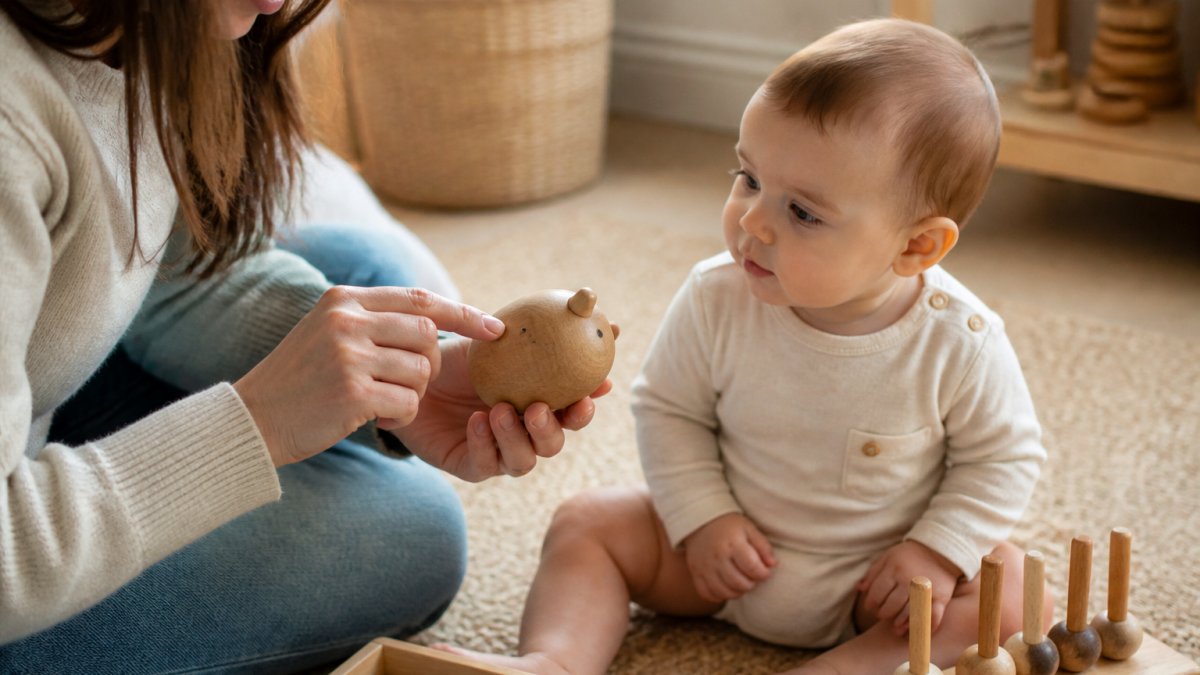
Sustainably sourced wood is the first priority. Look for FSC-certified wood (Forest Stewardship Council), which comes from responsibly managed forests.
The finish is critical. Water-based paints and oils don't off-gas harmful fumes and are non-toxic if ingested in small amounts.
Avoid these finishes:
- Polyurethane (contains volatile organic compounds)
- Lacquer (releases formaldehyde)
- Lead-based paint (banned but still found in older toys)
Smooth surfaces are essential, splinters are a real hazard.
Baby-Safe Silicone Toys: Benefits and What to Check
Silicone is a popular material for infant toys, safe, durable, and easy to clean, but not all silicone is created equal.
Food-grade silicone is the only type safe for babies, the same material used in baby bottles and pacifiers.
Why silicone works for infants:
- Soft and flexible (safe for gums and emerging teeth)
- Easy to clean and sanitize
- No off-gassing or chemical odors
When buying silicone toys, verify the material. Look for "food-grade silicone" explicitly stated.
Red flags with silicone:
- No mention of food-grade in the description
- Strong chemical smell when opened
- Cloudy appearance (may indicate additives)
Silicone toys can be mouthed safely for hours and won't break down from constant chewing, ideal for teething babies who need oral sensory input.
Natural Materials Beyond Wood: Cotton, Cork, and More
Montessori toys use a range of natural materials. Each offers different sensory experiences and developmental benefits.
Organic cotton is grown without synthetic pesticides or fertilizers, look for GOTS certification (Global Organic Textile Standard).
Cork is increasingly popular in Montessori toy design: naturally antimicrobial, durable, and offering unique sensory feedback.
Other safe natural materials:
Tender Tots Wooden Tool Disassembly Playset for Kids →
- Wool (for felt toys and soft play items), use organic, undyed wool
- Linen (durable natural fiber), organic linen is preferable
- Rubber (natural rubber from rubber trees), not synthetic rubber
The sensory benefits matter.
When choosing toys with multiple materials, check each component.
How to Clean Wooden Baby Toys and Maintain Safety
Cleaning is part of safety. Toys accumulate dust, drool, and bacteria. Regular cleaning keeps toys safe for mouthing.
For wooden toys:
- Wipe with a damp cloth weekly
- Use mild soap and warm water for deeper cleaning
- Dry immediately to prevent water damage
For silicone toys:
- Wash with warm soapy water
- Sanitize in boiling water for 5 minutes
- Use a bottle sterilizer if available
For cotton and fabric toys:
- Check care labels first
- Most can be machine washed on gentle cycle
- Use unscented, mild detergent
Inspect toys while cleaning for cracks, splinters, or peeling finish, regular inspection catches problems early.
Natural finishes may darken or show wear over time, normal and not unsafe. But if the finish is peeling or cracking, replace the toy.
Inspection, Damage Detection, and When to Replace Toys
Infants mouth, drop, and drag toys rather than play with them as older children do, which changes what you look for during inspection and which hazards matter most.
The four infant-specific hazards
1. Choking and ingestion. Anything that fits entirely inside a small-parts cylinder, the 1.25-inch diameter by 2.25-inch deep test cylinder from 16 CFR Part 1501, is a choking hazard for children under three. For infants, the practical threshold is even smaller, because a baby's airway is narrower. Watch for:
- Loose buttons, beads, bells, or rattles inside fabric toys
- Wooden pegs, dowels, or knobs that can be worked loose
- Silicone teether nubs that can be bitten off
2. Strangulation. Cords, strings, ribbons, and straps longer than about 7 inches pose a strangulation risk for infants.
**3. The American Academy of Pediatrics recommends keeping all toys, pillows, and soft bedding out of the sleep environment for the first year (Safe Sleep).
4. Mouthing-related material failure. A toy that's safe when dry may not be safe after weeks of drool and chewing.
The inspection routine
Before every use (10 seconds):
- Squeeze the toy, does anything shift, rattle, or feel loose?
- Run a finger along every edge and seam
- Check for new cracks, chips, or peeling
Weekly:
- Twist and tug every attached part (pegs, rings, handles)
- Look inside fabric seams for loose stuffing or beads
- Check silicone for cloudy spots, tears, or bite marks
Monthly:
- Hold the toy at arm's length in bright light and inspect the full surface
- Check wood for splinters, raised grain, or finish breakdown near mouth-contact areas
- Verify all fasteners (screws, rivets, glued joints) are tight
When to repair vs. replace
| Finding | Action |
|---|---|
| Minor surface scratch on sealed wood | Keep, cosmetic only |
| Raised grain or rough patch | Sand lightly with fine grit, re-oil with food-grade mineral oil |
| Small splinter | Replace, splinters can lodge in gums and throats |
| Peeling or flaking finish | Replace, flakes can be swallowed |
| Loose screw or rivet | Tighten if possible; replace if the hole has enlarged |
| Cracked or torn silicone | Replace, cracks harbor bacteria and can shed pieces |
| Frayed stitching or exposed stuffing | Replace, stuffing is a choking and ingestion risk |
| Any mold, mildew, or persistent odor | Replace, cannot be reliably cleaned from porous materials |
| Deformation that changes function | Replace |
Supervision is part of the material's safety
Even a toy that passes every test can fail in the wrong conditions. Rules that matter for infants:
- Stay within arm's reach during any mouthing play. A piece that breaks off can be swallowed in seconds.
- One toy at a time for babies under 12 months. Multiple toys on the floor make it harder to notice a missing part.
- No toys in the crib during sleep or unsupervised time.
- No toys on a raised surface where a baby could roll off while reaching.
Storage that protects the material
How you store a toy affects how long it stays safe. Wood warps in humid bathrooms and dries out near heating vents. Silicone picks up odors from scented products. Fabric grows mildew in damp bins.
- Store in a breathable cotton bag or open basket, not a sealed plastic bin
- Keep away from direct sun, radiators, and humidifiers
- Rotate toys so each one gets inspected before it comes back into play
- Wash storage bags monthly with unscented detergent
A toy that's been well-loved will show signs of use. Slight color changes and minor surface scratches are fine. But structural damage, finish failure, or any change near a mouth-contact area means it's time to retire the toy.
Frequently Asked Questions
What is the safest material for baby toys?
Natural, non-toxic materials are safest for infants. Food-grade silicone, sustainably sourced wood with non-toxic finishes, organic cotton, and cork are all excellent choices. Look for toys certified by CPSC (Consumer Product Safety Commission) or carrying ASTM F963 certification, which ensures the toy meets strict safety standards for lead, phthalates, and other harmful chemicals. Always check that materials are BPA-free and phthalate-free, especially for toys babies will mouth.
Are wooden toys safe for infants who mouth everything?
Yes, wooden toys are safe for teething infants when made from sustainably sourced, untreated wood with non-toxic water-based finishes. The key is ensuring the wood has no splinters, cracks, or peeling finish. Inspect regularly before each use. Avoid varnishes or stains containing harmful chemicals. Many parents prefer wooden toys specifically because they're durable and designed for heavy mouthing. Food-grade silicone teethers are another excellent mouthing-safe option that won't splinter.
How do I know if a Montessori toy is actually non-toxic?
Check for third-party certifications like CPSC compliance or ASTM F963 standards. Look at product descriptions for explicit claims about non-toxic paint, water-based finishes, BPA-free materials, and phthalate-free construction. Reputable brands disclose their material sourcing and manufacturing practices. Avoid toys with strong chemical smells, which often indicate harmful off-gassing from low-quality finishes or materials.
What should I check before giving an infant a Montessori toy?
Inspect for small parts that could pose choking hazards, splinters, cracks, or peeling finish. Verify the toy is age-appropriate and free of sharp edges. Check certifications and material composition. Wash the toy before first use. Ensure it's designed for your infant's developmental stage, for example, grasping toys for 3-6 months, stacking rings for 6-12 months. Never leave infants unattended with toys, and supervise mouthing behavior closely. Replace toys showing signs of damage immediately.
Choosing safe materials for your baby's toys doesn't have to be complicated. Start by understanding certifications, checking material sourcing, and inspecting regularly. At Tender Tots & Wellness, we stock toys that meet every standard covered in this guide. Our selection emphasizes natural materials, transparent safety practices, and beautiful design that grows with your child. Shop now to find toys you can feel confident about.