

Recycle or Repurpose Old Nursery Furniture: A Parent's Guide
Last Updated: November 9, 2026
Quick Summary
You can recycle or repurpose old nursery furniture by donating usable pieces first, repurposing wood into desks or benches second, and recycling raw materials third. Particleboard items usually go through bulk waste pickup or a transfer station, since curbside programs do not accept them. Landfilling should be the last resort.
- Donate only safe, complete items; check recalls at the CPSC database before donating.
- A standard crib yields about 28 to 30 slats, enough for a bench plus a small shelf.
- Test paint for lead before sanding if the crib was painted before 1978.
- Most bulky pickup programs need two to four weeks of lead time, and some charge per item.
- Crib slat gaps must be no wider than 2 3/8 inches, and drop-side cribs are banned.
Table of Contents
- Why Nursery Furniture Deserves a Second Life
- How to Donate Used Baby Furniture
- How to Repurpose an Old Crib
- How to Recycle Particleboard Furniture
- Used Nursery Furniture Safety: What to Check Before Reuse
- Non-Toxic Finishes and Prep Work for Upcycled Pieces
- Prep Your Nursery for What Comes Next
- Frequently Asked Questions
Why Nursery Furniture Deserves a Second Life
Learning how to recycle or repurpose old nursery furniture starts with one fact: most of it is too good to trash. For the broader case, see why secondhand baby gear is worth it for new parents.
You can donate usable pieces, repurpose them, or recycle the raw materials, each path keeps furniture out of the waste stream.
The Environmental Cost of Landfilling Baby Gear
Furniture is one of the heaviest items in the household waste stream, and nursery pieces are no exception. Cribs and dressers are bulky, so they take up landfill space fast.
Wood furniture also represents stored carbon and harvested timber. The Environmental Protection Agency's guidance on reducing household waste points to reuse and donation as the preferred first steps before recycling or disposal.
So the order of operations matters: donate first, repurpose second, recycle third, and landfill last.
How to Donate Used Baby Furniture
Donation is the fastest way to give old nursery furniture a second life, but only if the item is safe and complete.
Here is how to donate used baby furniture without wasted trips:
- Call ahead. Ask what the center accepts and whether they take assembled items.
- Clean it thoroughly. Wipe down surfaces and vacuum upholstery.
- Skip recalled items. Check recalls first at the Consumer Product Safety Commission recall database.
What Donation Centers Accept and What They Reject
| Item | Usually Accepted | Usually Rejected |
|---|---|---|
| Solid wood crib with all parts | Yes | Missing hardware or slats |
| Dresser with working drawers | Yes | Broken drawer glides |
| Changing table with safety strap | Yes | Cracked frame or missing strap |
| Mattress | Sometimes, if clean | Stained, torn, or sagging |
| Upholstered glider | Case by case | Torn fabric or broken frame |
A quick phone call can save you a wasted drive.
How to Repurpose an Old Crib
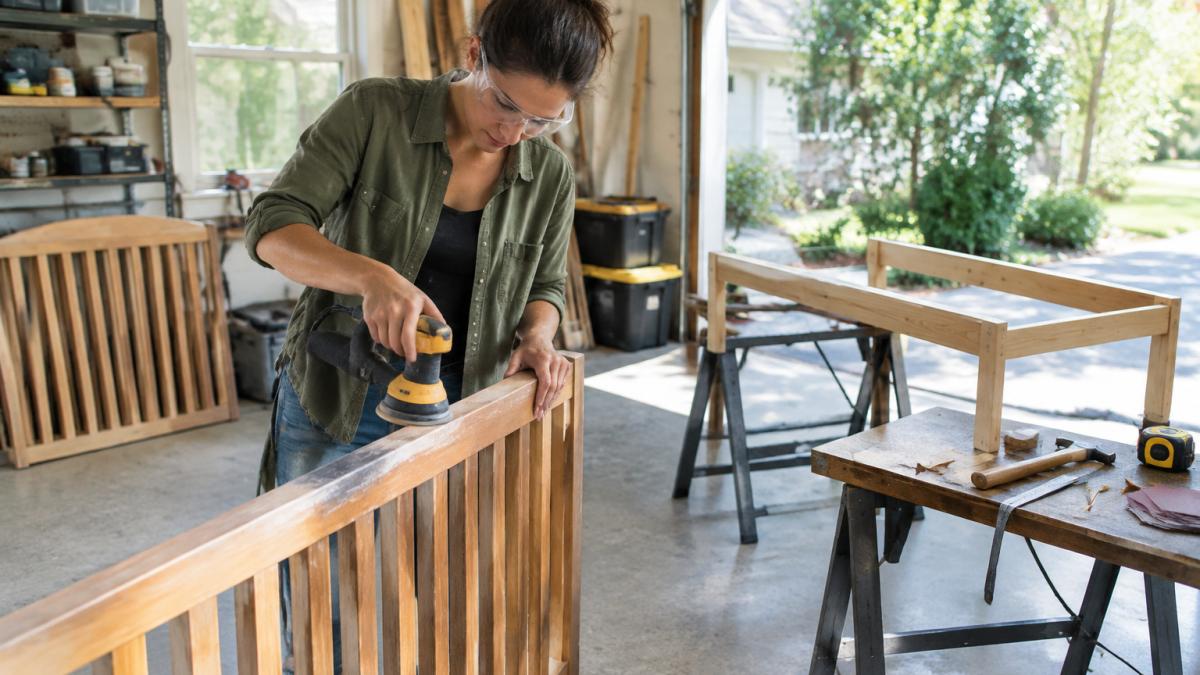
Repurposing an old crib can be a satisfying DIY project for a parent, and careful prep helps the piece last. Whether the material works well for desks, benches, or shelving depends on the crib and on checking the parts first.
Step 1: Disassemble and Inventory the Parts
Start by disassembling the crib and sorting the parts into three piles: long rails, slats, and hardware. Keep the longest rails for bench legs or desk supports. Save the slats for shelving or a headboard. Bag every bolt, cam lock, and screw, even if you plan to use new fasteners, the originals tell you the thread size.
Label each piece with painter's tape. A standard crib yields roughly four corner posts, two long side rails, two end panels, and 28 to 30 slats, enough for a bench plus a small shelf.
Watch out: Crib hardware often uses non-standard cam locks and barrel nuts that are hard to replace. Once the crib is secure with standard screws, its sound wood can take on a new purpose with ideas from Regained Relics.
Step 2: Check the Wood Before You Cut
Run a quick integrity check on every rail and slat. Look for cracks near screw holes, splintering along the edges, and any sign of water damage or delamination.
If the crib was painted before 1978, test the paint for lead with a hardware-store swab kit before sanding. The EPA's lead-safe renovation guidance explains why sanding old paint without testing is a risk, especially on a piece headed back into a child's room.
Step 3: Build the Crib-to-Desk
Cut list (for a typical 52-inch crib rail):
- Desktop: one piece of 3/4-inch plywood or solid wood, 48 inches long by 24 inches deep
- Apron: two rails cut to 44 inches, two cut to 20 inches
- Legs: four pieces cut from the longest corner posts to 28 inches (standard desk height)
Assembly:
- Cut the desktop to size and sand the edges.
- Build a simple apron frame by attaching the 44-inch rails to the 20-inch rails with pocket screws or corner brackets.
- Attach the legs to the inside corners of the apron with 2 1/2-inch wood screws.
- Set the desktop on the apron and fasten from underneath with 1 1/4-inch screws.
- Sand, prime, and finish.
A desk built this way takes a weekend and basic tools: a circular or miter saw, a drill, a sander, and a square. No advanced joinery is required.
Step 4: Build the Crib-to-Bench
The bench uses the crib's side rails as the bench ends, which gives it a built-in look.
Cut list:
- Bench ends: two side rails, left intact
- Seat board: one piece of 3/4-inch plywood or solid wood, 48 inches long by 16 inches deep
- Lower shelf: one piece of 1/2-inch plywood, 44 inches long by 14 inches deep
Assembly:
- Stand the two side rails upright and check that they sit level. Shim as needed.
- Attach the seat board across the top with 2-inch screws driven down through the seat into the rails.
- Attach the shelf supports to the inside faces of the rails at the height you want the shelf.
- Set the lower shelf on the supports and fasten with 1 1/4-inch screws.
- Sand, prime, and finish.
This works well as a mudroom bench or a reading seat. The lower shelf holds shoes or baskets.
Step 5: Finish for a Child-Safe Result
Prep work decides how well the finish holds:
- Sanding: Work from 80-grit to 120-grit to 220-grit until the surface is smooth.
- Cleaning: Wipe off all dust with a damp cloth and let the wood dry.
- Priming: Use a water-based primer on bare wood or painted surfaces.
- Painting: Apply thin coats and let each one dry fully.
- Curing: Wait the full cure time, often several days, before the piece goes into the room.
Sanding and priming are the steps most people rush, and they are the reason finishes peel. Take the extra hour.
Safety Check Before the Piece Goes Back in the Room
Before you move a repurposed crib piece into a child's space, run the same checks you would on a crib:
- Stability: The piece does not wobble or tip when nudged.
- Edges: No sharp corners or splinters at child height.
- Fasteners: No screw tips or bolt ends protruding where a child can reach them.
If a piece fails any check, retire it. Repurpose the wood into something non-child-facing instead of passing it on as a crib.
If you are still deciding whether to repurpose or replace, our guide to the best convertible cribs for small apartments covers options that grow with your child.
How to Recycle Particleboard Furniture
The realistic path is bulk waste collection, a transfer station, or a private hauler, and the logistics differ enough by jurisdiction that a phone call or website check is worth more than any general guide.
Why Particleboard Is Not Curbside Recyclable
Curbside recycling programs are built for containers, paper, and rigid plastics. The EPA's guidance on reducing household waste treats composite wood as a bulky-item problem rather than a recycling-stream problem, which is why reuse and repurposing come first.
Ask specifically whether the site accepts "engineered wood" or "composite wood", a site that takes pallets may not take furniture panels.
Local Disposal Logistics: A Step-by-Step Checklist
- Check your hauler's website first. Search for "bulky item pickup" plus your city or county name. Most programs list accepted items, size limits, and scheduling instructions.
- Confirm the item qualifies. A dresser or changing table usually counts as bulky waste. A crib may count as bulky or may need to be broken down, ask.
- Schedule the pickup. Most programs let you book online or by phone, often with a two- to four-week lead time. Some charge a per-item fee; others include a set number of free pickups per year.
If pickup is not available, a transfer station or private hauler is the next option. Call ahead to confirm the station accepts furniture and to ask about load size limits.
Watch out: Never leave furniture on the curb without checking local rules. Many areas fine illegal dumping, and a piece left out on the wrong day can sit for weeks and draw pests.
What Happens to Particleboard After Pickup
That hierarchy is why repurposing beats recycling for particleboard. A dresser converted into a storage bench keeps the material in use for years and avoids the whole disposal chain.
When to Choose Repurposing Over Recycling
If the piece is structurally sound, drawers glide, the frame is square, the panels are not swollen from moisture, repurposing or donating it is almost always the better environmental choice.
If the piece is swollen, crumbling, or smells of moisture damage, recycling or disposal is the right call.
For pieces that are still usable, our guide to styling a sustainable nursery on a budget shows how to work an older dresser or changing table into a refreshed room.
Used Nursery Furniture Safety: What to Check Before Reuse
Safety comes before sentiment. A crib that fails a basic check is not worth passing on, no matter how good it looks. The CPSC crib safety standards set the rules that every reused crib should meet.
Run this checklist before you donate, sell, or reuse any nursery piece:
- Slats: No gaps wider than 2 3/8 inches, and no missing or cracked slats.
- Hardware: All bolts, brackets, and screws present and tight.
- Drop sides: Avoid cribs with drop-side rails, which are banned.
Crib Slats, Hardware, and Consumer Product Safety Rules
Crib slat spacing and hardware integrity are the two failure points that matter most. Loose slats create a gap a baby can slip through. Missing hardware makes the whole frame unstable. Both are fixable only if you have the original parts, which is why bagging hardware during donation matters so much.
Non-Toxic Finishes and Prep Work for Upcycled Pieces
Prep work decides how well the finish holds:
- Sanding: Work from coarse to fine grit until the surface is smooth.
- Cleaning: Wipe off all dust with a damp cloth.
- Priming: Use a water-based primer on bare wood or painted surfaces.
- Painting: Apply thin coats and let each one dry fully.
- Curing: Wait the full cure time before the piece goes in the nursery.
Sanding and priming are the steps most people rush, and they are the reason finishes peel. Take the extra hour.
Once the piece is finished, you may want ideas for pulling the room together. Our guide to styling a sustainable nursery on a budget pairs well with a freshly upcycled piece.
Prep Your Nursery for What Comes Next
Clearing out old furniture is the easy part. The harder question is what fills the space next.
Start with the layout. Keep the crib away from windows and cords.
For a full room plan, our guide on how to organize a small nursery for a newborn walks through layout, closet, and storage ideas step by step.
Then restock what you actually need. You can browse baby and toddler gear essentials to fill the gaps without overbuying.
At Tender Tots & Wellness, we built our shop around exactly this stage of parenthood. Our Pure Cotton Changing Pad Cover is 100% pure cotton, removable, and machine washable, and it fits most standard changing tables at $21.99.

The challenge with old nursery furniture is not the stuff itself. It is the missing plan.
Tender Tots & Wellness makes that last step simple.
Frequently Asked Questions
How can I recycle old nursery furniture?
Start by checking with your local waste management department for bulk waste collection days and curbside pickup rules. Wood furniture in good condition can often go to donation centers, while broken pieces may be accepted at recycling centers that handle scrap metal and wood. Particleboard items are harder to recycle because of their resin content, so confirm acceptance before hauling anything. Remove hardware, cushions, and upholstery first, and keep hazardous materials like old paint out of regular recycling bins.
Where can I donate used baby furniture?
Local charities, family shelters, and community centers are common options for how to donate used baby furniture. Call ahead to confirm what they accept. Clean each piece, bag loose screws and bolts, and include assembly instructions if you have them.
Can an old crib be repurposed?
Yes, and the most popular projects turn cribs into desks, benches, and wall shelves. The key is to remove all hardware and inspect the wood for cracks or splinters before cutting.
How do I know if used nursery furniture is safe to reuse?
Look up any recalls by model number, and confirm that all hardware is present and tight. Inspect wood for cracks, peeling paint, and loose joints. If a piece is missing parts or predates current safety rules, it is safer to repurpose it for storage or donate it as a non-sleep item rather than reuse it for a baby.
