

How to Baby Proof a Small Nursery Room Safely
Last Updated: November 16, 2026
Quick Summary
To learn how to baby proof a small nursery room, start by walking the room on your hands and knees to spot hazards at your baby's eye level. Anchor every piece of furniture taller than it is wide to a wall stud, cover all reachable outlets, secure windows and blind cords, and keep the crib or floor bed on an interior wall away from windows and cords.
- Anchor every furniture piece taller than it is wide to a wall stud, and mount or remove the TV.
- Keep the crib or floor bed on an interior wall with a clear perimeter, never against a window.
- Cover unused outlets with outlet covers or tamper-resistant plates and route cords in cable tracks.
- Install window locks or guards and use cordless window treatments or secured blind cords.
- Fix highest-priority hazards first: furniture anchors, windows and cords, and moving the sleep area.
Table of Contents
- How to Set Up a Nursery in a Small Room Without Adding Hazards
- Anchor Furniture and Televisions to Prevent Tip-Overs
- How to Baby-Proof a Room for a Floor Bed
- Baby-Proofing Outlets, Cords, and Windows in Tight Spaces
- Pad Sharp Edges and Lock Cabinets, Drawers, and Doors
- Your Baby-Proofing Checklist Printable for Small Nurseries
- Shop Small-Nursery Safety Essentials at Tender Tots & Wellness
- Frequently Asked Questions
How to Set Up a Nursery in a Small Room Without Adding Hazards
Learning how to baby proof a small nursery room starts with one hard truth: tight spaces force hard choices. Every item you add removes floor space and adds a new hazard to check. Parents in compact apartments often find the same pattern. The room that stays safest is the one with the least in it.
A small nursery works best with a simple layout:
- Crib or floor bed against an interior wall, away from windows and cords
- One low storage piece, anchored to the wall
- A clear path from the door to the sleep area
- Nothing overhead that could fall
That's the whole plan. Everything below is about making that layout safe.
Before you arrange anything, walk the room on your hands and knees. You'll spot outlets, cords, and sharp corners at your baby's eye level fast. This one habit catches more hazards than any checklist.
Anchor Furniture and Televisions to Prevent Tip-Overs
Furniture tip-overs are a hazard many parents underestimate. A dresser that feels solid to you is climbable to a toddler, and small rooms often mean furniture sits close to the crib.
Anchor every piece taller than it is wide:
- Attach anti-tip straps or brackets from the furniture top to a wall stud.
- Anchor the TV, or better, mount it and keep it out of the nursery.
- Remove climbable items from shelves your child can reach.
- Keep heavy objects on the lowest drawers.
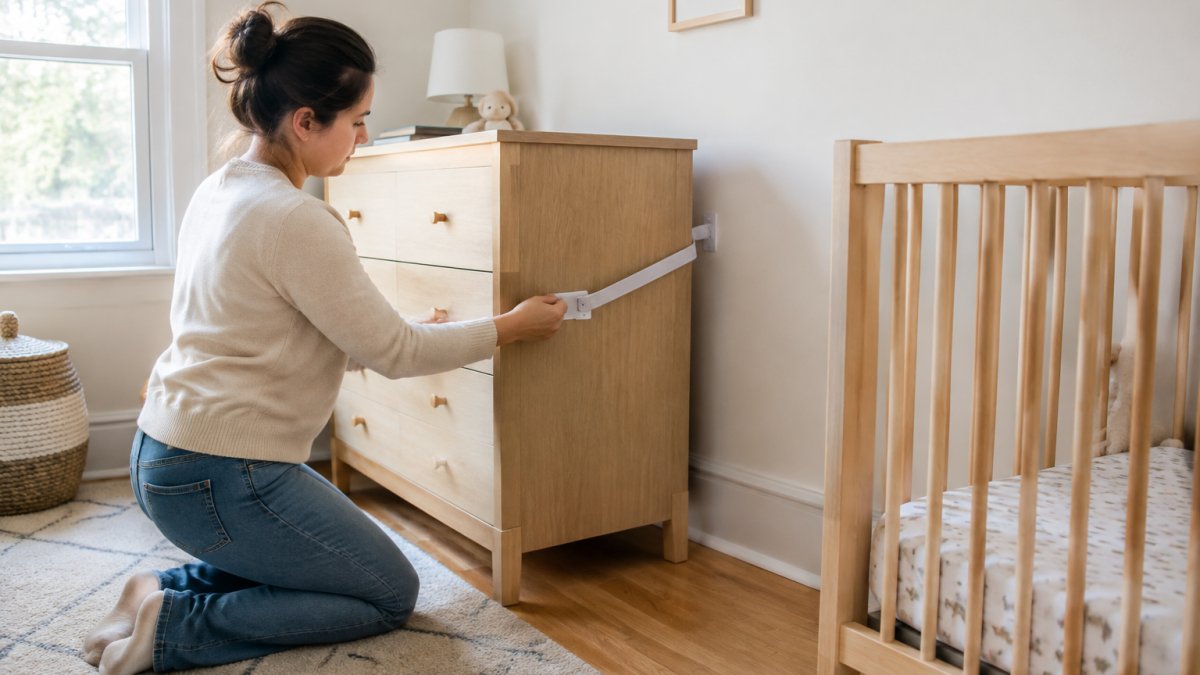
Rental-friendly note: strap anchors that screw into studs are the strongest, but tension-style anchors work for light furniture without wall damage. Check with your landlord before drilling. Watch out: drywall anchors alone won't hold a tipping dresser, so find a stud or skip that piece entirely.
How to Baby-Proof a Room for a Floor Bed
A floor bed changes the safety math. Your baby can move freely from day one, so the whole room becomes the sleep area. That's why baby-proofing a floor bed room means securing everything, not just the crib zone, and it means re-checking the room at each new mobility stage rather than treating babyproofing as a one-time task.
Start with the sleep surface itself. Use a firm mattress that fits the frame with no gaps, and keep blankets and pillows out for infants. The safe sleep guidance from the American Academy of Pediatrics is the standard to follow here.
Then work outward in mobility stages, because the hazards change as your baby does:
Before rolling and crawling (roughly 0-6 months): The floor bed is low, so the main risks are the sleep surface itself and anything within a rolling baby's reach. Keep the mattress clear, secure all cords and cables well away from the bed, cover every outlet within reach, and make sure no small objects or choking hazards sit on the floor near the bed. A rolling baby can cover surprising distance, so treat a two-to-three-foot perimeter around the mattress as the danger zone.
Before pulling to stand (roughly 6-10 months): Now the room's furniture becomes climbable and grab-able. Anchor every piece taller than it is wide, pad sharp edges on low furniture, lock drawers and cabinets, and clear the floor of small objects. Remove anything a standing baby could grab and pull down, lamp cords, monitor cables, draped blankets, and lightweight shelving. Check that the floor bed frame itself has no sharp corners or pinch points at standing height.
Before walking and climbing (roughly 10-18 months): A walking toddler turns the whole room into a climbing gym. Because shutters can leave reachable gaps or cords near a climbing toddler, check that they are secure and out of reach, with Shutters West London in mind when assessing the window area.
For safe-sleep basics you can apply around a floor bed, see our guide to safe sleep environment tips for newborn babies. It covers the mattress, bedding, and room setup details that matter most.
Watch out: a floor bed placed against an exterior wall or window puts your baby within reach of glass, cords, and temperature swings. Keep the bed on an interior wall with a clear perimeter, and never push it into a corner where a crawling baby could get trapped between the mattress and two walls.
Baby-Proofing Outlets, Cords, and Windows in Tight Spaces
Outlets and cords cause more injuries than most parents expect, and small rooms put more of them within reach. Baby-proofing outlets takes minutes and costs little.
Cover every unused outlet with outlet covers or tamper-resistant plates. For cords, use cable tracks or cord concealers along baseboards, and move lamps and monitors out of reach. electrical safety guidance from the U.S. Consumer Product Safety Commission is worth a read before you start.
Windows need three fixes:
- Locks or guards on every window your child can reach
- Cordless window treatments, or blind cords secured with tension devices
- Furniture moved away from windows so nothing is climbable
Watch out: a crib or bed pushed against a window puts your baby within reach of glass and cords. Move the sleep area to an interior wall instead.
Pad Sharp Edges and Lock Cabinets, Drawers, and Doors
Sharp edges and open storage are the two hazards small nurseries create most often. Low dressers, shelf corners, and table edges all sit at head height for a crawling baby.
Pad hard corners with corner guards and edge padding on any surface below waist height. Then lock things up:
- Cabinet and drawer locks on every storage piece
- Door safety devices on closets
- Toe latches on bins your child can tip
Open shelving looks lovely, but it invites climbing. Use the lower shelves for soft items only and keep everything small out of reach.
For the floor area you're securing, a non-toxic play mat adds a soft landing. Our guide to non-toxic baby play mats for floor time covers what to look for.
Your Baby-Proofing Checklist Printable for Small Nurseries
Most checklists tell you what to fix but not how to find it or what to fix first. Use this one as a floor-to-ceiling inspection you perform from your child's viewpoint, then prioritize the fixes so a tight budget goes to the hazards that matter most.
How to run the inspection: Get down on your hands and knees at the nursery doorway and work the room in a slow circle, floor first, then waist height, then eye level, then ceiling. At each level, ask what a crawling baby could reach, what a standing baby could grab, and what a climbing toddler could pull down.
Floor level (crawling baby's view):
- Small objects, choking hazards, and loose batteries cleared from the floor
- Outlets within reach covered with sliding covers or tamper-resistant plates
- Cords and cables routed in cable tracks along baseboards, not across the floor
- Floor bed or crib mattress fits with no gaps against walls or frame
- No gaps between furniture and walls where a baby could wedge or climb
Waist height (pulling-to-stand view):
- Every furniture piece taller than it is wide anchored to a wall stud
- TV mounted or removed from the nursery entirely
- Sharp edges and corners padded on surfaces below waist height
- Cabinet and drawer locks fitted on every storage piece
- Door safety devices on closets
- Climbable items (toy bins, step stools, low shelves) moved away from windows and tall furniture
Eye level and above (climbing toddler's view):
- Crib or floor bed away from windows and cords, on an interior wall
- Window locks or guards installed on every reachable window
- Blind cords secured with tension devices or replaced with cordless treatments
- Nothing overhead that could fall into the sleep area
- Heavy objects stored on the lowest drawers, not upper shelves
Prioritize your budget: If money or time is tight, fix in this order. Highest priority, anchor furniture and televisions, secure windows and blind cords, and move the sleep area away from windows. These prevent the injuries most likely to be fatal or severe. High priority, cover outlets and manage cords. Medium priority, pad sharp edges and fit cabinet locks.
Before you finalize the list, verify any secondhand toys or gear. Our step-by-step guide on how to check for toy recalls before buying walks you through it. If you're still choosing a crib for a tight space, our roundup of convertible cribs for small apartments is a good next stop, and our Montessori minimalist nursery guide goes deeper on layout.
| Hazard | Fix | Priority |
|---|---|---|
| Tipping furniture | Wall anchors | Highest |
| Windows and cords | Locks, cordless blinds | Highest |
| Sleep area near window | Move to interior wall | Highest |
| Outlets | Outlet covers | High |
| Sharp edges | Corner guards | Medium |
| Cabinets | Child locks | Medium |
Watch out: outlet covers, monitors, and other products do not replace supervision or secure installation, an anchored dresser and a crib away from the window do more for safety than any single gadget.
Shop Small-Nursery Safety Essentials at Tender Tots & Wellness
Small-room safety gear should be simple and well-made. Our curated selection of baby gear and Montessori-inspired pieces suits modern, minimalist nurseries.
Every order ships free worldwide, and we aim to offer high-quality items at fair prices. As one customer put it, "Every item feels like it was carefully chosen to fit a modern family's needs."
A safe small nursery comes down to anchoring, covering, securing, and clearing. Do those four things and you've handled the hazards that matter most.
Ready to make your nursery safer without sacrificing style? Tender Tots & Wellness offers free worldwide shipping, a curated mix of timeless and modern pieces, and high-quality products at fair prices. Get started with Tender Tots & Wellness and build a nursery that's both beautiful and safe.
Frequently Asked Questions
At what age should I start baby proofing a small nursery?
Start before your baby is mobile, usually around 4 to 6 months, so the room is ready when rolling and crawling begin. Even newborns benefit from anchored furniture, covered outlets, and cord-free sleep areas, since tip-over and strangulation risks exist from day one. A room-by-room inspection now saves rushed fixes later, and a printable checklist helps you track what is done as your child grows from crawling to climbing.
How do you baby proof outlets in a nursery?
Install outlet covers on every receptacle within reach and keep cords routed behind furniture or inside cable tracks. Sliding outlet plates are convenient for frequently used plugs, while simple plug-in caps work for rarely used outlets. Pair outlet covers with cord management so lamps and monitors cannot be pulled down. Check the whole room monthly, since crawling babies find outlets you forgot were there.
Can I baby proof a small nursery without drilling into the walls?
Yes. Rental-friendly options include furniture straps that wrap around a leg and anchor to a stud-free bracket, adhesive cord clips, and tension-mounted window guards. For heavy dressers, a no-drill anti-tip strap still needs a solid anchor point, so check the hardware instructions. Combine these with outlet covers and corner guards, then re-inspect each season as your child's reach and strength change.
What should be on a baby-proofing checklist for a small nursery?
A solid checklist covers furniture anchoring, crib placement away from windows and cords, outlet covers, cord management, window locks or guards, cordless window treatments, edge padding, and child locks on drawers and doors. Add toy storage that keeps small objects out of reach and clear floor space for safe play. Print the list, work top to bottom, and recheck after any new purchase or furniture move.
