

Why Choose Montessori Toys for Infants: Benefits & Guide
Table of Contents
- What Makes Montessori Toys Different From Traditional Toys
- Key Benefits of Montessori Toys for Infant Development
- Montessori Toys for 1 Year Olds: Age-Appropriate Selection
- Montessori Toy Safety Standards and What to Look For
- How to Set Up a Montessori Play Area for Your Infant
- Budget-Friendly Montessori Options and DIY Alternatives
- Conclusion
Last Updated: August 29, 2026
What Makes Montessori Toys Different From Traditional Toys
Montessori toys for infants are fundamentally designed around child-led learning and hands-on exploration. Traditional toys typically feature bright colors, sounds, and moving parts designed to capture attention. Montessori toys use natural materials, simple designs, and open-ended functionality that invites infants to direct their own play.
The core distinction lies in how each approach views the infant's role. Traditional toys tell the child what to do: press this button, watch this light, hear this sound. Montessori toys present possibilities and let the infant discover. A wooden ring stacker doesn't beep or flash; it simply waits for small hands to explore its weight, texture, and function.
Natural materials form another critical difference. Montessori toys prioritize wood, metal, and fabric over plastic. These materials provide authentic tactile feedback, warmth, and texture that synthetic alternatives cannot replicate. Simplicity in design is equally important. A Montessori toy typically serves one clear purpose or invites multiple uses through open-ended play, with no unnecessary features or distracting embellishments. This minimalist approach reduces cognitive overload and allows infants to focus deeply on the task at hand.
Key Benefits of Montessori Toys for Infant Development
Fine Motor Skills and Hand-Eye Coordination
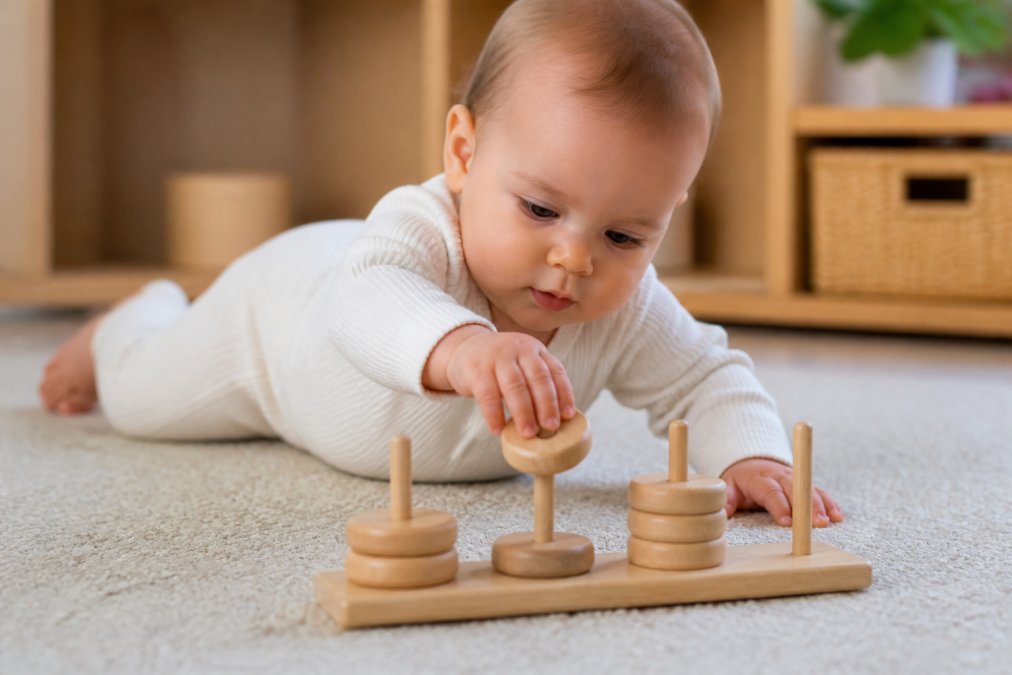
Montessori toys for infants are specifically designed to strengthen the precise movements that lay the foundation for writing, eating, and self-care. Toys like wooden grasping rings, stacking toys, and transfer activities require infants to isolate finger movements, adjust grip strength, and coordinate hand and eye together.
Hand-eye coordination improves when infants can see their hands working with objects and predict outcomes. A wooden toy that rolls when pushed teaches cause-and-effect while building neural pathways that connect vision to movement. Repetition is where real growth happens. Infants naturally want to repeat actions that produce satisfying results. A simple wooden peg board might seem monotonous to adults, but for an infant, placing the same peg in the same hole dozens of times builds muscle memory, refines motor control, and strengthens neural connections required for later skills like writing.
Sensory Exploration and Cognitive Growth
Sensory exploration drives cognitive development in infancy. Montessori toys provide varied tactile experiences, smooth wood, cold metal, soft fabric, that build the sensory pathways infants need to understand their world. Open-ended play with natural materials supports problem-solving from the earliest months. When an infant encounters a wooden toy with different weights, shapes, and surfaces, they're gathering data through their own experimentation.
Cognitive growth accelerates when infants can control the pace and direction of their own learning. Montessori toys don't demand attention or interrupt play with unexpected stimuli. An infant who spends fifteen minutes transferring objects from one container to another is building concentration, spatial awareness, and logical thinking.
Concentration and Independent Play
The ability to concentrate deeply is foundational for all later learning. Montessori toys support this by removing distractions and allowing sustained engagement. A toy that lights up, plays music, or moves on its own fragments attention. Independent play, the capacity to engage meaningfully without adult direction, builds confidence and self-directed learning habits. When an infant chooses what to explore and how long to explore it, they're developing autonomy.
Concentration improves when toys are appropriately challenging, tasks the infant can accomplish with effort but without becoming overwhelmed. This sweet spot is where deep focus naturally emerges.
Montessori Toys for 1 Year Olds: Age-Appropriate Selection
At twelve months, infants are developing stronger grasping skills, exploring cause-and-effect relationships, and beginning to understand object permanence. Montessori toys for 1 year olds should reflect these emerging abilities while remaining simple enough to avoid frustration.
Grasping toys with varied textures work well at this age: wooden rings, fabric-wrapped objects, and textured balls invite repeated handling. Transfer activities support fine motor development and provide satisfying cause-and-effect feedback. Simple stacking toys with large pieces let one-year-olds experiment with spatial relationships and balance.
Cause-and-effect toys should have clear, immediate consequences. A wooden toy that rolls when pushed teaches the relationship between action and result. The Tender Tots Wooden Tool Disassembly Playset (https://tendertotswellness.com/products/wooden-toy-simulation-disassembly-toolbox) exemplifies this principle, inviting infants to take apart and reassemble pieces, building problem-solving skills and fine motor control through purposeful, repetitive play.

Object permanence games become increasingly engaging around twelve months. Toys that hide and reveal, like simple wooden boxes with sliding lids or fabric pouches, support the infant's growing understanding that objects still exist even when out of sight. Regular toy rotation keeps engagement high without requiring constant new purchases.
Montessori Toy Safety Standards and What to Look For
Safety is non-negotiable when selecting toys for infants. Look for toys made from non-toxic materials, finished with food-safe stains or oils. Check for small parts that could pose choking hazards. Montessori toys for infants should be large enough that they cannot fit inside a toilet paper tube.
Splinters, sharp edges, and rough finishes are safety concerns with wooden toys. Quality construction prevents these issues. Look for toys finished with natural oils, beeswax, or certified non-toxic stains. Avoid toys with bright synthetic paints, especially older pieces where lead paint remains a risk.
Stability is critical for toys infants interact with while sitting or standing. Stacking toys, push toys, and structures should be weighted and designed so they won't tip unexpectedly. Look for certifications like ASTM F963 (U.S. toy safety standard) or CE marking (European standard), which indicate the toy has undergone safety testing.
How to Set Up a Montessori Play Area for Your Infant
Creating a Minimalist, Prepared Environment
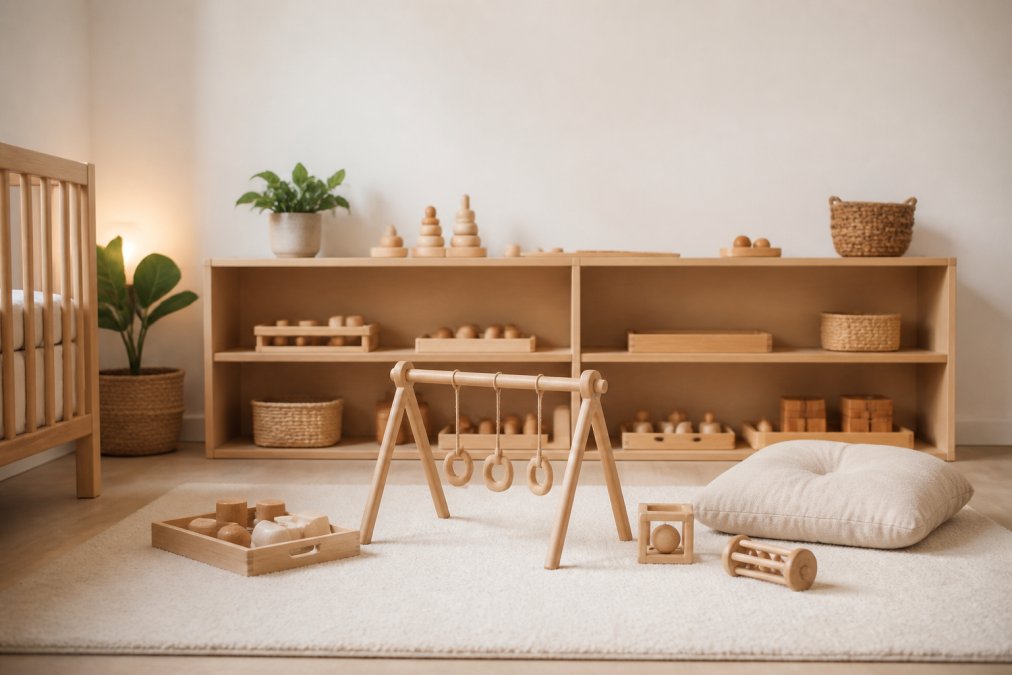
The physical environment shapes how infants play and learn. A prepared Montessori environment for infants is calm, organized, and intentionally sparse. Start by reducing clutter dramatically. Display only 4-8 toys at a time, arranged on low shelves where the infant can see and access them independently.
Furniture and storage should be sized for the infant. Low shelves allow infants to see what's available and make choices. Open shelving also makes cleanup easier and more visible to the child. Lighting matters, natural light is ideal; use warm-toned bulbs rather than bright white ones.
Floor space should be clear and safe. Infants need room to move, roll, and explore without navigating around obstacles. A low, washable mat defines the play area and protects from hard floors. Use a neutral or soft color palette, whites, creams, soft greens, and warm wood tones create a calming environment without overstimulation.
Toy Rotation and Managing Overstimulation
Toy rotation is a practical strategy for maintaining infant engagement without purchasing endless toys. Rather than displaying all toys simultaneously, rotate them every 2-4 weeks. This keeps the environment fresh and makes previously seen toys feel new again.
Rotating toys reduces visual clutter and sensory overload, extends toy lifespan, and allows you to observe which toys genuinely capture your infant's attention. When an infant has only 6-8 toys to choose from rather than 30, they can engage more deeply with each one. Create a storage system for rotated toys in bins or cabinets, labeled by age or toy type.
Pay attention to your infant's cues. If they seem frustrated or bored, rotation might help. The goal is to support your infant's development and maintain a calm, focused environment.
Budget-Friendly Montessori Options and DIY Alternatives
Quality Montessori toys can be expensive, but thoughtful alternatives exist. DIY alternatives can be remarkably effective. Wooden spoons, metal measuring cups, and fabric scarves offer the same sensory and developmental benefits as purchased toys at a fraction of the cost. An infant can spend twenty minutes transferring dried beans between containers, a classic Montessori activity, using items already in your kitchen.
Natural objects from your environment work beautifully. Smooth stones, branches, pinecones, and shells provide varied textures and weights. Ensure items are clean, large enough to be safe, and free from splinters or sharp edges. Fabric scraps in different textures, cotton, silk, linen, wool, support sensory exploration.
Simple wooden toys from general toy retailers can work if they meet safety standards and feature natural materials. Look for toys with simple designs, natural finishes, and clear purposes rather than toys with multiple features or electronic components. Secondhand Montessori toys offer budget-friendly access to quality pieces through online marketplaces, consignment shops, and parent groups.
The Tender Tots Wooden Tool Disassembly Playset at $55.99 represents solid value for a quality, Montessori-inspired toy that supports fine motor development and problem-solving through extended, purposeful play.
Choosing Montessori toys for infants means prioritizing your child's developmental needs over flashy marketing. The benefits, deeper concentration, stronger fine motor skills, genuine sensory exploration, and early independence, emerge naturally when toys are thoughtfully selected and presented in a calm, prepared environment.
Tender Tots & Wellness specializes in curated Montessori-inspired toys and infant essentials designed for modern families who value quality, sustainability, and developmental appropriateness. Our collection features natural materials, non-toxic finishes, and simple designs that support focused, self-directed play. With free worldwide shipping and fair pricing, building a developmentally rich play environment is more accessible than ever. Explore our selection and discover toys that truly support your infant's growth.
| Toy Type | Developmental Focus | Age Range | Budget Option |
|---|---|---|---|
| Grasping rings | Fine motor, hand-eye coordination | 3-12 months | Wooden spoon or fabric scrap |
| Stacking toys | Spatial awareness, motor control | 6-18 months | Plastic cups or wooden blocks |
| Transfer activities | Fine motor, cause-and-effect | 6-24 months | Beans and kitchen containers |
| Cause-and-effect toys | Problem-solving, understanding consequences | 9-18 months | Rolling wooden toy or ball |
| Object permanence games | Cognitive development, memory | 9-18 months | Fabric pouches with hidden objects |
According to the American Academy of Pediatrics, infant development depends heavily on sensory exploration and hands-on engagement with safe, age-appropriate materials. Montessori approaches align with this evidence by prioritizing tactile, open-ended play over passive entertainment.
Research from developmental psychology studies on infant cognition shows that sustained, self-directed play builds concentration and problem-solving abilities more effectively than toys that demand passive attention. Educational standards from the National Association for the Education of Young Children emphasize that infant environments should be calm, organized, and designed to support child-led exploration, directly reflecting best practices for optimal infant development.
Frequently Asked Questions
What age should you start introducing Montessori toys to your infant?
You can introduce Montessori toys as early as birth, starting with high-contrast cards and simple grasping toys designed for newborns. Around 3-4 months, infants benefit from cause-and-effect toys like rattles and shakers. By 6-12 months, introduce stacking rings, wooden blocks, and objects that encourage fine motor skill development. Always choose age-appropriate toys that match your infant's developmental milestones.
How do Montessori toys for 1 year olds differ from regular baby toys?
Montessori toys for 1 year olds emphasize natural materials, simple design, and open-ended play rather than electronic features or bright plastic. They focus on functional play and problem-solving, like stacking cups or inserting objects, rather than passive entertainment. This approach supports self-directed activity, concentration span development, and hands-on education that traditional toys often miss.
Are Montessori toys safer than conventional plastic toys?
Montessori toys are often safer when they meet rigorous toy safety standards. Look for toys certified by the Consumer Product Safety Commission (CPSC) and made from non-toxic finishes and sustainable wood. Many Montessori-inspired toys avoid small parts and choking hazards common in plastic toys. Always verify that any toy meets CPSC standards and is age-appropriate before purchasing.
Can I create a Montessori play area on a budget?
Yes. Start with a few high-quality wooden toys rather than filling shelves with plastic items. DIY alternatives include wooden spoons for sensory exploration, fabric scraps for tactile play, and empty containers for cause-and-effect games. Rotate toys every few weeks to maintain engagement and reduce overstimulation. Quality matters more than quantity in a Montessori-inspired environment, so invest in a few durable pieces over many cheap options.
This article was written using GrandRanker